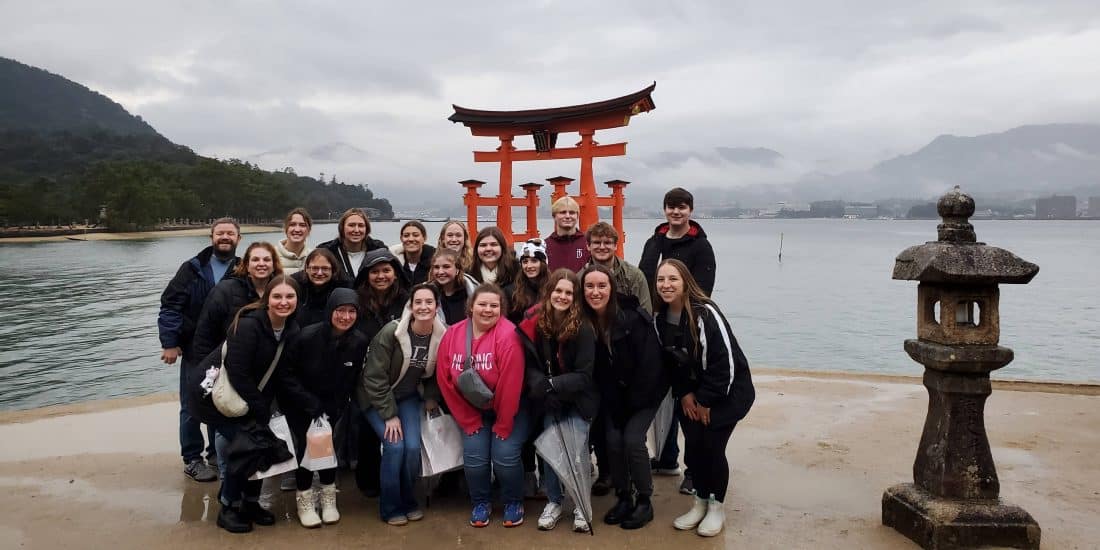


Students Travel to Japan to Study Primate Behavior
“The best thing about the course was being able to combine two aspects of my life I am very passionate about: animal behavior, and traveling,” says Randolph-Macon College student Moriah Carper ’16.
Carper is talking about the 2016 January Term (J-term) course that took her and nine of her classmates to Japan to study the cultural aspects of behavior in primates. The students were enrolled in Psychology Professor Massimo Bardi’s course, Animal Cultures.
Observational Research
Students investigated the issue of animal culture, which has been debated in several disciplines, including ethology, zoology, sociology, and comparative psychology. They also experienced a unique opportunity to study one of the most intriguing primate species, snow monkeys, by conducting observational research at the Arashiyama Park (Kyoto Prefecture, Japan). Monkeys at this location are wild, but are accustomed to humans because feeding stations have been maintained since the early 1950s.
“Studying wild snow monkeys in Japan is an incredible learning adventure,” says Bardi. “The social trajectory and evolution of snow monkeys and Japanese people are intertwined, since they shared the same habitat and very similar needs for thousands of years.”
Observing monkeys, says Bardi, allows scientists to focus on a simplified version of cultural variation in different populations, thus providing them with a better framework to develop and test specific hypotheses about the origin and function of cultures.
“For example, the monkeys of Arashiyama are well known for a behavior called ‘stone playing,'” he explains. “They accumulate rocks and then spend hours playing with them and trying to create different sounds by smashing one into another. The amount of time, the kinds of rocks, and the preferred sounds vary group by group. Trying to observe, analyze and understand why that happens is much easier than trying to disentangle all the functions of rituals, playing behavior, and politics in humans.”
Reaching New Heights
Carper and her classmates often discovered things about themselves as they explored Japan.
“I’m a biology major, and I assumed that the monkeys would be the most interesting part of the trip for me,” says Carper. “To my surprise, learning about the Japanese culture was particularly intriguing. For example, the Japanese culture emphasizes respect for one another and humility. Being in a new country and experiencing a different culture was eye-opening.”
Ella Groner ’19 is a business major and communication studies minor.
“Seeing the Japanese macaques in their natural environment is not something that everyone gets to experience,” she says. “There are so many things students learn by taking a travel course. You gain confidence and learn how to interact with different people.”
Brittaney Ritchie ’16, a biology major, chemistry minor, and member of the Pre-health Society, says the best part of the trip was the 12-mile climb to the top of Mount Atago, Kyoto’s tallest mountain.
“We were told that it’s normally a three-to-five-hour hike, but my classmates and I conquered it in three hours,” she says. “The view from atop was surreal.”
Grace Aylor ’16 is a psychology major and Asian studies minor. She, too, was excited to reach the summit of Mount Atago.
“This was my second travel course—and my third time in Japan,” says Aylor. “The opportunity to travel abroad has helped me become closer to my dream of living and working in Japan.”
January Term at RMC
RMC’s J-term offers something for everyone. For some students, that something is a chance to travel to destinations around the world; recent J-term travel courses have visited France, England, Italy, China, Germany, Ghana, Brazil, and Australia & New Zealand.
J-termers abroad have studied evolution and conservation in the Galapagos Islands, Central American culture in Costa Rica, the history of mathematics in England, and have helped build homes in El Salvador.
Other students dedicate the month to internships; RMC’s Bassett Internship Program connects students with internships in a wide range of locations and career fields.
On campus, J-term offers for-credit courses across the curriculum, making it possible for students to immerse themselves for one month in a single subject.