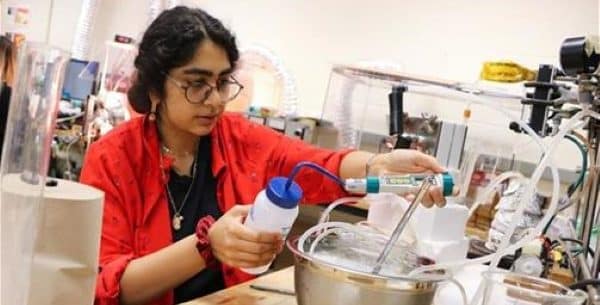


Mousetrap Project Helps Students Understand Design Process
Randolph-Macon College students in Professor James T. McLeskey Jr.’s Introduction to Engineering Physics course learned about a variety of topics, from static equilibrium to fluid mechanics. The January Term (J-term) course is designed to introduce students to the topic of engineering in general and to the engineering physics major in particular. Experiential learning is also a key aspect of the course.
A Unique Design Project
McLeskey, head of RMC’s engineering programs, says, “We present the various fields of engineering (civil, mechanical, etc.) through class discussion, guest speakers, and videos and we introduce the topics taught in our core engineering physics courses: static equilibrium; solid mechanics and fluid mechanics through the working of problems; laboratory exercises; and a design project.”
That design project—the Mousetrap-powered Hydraulic Lift Challenge—was a unique, fun way for students to tap into their creativity and hone their design skills.
“While many associate engineering with analysis (solving closed-ended problems), one important aspect of the discipline is design,” says McLeskey. “Design is a creative, open-ended process used to create a machine or process to satisfy a need. The mousetrap-powered project was developed to help students understand and master the design process.”
The Challenge
Each team of two students was given two mousetraps, five syringes, and a variety of other materials. They were tasked with building a hydraulic lift that would raise as much weight as possible by at least one inch.
Before they could begin construction, students were required to brainstorm and develop several unique designs and then analyze their designs in order to predict how much weight their chosen design would be able to lift. On the penultimate day of class, a contest was held to see which team’s device could lift the most weight. “All eight teams built functional devices and two of the designs succeeded in lifting over one kilogram—demonstrating the kind of creativeness and ingenuity that one would expect from Randolph-Macon engineers,” says McLeskey.
Creativeness and Ingenuity
Megan Gunn ’23 (engineering and mathematics major; Spanish minor) says the Introduction to Engineering course “was a good combination of practical topics, a fun design project, and helpful information about career choices.”
She especially liked the Mousetrap Challenge. “It was a fun, hands-on project that combined engineering principles and allowed us to work through the engineering design process that we discussed in class,” she says. “We worked with partners to brainstorm unique ideas for a design, make calculations for the design’s performance, and to build, test, and optimize the hydraulic lift. Through this process, we learned to apply engineering principles to a real-life project.”
Engineering Major
The college recently established a new major in engineering. The major includes courses focusing on engineering mechanics as well as courses incorporating project-based design and analysis that apply foundation principles to complex real-world problems.
James T. McLeskey Jr.
McLeskey earned his B.S. in Physics from the College of William & Mary, his M.S. in Mechanical Engineering from the University of Illinois at Urbana-Champaign, and his Ph.D. in Mechanical Engineering from the University of Virginia.
His research is focused largely in the areas of renewable energy and clean water. His lab was the first to report the fabrication of solar cells made using a water-soluble polymer, and his background includes six years in industry working on the design and repair of large turbo-generator rotors. McLeskey has authored 40 peer-reviewed journal publications as well as two book chapters and served as Principal Investigator (PI) or Co-Investigator on more than $1.5M in funded research. He has numerous international collaborators and has given invited talks in India, Egypt, and China as well as the United States. Most recently, he served as the PI on a grant from the Qatar National Research Fund for developing optimized membranes for saltwater desalination.
McLeskey has received numerous teaching awards, including the 2006 Outstanding Faculty Award from the State Council of Higher Education for Virginia (SCHEV). In addition to his eighteen years of teaching at the college level, he taught high school science for four years and held a Commonwealth of Virginia Teaching Certificate with endorsements in Physics and Chemistry. He served as the Co-PI on a grant entitled “The Experiential Engineering Library” sponsored by the National Science Foundation for bringing hands-on projects to the Engineering curriculum.