

SURF Kicks Off Summer Undergraduate Research

Randolph-Macon’s signature summer research program, the Schapiro Undergraduate Research Fellowship (SURF), officially began for 27 students on Monday, June 1.
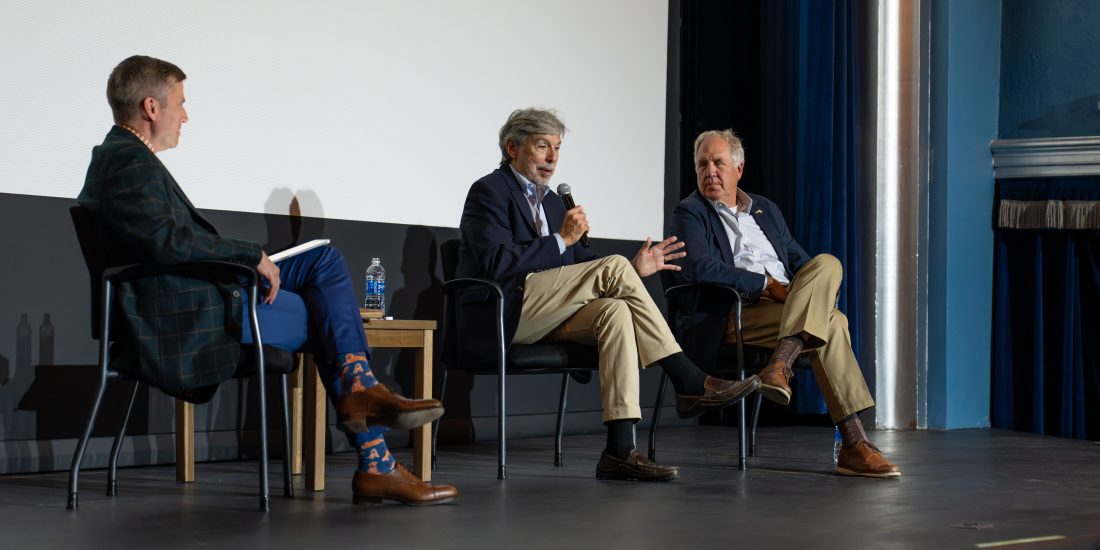
For nine weeks this summer, students will conduct original research under the guidance of faculty mentors, in addition to other learning and social events as a campus cohort. In opening remarks to the gathered students at a Monday luncheon, President Michael E. Hill reflected on the impact of this experience for students.
“SURF is so special because it emphasizes our college’s passion for research and scholarship, for the connection that happens between students and their professors when they work together on unique intellectual challenges, and for the importance of innovative ideas,” he said.
Twenty-one students are funded through SURF, including the newly established Kathleen and John A. Luke Jr. Research Fellowship, while six also received funding from other sources, including the National Science Foundation.
From the cultural impact of the music of Bad Bunny, to identifying freshwater macroinvertebrates, to analyzing burnout in healthcare workers, this summer’s research projects span a broad range of disciplines including Biology, Chemistry, Business, History, Psychology, and more.
Below is a full listing of 2026 SURF Projects, including student and faculty names and project titles:
- Layan Bashir Abdalla ’28, Dr. Inigo Arroniz (Business) “Designing and Evaluating a Reproducible Credit Risk Classification Pipeline Using Relational Data Organization and Baseline Machine Learning Models”
- Anna Collins ’27, Dr. Lauren Bell (Political Science) “The Impact of the Certiorari Process on the Supreme Court’s Religious Freedom Decisions”
- Patricia Martin Zambrano ’27, Dr. Maria Jose Bordera-Amerigo (Hispanic Studies) “Cross-Cultural Financial Literacy and Online Financial Decision-Making: Comparing Young Adults in the U.S. and Spain”
- Diana Vite ’27, Dr. Bordera-Amerigo (Hispanic Studies) “Bad Bunny: Amplifying Global Visibility Through Spanish Music, Marketing, and Cultural Representation”
- Kathleen Connor ’27, Dr. Kimberly Cox (Biology) “The Effects of Perfluorooctanoic Acid on Reproductive Maturation and Anxiety Behaviors in Mice”
- Kat Brabson ’28, Dr. Michael Fischbach (History) “Was the 1930-1933 Famine in Soviet Kazakhstan the Result of Intentional Genocide of the Kazakh Population, or a Catastrophic Consequence of Rapid Agricultural Collectivization and Forced Sedentarization under Stalin?”
- Amelia Mickelson ’28, Dr. Fischbach (History) “How did the religious nature of the 1980s Sanctuary Movement contribute to its political success?”
- Ifeoma Edozie ’28, Dr. Jim Foster (Biology) “The Study of GPR56 and CD81 proteins on mouse sperm in preparation for fertilization”
- Miona Klacar ’29, Dr. Gary Glick (Psychology) “Better than nothing: Loneliness, Fear of Being Single, and Settling for Less Among Immigrants in the United States”
- Emily Tayman ’27, Dr. Glick (Psychology) “Compassion Fatigue and Mental Health: The Moderating Roles of Humor and Social Support in Health Care Workers”
- Kelly Hotaling ’28, Dr. Melanie Gubbels-Bupp (Biology) “Using RT-PCR to confirm the increased expression of Klf11 and Tsc22d3 in naïve T cells that travel to the bone marrow when Mus musculus are malnourished”
- Josiah Lester ’27, Dr. Gubbels-Bupp (Biology) “Confirming overexpression of Abca1, Ddit4, and Cpt1a in malnourished naïve T cells within the lymph nodes”
- Alyssa Schumacher ’28, Dr. Kate Laws (Biology) “Is the frazzled gene important for larval crawling?”
- James Woods ’28, Dr. Laws (Biology) “The role of Gliotactin in Drosophila oogenesis”
- Rahmah Naas ’29, Dr. April Mattei (Chemistry) “Microwave Synthesis and Optimization of Nickel Phosphide Nanoparticles for Hydrogen Evolution Catalysis”
- Evan Sambrook ’29, Dr. Mattei (Chemistry) “Investigation of Polyvinyl Pyrrolidone’s Impact on Microwave Synthesized Nickel Phosphide Nanoparticles”
- Abigail Chandler ’29, Dr. Evan Reynolds (Chemistry) “Exploring enzymatic carbon-nitrogen bond formation for the synthesis of metal-binding ligands”
- Isaac Kim ’28, Dr. Reynolds (Chemistry) “Synthesis of stereochemically complex alpha-hydroxyketones as precursors to biologically active molecules”
- Russell Nichols ’29, Dr. Reynolds (Chemistry) “Exploring Thiamine-Dependent Enzymes for the Stereoselective Synthesis of Molecules with Multiple Chiral Centers”
- Mya Pearman ’29, Dr. Reynolds (Chemistry) “Light Driven Radical Reactions Catalyzed by Thiamine-Dependent Enzymes”
- Vivian Lau ’28, Dr. Nick Ruppel (Biology) “Surveying pollinators along the Fall Line Trail, Hanover County, VA”
- Campbell Taylor ’28, Dr. Ruppel (Biology) “Evaluating the growth of Lactuca sativa leaves and roots after exposure to microplastics”
- Brennan Clark ’27, Dr. Ray Schmidt (Biology) “Using DNA Barcoding to Identify Freshwater Macroinvertebrates from Kenya
- Mason Bradley ’27, Dr. Serge Schreiner (Chemistry) “Finding the best location: Improving the anti-amyloid ability of ruthenium(II) complexes with phosphine ligands aimed to prevent Alzheimer’s”
- Luke Hutchins ’28, Dr. Schreiner (Chemistry) “Synthesis and Characterization of Ruthenium(II) Piano-stool Complexes With Phosphine Ligands for Potential anti-Aβ Activity”
- Lily Macias ’28, Dr. Schreiner (Chemistry) “Heterobinuclear Ruthenium-Nobel Metal Complexes: Synthesis, Structure, and DNA Binding Studies”
- Malia Madrigal ’27, Dr. Schreiner (Chemistry) “The synthesis and characterization of bimetallic ruthenium(II) complexes as potential anti-cancer agents”
SURF, in its 30th season, was introduced in 1995 and has been supported through a generous endowment by Ben Schapiro ’64 and his wife, Peggy Schapiro and other donors. Nearly 900 students have participated in this transformative experience. The fellowship provides students with a stipend and housing on campus during the summer.
Led by co-directors, Art History Professor Evie Terrono and Serge Schreiner, The Dudley P. & Patricia C. Jackson Professor of Chemistry, SURF is often cited by graduates as one of the most significant academic and professional development opportunities in their undergraduate studies. The program will conclude on July 31 with a SURF symposium, where students share their findings in oral and poster presentations.