

2026 SURF Fellowships Highlight Incisive Questions and Deeper Understanding
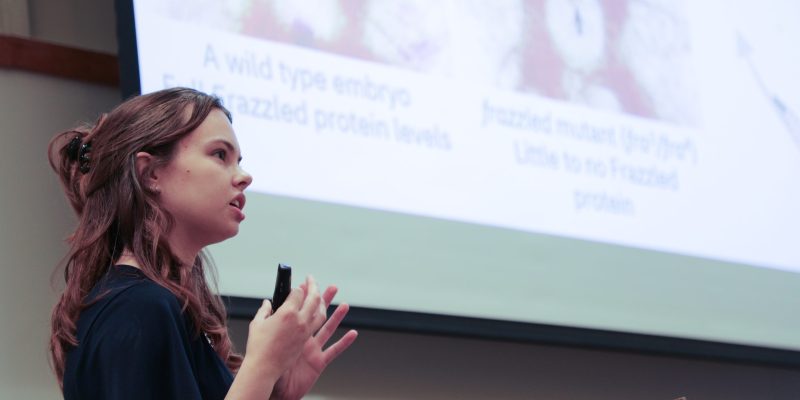
Presentations at the concluding symposium for Randolph-Macon’s Schapiro Undergraduate Research Fellowship (SURF), provided clear evidence that challenging and thought-provoking questions are central to the students’ research projects.
This was the 30th year of SURF, a program supported through a generous endowment by Ben Schapiro ’64 and his wife Peggy and many other donors. Since 1996, 880 students have conducted original research under the guidance of a faculty mentor. In this year’s cohort students represented Chemistry, History, Political Science, Biology, and Modern Languages among other disciplines.
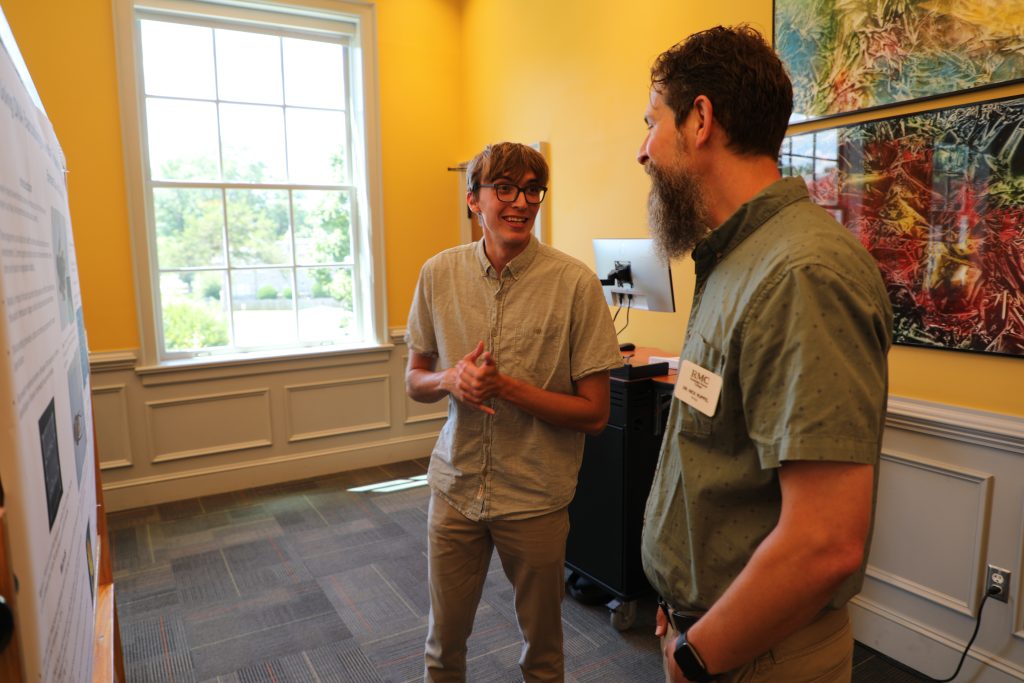
For Katerina Brabson ’28, her inquiry related to her personal story; she was born in Kazakhstan and later adopted by her American parents.
In her research, entitled “Intent, Catastrophe, and the Kazakh Famine: Reassessing Genocide in Soviet Kazakhstan, 1930-1933,” which she conducted under the guidance of Dr. Michael Fischbach, Professor of History, Brabson investigated the political origins and the social impact of this humanitarian disaster that took the lives of 1.5 million ethnic Kazakhs. Her primary question was whether it can be classified as a genocide under international law.
Brabson discussed the nomadic identity of Kazakhs and the devastating impact of Soviet policies that forced sedentarization, and the diversion of livestock and grain to sustain Soviet industrial needs as evidence that the Stalin regime was aware that its policies were killing Kazakhs. She argued that historians must take a broader understanding of what genocide means to accurately describe this disaster.
While some students explored historical topics others investigated subjects of ongoing contemporary concern and relevance.
Amelia Mickelson ’28 studied the 1980s Sanctuary Movement, when—in defiance of the law—faith communities harbored refugees from Central American countries, and the intersection of religion and politics as the movement eventually influenced legislation establishing Temporary Protected Status.
Diana Vite ’27, under the mentorship of Dr. Maria Jose Bordera-Amerigo, Associate Professor of Hispanic Studies, explored the impact of the global success of Puerto Rican recording artist Bad Bunny, who performs in Spanish, on the cultural representation of Latinos.
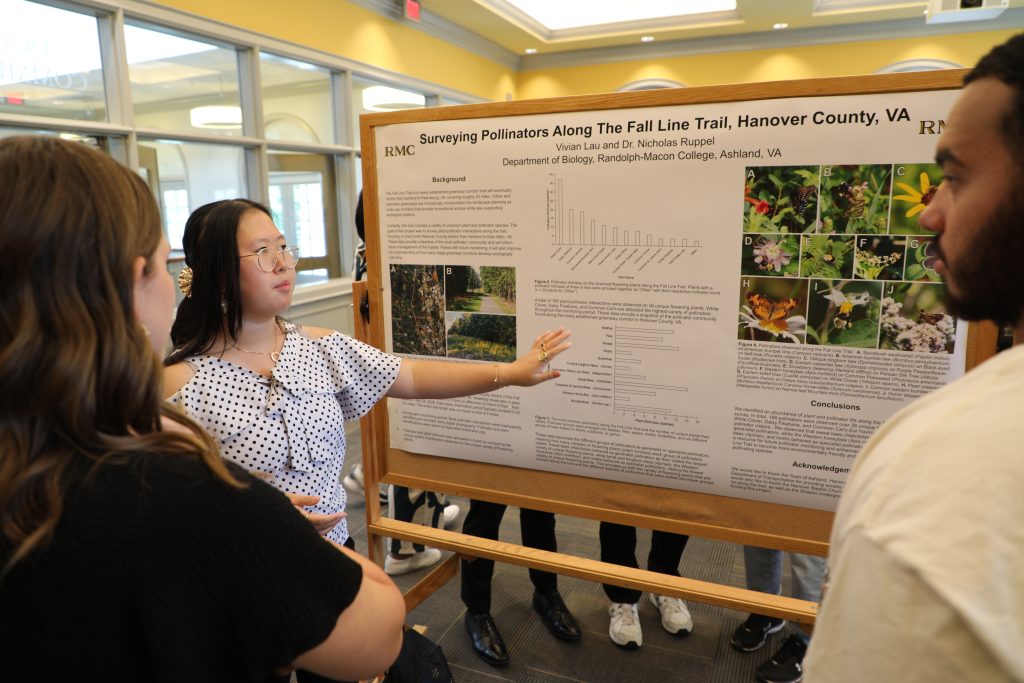
Biology projects included Brennan Clark ’28, who used DNA barcoding to identify freshwater macroinvertebrates from Kenya, and Vivian Lau ’29, who surveyed pollinators along the Fall Line Trail in Hanover County, Virginia.
Interim Provost Patrice DiQuinzio welcomed attendees at the event and reflected on the lifelong skills that students developed and practiced during SURF including project management, teamwork, and resilience.
“Perhaps most importantly, you have experienced the unique pleasure that curiosity-driven passion for learning brings,” DiQuinzio said. “There really is nothing like that wonderful, ‘aha’ moment when your efforts come together and you figure out something important or you get to marvel at how some part of the world works. It makes all the hard work worthwhile.”
At the luncheon, RMC President Michael E. Hill reiterated the lasting value of the research experience.
“In an age where information is available instantly, wisdom has become increasingly valuable,” President Hill said. “Artificial intelligence can retrieve facts. Search engines can summarize articles. Technology can process enormous amounts of data….None can replace the uniquely human ability to discern meaning, connect ideas across disciplines, or recognize the ethical implications of discovery. That remains your responsibility.”
The College was incredibly fortunate to have Dr. Richard Scott ’79 return to campus to serve as keynote speaker. Dr. Scott is a reproductive endocrinologist, embryologist, andrologist, and molecular geneticist whose research interests have focused on understanding embryonic reproductive competence. He is the author of more than 800 publications and recently received the Lifetime Investigator Achievement Award from the American Society for Reproductive Medicine.
Dr. Scott is a founder and former CEO of IVIRMA Global, which became the world’s largest infertility and reproductive genetics network. Since retiring, he remains active in research and education and is an Adjunct Professor at Yale, Emory, and the University of South Carolina. Dr. Scott spent the entire day engaging with students, taking in their research, asking questions, and offering advice.
While for most students, this was their first time doing SURF, there were a few who valuing the learning significance of this experience and understanding its importance in their professional pathways, undertook another SURF project this year. Among them, Lily Macias ’28, one of four students in the lab of Dr. Serge Schreiner, the Dudley P. & Patricia C. Jackson Professor of Chemistry, studied the potential of ruthenium complexes as anti-cancer agents.
“This is my second year doing SURF, and I’ll be doing it next year,” Macias said, reflecting on the joy of problem-solving every day. “It’s opened up my eyes to my career and my future.”
Follow this link for a full listing of this year’s SURF projects.