

RMC Students and Alumnae Present Papers at Conference
Six Randolph-Macon College students and alumnae attended the Classical Association of the Middle West and South (CAMWS) Southern Section Meeting, which took place October 27-29, 2016 in Atlanta Georgia. CAMWS is a professional organization that promotes the classics through its annual meeting, through publications in The Classical Journal, and through its awards, scholarships and outreach initiatives.
Paper Presentations
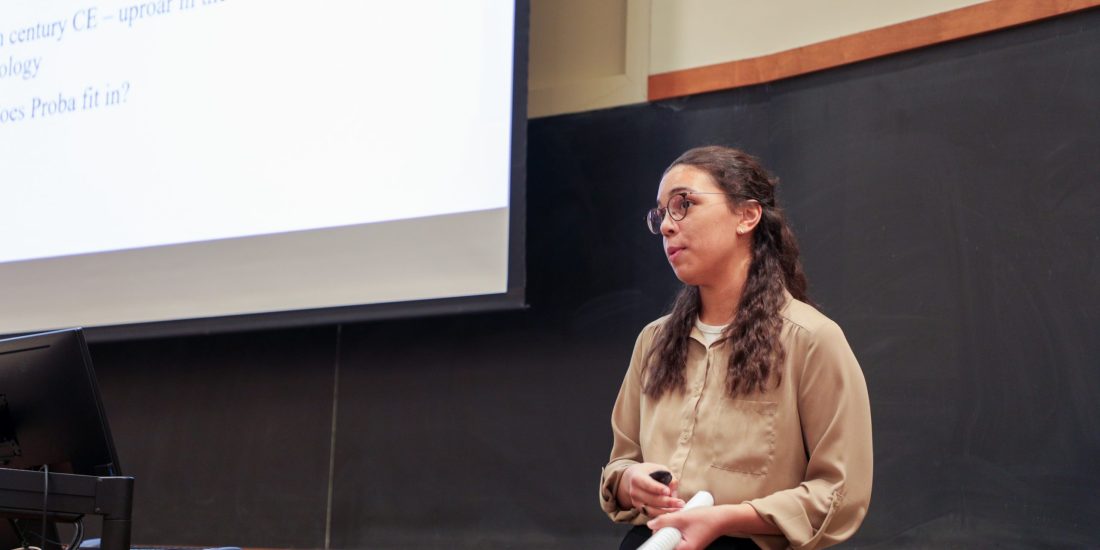
Grace McIntire ’19, James Patton ’18, Madeline Wyatt ’17, Hali Johnson ’15, Sarah Keith ’15, and Madeline Monk ’16 presented papers at the meeting. RMC Classics Professor Bartolo Natoli accompanied the group.
“It is quite a big deal that these students and alumnae had a chance to share their work, as many of their papers beat out papers from graduate students and professors in order to be presented,” says Natoli. “The Classics Department is duly proud of them—and we are thankful to the Provost’s Office and Dean Lauren Bell for assisting our current students with their travel and registration costs for the conference.”
Grace McIntire ’19 presented “The Ambiguity in Normativity: Propertian Use of trahere in 3.11.” McIntire is a Latin and Greek major with minors in secondary education, mathematics, and history. In March 2016 she was awarded a National Latin Exam New Latin Educators Scholarship, which will enable her to attend the American Classical League Institute in summer 2017. She is also the recipient of Paideia Institute Living Greek in Greece scholarship. The Living in Greece program, held in July 2016 in Selianitika, Greece, was an intensive introduction to spoken Attic Greek.
James Patton ’18 presented “Theseus, Bacchus, Ariadne, and You: Parallel and Intertextual Exempla in Ars Amatoria Books One and Three.” Patton is a Latin and Greek major and film studies and women’s studies minor.
Madeline Wyatt ’17 presented “Tibullus and His Trivia: A Pun on Prostitution.” Her paper explores Tibullus’ poem 1.5, which plays with most typical tropes of elegy.
“Previous scholars have identified a framing aspect to the poem and have connected two figures, a witch and a madam of a brothel, as the same person in the poem,” explains Wyatt. “I also examined framing in the beginning of the poem with the goddess Trivia and the mention of triviis, or crossroads, at the end of the poem.” Wyatt is a classics and Latin major, and education, history, and archaeology minor. She will begin student teaching high-school Latin in the Henrico County Public School System in spring 2017.
Hali Johnson ’15, a graduate student at Texas Tech University, presented “Parthénos on Parade: Performance of Athenian Ideology and the Display of Girls in the Panathenaic Procession.” Johnson, who majored in archaeology, Greek, and Latin at RMC, is pursuing an M.A. in classics.
Sarah Keith ’15, who is pursuing an M.A. in classics at the University of New Mexico, presented “Naughty or Nice: Erotic Recollection and Chastisement in Seneca’s Letter 43.” At RMC she majored in Latin and classics and minored in education.
“Making a presentation can be daunting, but it was encouraging that Professor Natoli and some of my former classmates were there to support me,” says Keith. She did three presentations as an undergraduate, which helped prepare her for the rigors of graduate school. “For me, graduate work is achievable because of the level of preparation I received at RMC. I continue to be grateful for the time and energy my professors put in to help me get to where I am.”
Madeline Monk ’16, a graduate student at University of Texas at Austin, presented “The Multiple roles of Marathus: Tibullus’ Use of the Boy Beloved in 1.4, 1.8, and 1.9.” Monk majored in English, Latin, and history at RMC, minored in classics, and was the valedictorian of her class. She is pursuing a Ph.D. in classics.
Classics, Greek and Latin at RMC
Many of the foundations of Western culture—from literature and philosophy to art and architecture—can be traced to the early Greek and Roman civilizations. RMC majors in classical studies, Latin, and Greek form a broad understanding of the richness and complexities of these cultures and the long reach of their influence.
RMC Classics provides its students with unique and challenging opportunities to study the past, from a variety of project-based learning activities, to numerous guest lectures from internationally recognized scholars, and even to hand-on experiences at archaeological sites in Ancient Greece. With an RMC classics degree, students are able to think critically about complex issues and to gain a deeper understanding and appreciation of their own values and beliefs through interaction with foreign cultures, both ancient and modern.