

Mousetrap Project Helps Students Understand Design Process
2/4/19
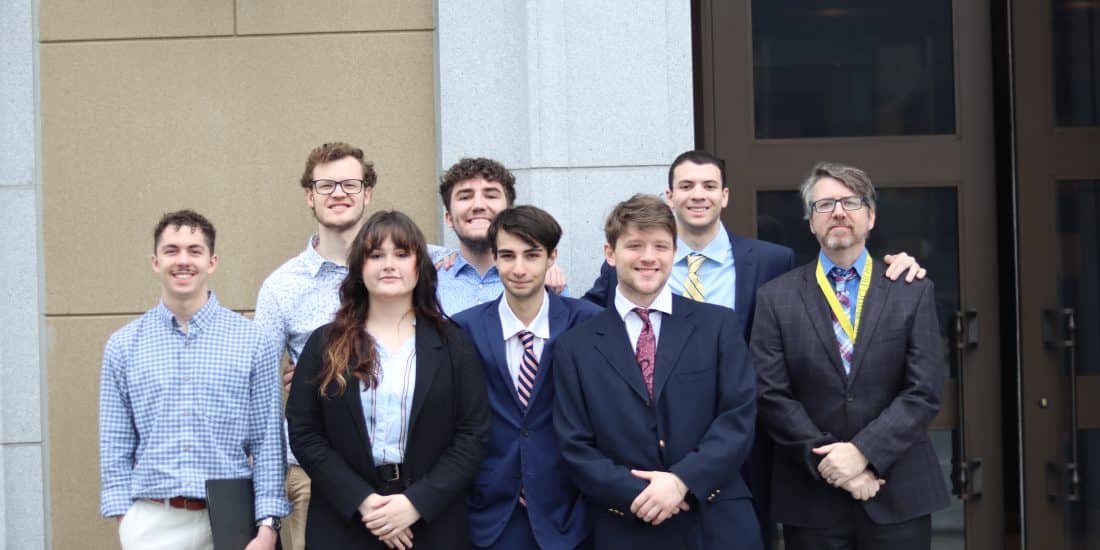
Randolph-Macon College students in Professor James T. McLeskey Jr.’s Introduction to Engineering Physics course learned about a variety of topics, from static equilibrium to fluid mechanics. The January Term (J-term) course is designed to introduce students to the topic of engineering in general and to the engineering physics major in particular. Experiential learning is also a key aspect of the course.
A Unique Design Project
McLeskey, director of the engineering physics program, says, “We present the various fields of engineering (civil, mechanical, etc.) through class discussion, guest speakers, and videos and we introduce the topics taught in our core engineering physics courses: static equilibrium; solid mechanics and fluid mechanics through the working of problems; laboratory exercises; and a design project.”
That design project—the Mousetrap-powered Boat Distance Challenge—was a unique, fun way for students to tap into their creativity and hone their design skills.
“While many associate engineering with analysis (solving closed-ended problems), one important aspect of the discipline is design,” says McLeskey. “Design is a creative, open-ended process used to create a machine or process to satisfy a need. The mousetrap-powered boat project was developed to help students understand and master the design process.”
Teamwork + Brainstorming
McLeskey’s students formed teams and were asked to build a boat powered by a single mousetrap to satisfy one criterion: to complete as many laps around a wading pool as possible. They could use additional materials beyond those that were provided (for example, blocks of wood, or wheels) but only one mousetrap per boat was allowed.
Each team brainstormed and created four different designs before selecting the design they wanted to build. Before construction began, the students were asked to analyze their design in order to predict how far their car would travel. Once the boats were built, each team optimized their design for a maximum number of laps.
Creativeness and Ingenuity
On the penultimate day of class, a contest was held to see which team’s boat would complete the most laps in the pool (each lap was 6-8 feet in distance). The winning boat—named Liquid Lightning—completed 2 3/8 laps, but, McLeskey says, “all of the cars demonstrated the kind of creativeness and ingenuity that one would expect from Randolph-Macon engineers!”
Engineering physics and environmental studies major Kyle Browne ’21 enjoyed the challenge of finding solutions to problems.
“Whether we were doing mathematical equations or trying to design a mousetrap boat, we had to use various pieces of information we were given to figure out the best solution,” says Browne, a computer science minor. “It was a lot like solving a puzzle.” When the class studied the concept of buoyancy, for example, Browne discovered that “seeing some of the principles we talked about in action was a fantastic experience. It was also a challenge, trying to design a boat that was better than those of my peers—but that just added to the fun.”
James T. McLeskey Jr.
McLeskey, who joined the RMC faculty in 2015, earned his B.S. from the College of William & Mary, his M.S. from University of Illinois at Urbana-Champaign and his Ph.D. from University of Virginia.
McLeskey’s research is focused largely in the areas of renewable energy and clean water. His current focus is the fabrication of polymer membranes via electrospinning for use in Direct Contact Membrane Desalination (DCMD). Previously, his lab was the first to report the fabrication of solar cells made using a water-soluble polymer, and his background includes six years in industry working on the design and repair of large turbo-generator rotors. McLeskey has received numerous teaching awards, including the 2006 Outstanding Faculty Award from State Council of Higher Education for Virginia (SCHEV). He has authored more than 35 peer-reviewed journal publications, authored two book chapters and served as Principal Investigator or Co-Investigator on more than $1.5M in funded research.
January Term: A Month of Discovery
Each year, Randolph-Macon College offers its popular January Term (J-term), which provides students with the opportunity to immerse themselves in another culture, embark on an internship, or conduct groundbreaking research. On campus, J-term offers for-credit courses across the curriculum, making it possible for students to fully engage for one month in a single subject.