

Learning Beyond Borders: Randolph-Macon Education Travel Courses Explore French Classrooms
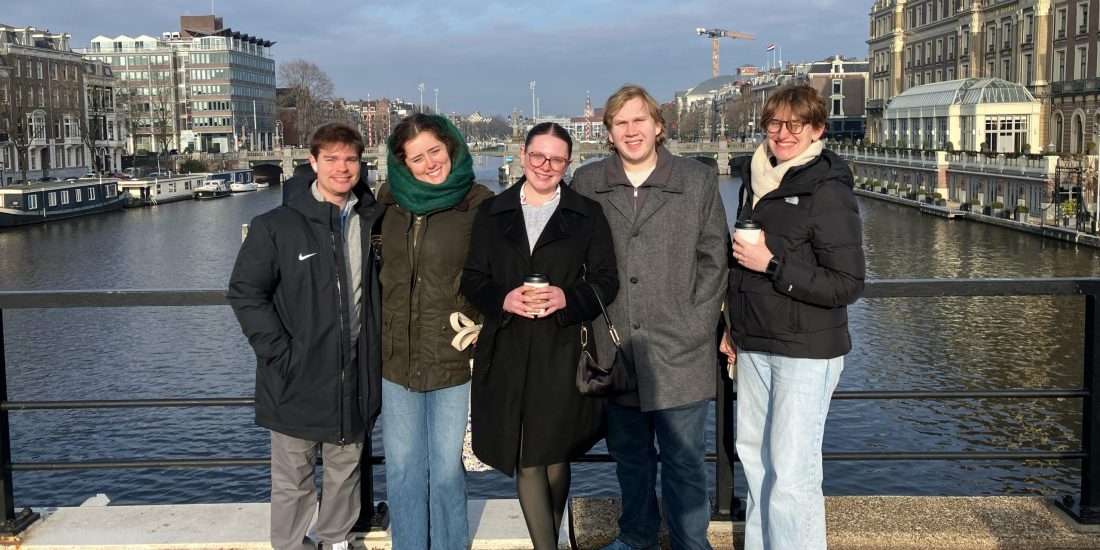
When Randolph-Macon College’s Education students boarded a plane bound for France, they weren’t just traveling abroad; they were stepping into classrooms, cultures, and conversations that would reshape how they understand teaching and learning.
The Education Department previously offered travel courses in Italy and Spain, but this January Term marked the first time these courses were taught in France, giving students an opportunity to study education where history, routine, and culture intersect daily.
Under the guidance of Dr. Erin McDonnell-Jones, Associate Professor of Education, the dual courses—Comparative Education and The French Educational System— were designed to examine the differences between American and French educational systems.
“I think it will be very impactful,” Michelle Rittenhouse, one of the trip’s chaperones and a Senior Lecturer of Mathematics at RMC observed.… “They can implement procedures they like here into their classroom, and appreciate more systems we have that France doesn’t.”
Learning Inside and Outside the Classroom
A typical day for the RMC students in France moved seamlessly between academic learning and hands-on cultural engagement. In order to help students synthesize what they had seen in French schools, some mornings started with two-hour class sessions centered on journaling, reflection, and discussion.
On other days, students visited educational institutions throughout Paris, where they interacted with instructors and students and witnessed firsthand how classrooms function in a different country. Afternoons were frequently free for solo exploration, guided trips, or sightseeing. A balance that made it possible for learning to extend beyond lectures.
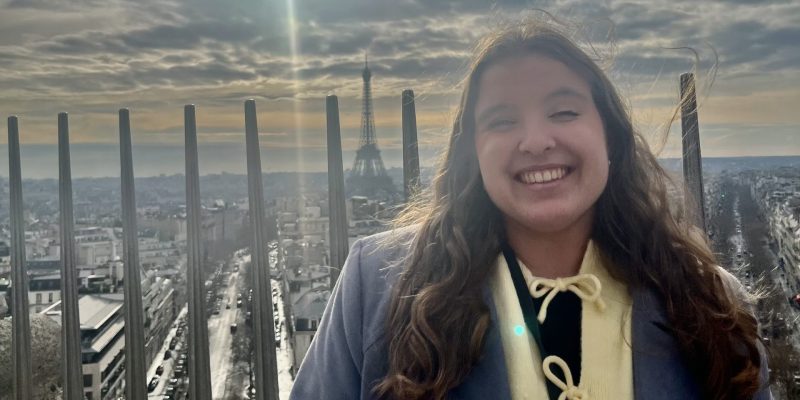
For Sarah Mandeville ‘28, an Elementary Education major with a French minor, the reality of studying abroad hit almost instantly. “When I saw the Eiffel Tower for the first time, I was just absolutely blown away,” she shared, sounding as if she was reliving the moment. “I’ve been studying French since I was eleven, so seeing it in person felt like my dreams were coming true.”
Outside of Parisian school visits, students explored some of France’s most timeless landmarks, including Notre-Dame Cathedral and the Palace of Versailles. For Mandeville, attending Mass at Notre-Dame stood out as an unforgettable moment she was happy to recall. “It was breathtaking… It was amazing to sing at Mass in such a beautiful space where the bells and organs were echoing too!”
Rethinking Education Through a Global Lens
The heart of the course, however, lay in its educational comparisons. One aspect that predominantly stood out to Professor Rittenhouse was how early French students are encouraged to collaborate and reflect. “Children have, at an early age, an hour a week to talk about what works and what doesn’t,” she shared. “They are more independent and comfortable making decisions… They also learn how to talk with someone who has a different view than themselves.”
Observations like this sparked impactful class discussions for the students. In one conversation, a professor’s reminder that teachers must “meet students where they are” reshaped how Mandeville viewed success in education. “Not everyone will have amazing grades,” she said. “Improvement and developing the students’ person and character to prepare them to be a diligent citizen are the main objectives of teaching.”
Visits to diverse Parisian schools further reinforced these lessons. Students met children from a wide range of backgrounds who described how finding the right school community changed their lives. “Sometimes the only thing that kept them coming back was the support of their teachers,” Mandeville said. “It was amazing to see how much they cared for their students.”
Growth Beyond the Comfort Zone
Studying abroad came with its challenges as well. Navigating public transportation and communicating across language barriers became integral parts of the learning experience. The trip required students to grow in confidence and independence, qualities essential for future educators.
Despite the challenges, both professors and students agree the rewards far outweighed any discomfort. “Treasure every moment,” Mandeville advised future students considering going abroad. “I kept reminding myself this is a once-in-a-lifetime experience… it was important to me to stand before these gorgeous structures and take it in with my own eyes too, not just my phone screen.”
Students returned not only with memories of Parisian streets and historic landmarks, but with a broader understanding of education, culture, and their own roles as future teachers.
For Professor Rittenhouse, the message to future students is simple: “Do it! This might be the only time you can travel to that country.” And for those who participated, France was more than a destination; it was a classroom without walls where lessons in teaching, independence, and global perspective came to life.