

Intensive Focus and Unique Coursework Highlight January Term in the Classroom
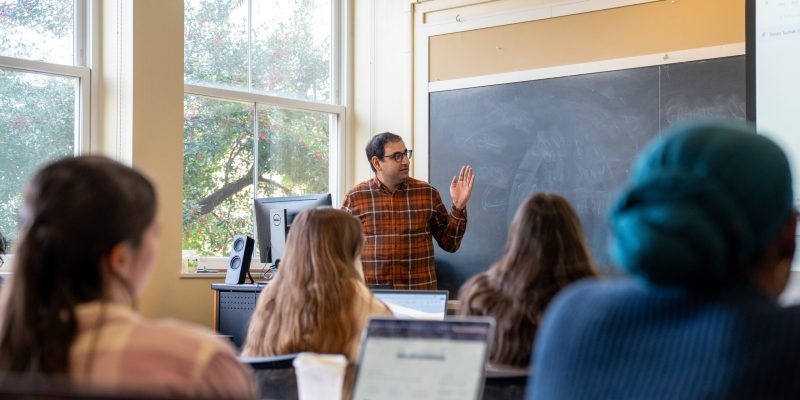
January Term at Randolph-Macon is a time for immersion. While some students took travel courses abroad or completed internships, many students chose to take advantage of the four-week period with an intensive focus in courses that met on campus daily. Those courses range from major requirements to unique and interdisciplinary classes, many taught exclusively during J-Term. Here’s a look at just some of the interesting work they did in 2026.
The Chemistry of Food and Cooking
Targeted to non-science majors, The Chemistry of Food and Cooking offers students the opportunity to explore how science is woven into our everyday lives, and especially in the food that we eat.
“Every time you take an ingredient and you add heat, and you change the texture or the flavor, those are chemical reactions that are taking place,” explained Nora Green, Chemistry Professor and Department Chair. “A knowledge of those things helps us become better cooks as well.
“You really get a good idea of why we use certain things when we bake and cook,” observed Netanya Shaffin ’28, a Psychology and Criminology double major.
Watch the full video on this hands-on course below:
History of Western Medicine
In her History of Western Medicine course, Associate Professor of History and Department Chair Anne Throckmorton uses a personal example to illustrate how fast medical advances came in the 20th century: her great-great-grandfather died from an infection in 1918 after cutting himself while shaving; two generations later, he father survived both a gunshot wound and being thrown out of a helicopter during the Vietnam War, two injuries that would have been death sentences just 50 years prior.
The scope of the course spans centuries, starting with the history of disease and the contributions of Hippocrates, who secularized medicine (the idea that diseases have natural causes and natural cures) and established an ethical code (the eponymous Hippocratic Oath), to more modern developments.
“I hope they realize that medical advances happen in a context,” Throckmorton said of what students should take from the course. “Most of the major advances have been made in the last 150 years or so, because people had to have a paradigm shift in the way they perceive disease.”
An example of this paradigm shift is the death of James Garfield, the 20th President of the United States, who died from infection related to a gunshot wound after being treated by doctors who reused instruments and didn’t wash their hands. As best practices shifted, Garfield could have easily survived just years later.
While the course is an option for History students to complete a major or minor, it also has a broad appeal that often extends to science and Nursing students. “For me personally, as a Nursing major, I thought it was really interesting to see where we were before, where we are now, and how much, possibly in just four years, the medical world will change,” commented Samantha Ernst ’29.
Exploring Banned Books
Jenna Zachry ‘27 contributed to this report
Taught by Dr. Nancy Falciani, Director of McGraw-Page Library, Exploring Banned Books introduces Randolph-Macon students to the debates around banned or challenged books.
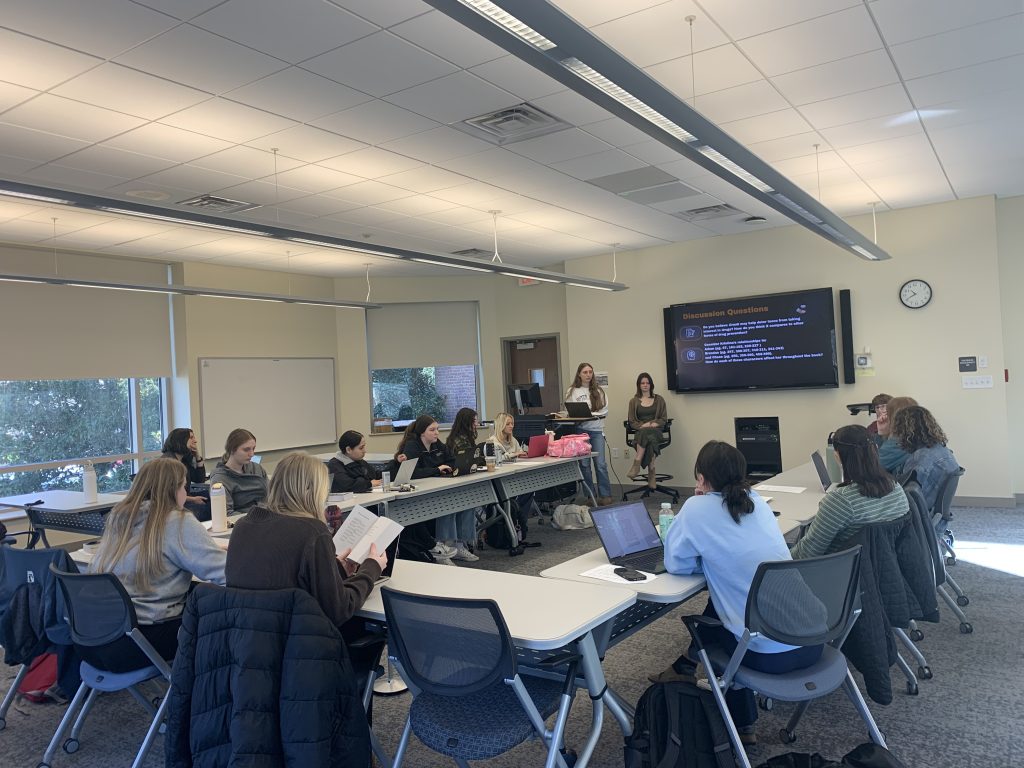
The course includes book discussions led by groups of students themselves, giving them the opportunity to facilitate one another’s learning. Students learn about the history of censorship in the United States and beyond and the numerous implications of challenging and banning books. On the last day of class, each student presents a banned book of their choice that aligns with the themes of the course.
Liz Pluim ‘27 appreciates hearing perspectives from her classmates during their discussions. She said, “Someone from the class has grasped something from the book that I didn’t even think about. And then hopefully I’m able to add things into it that someone else didn’t think about.” Her favorite part of the class is the collaborative aspect of their conversations and listening to others’ viewpoints.
The course content hits close to home, with the Hanover County school district banning more books (125) than any other county in Virginia. Many students in the class, however, left the experience with a rekindled love of reading, with over half voluntarily signing up for public library cards.
“Anytime I teach this class, what is most unexpected to me is the ways in which students connect, often in very personal ways, with the things that we talk about,” Falciani said.
Feature Writing
Students in Dr. Seth Clabough’s Feature Writing course got more than just hands-on experience this January; they got their names on bylines in multiple publications. The class served as a stable of writers for RVA Magazine, The Richmonder, and right here on rmc.edu (including a contribution to this very story). Below is a sampling of their work, with more to be published in the coming weeks:
- How Richmond College Students Fit Into the Growing Thrift Economy – by Jenna Zachry ‘27
- Baroque Traditions: RMC Students Learn Chamber Music in J-Term Course – by Jolene Smith ‘26
- Learning Beyond Borders: Randolph-Macon Education Travel Courses Explore French Classrooms – by Emyle Najera ‘28
- Community Connection: A J-Term Internship with Hanover and King William Habitat for Humanity – by Asher Burns ‘26
- The Next Generation of Richmond Straight Edge – by Annah Pugh ’26
- Knit Against the Machine: How Gen Z Is Fighting Tech With Yarn – Jolene Smith ’26