

Gospel of the Dispossessed: S.A. Cosby Discusses Southern Crime Fiction During Virginia Creators Series
The opening discussion topic for the inaugural event of the Virginia Creators Series was an appropriate one: place. Specifically, eastern and central Virginia.
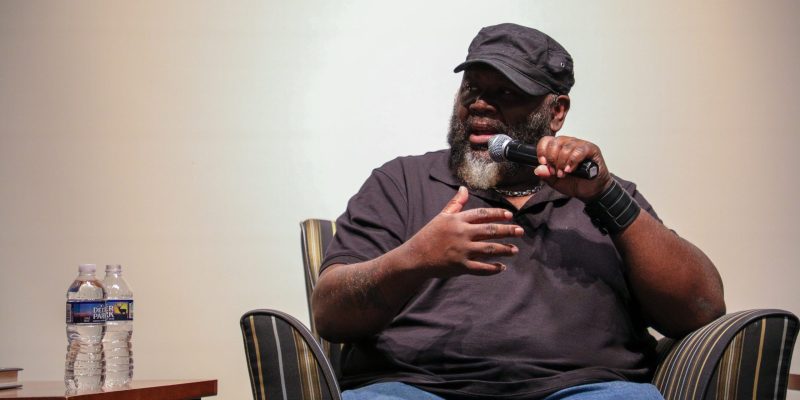
The novels of New York Times bestselling author S.A. Cosby often take place in settings that resemble his home of Matthews, Virginia. In a discussion moderated by Dr. Bob Volpicelli, Professor of English and Director of the Humanities Initiatives, and Dr. Erin McDonnell-Jones, Associate Professor of Education and a former English teacher, Cosby explained the importance of place in his writing.
“Growing up, I never saw the Virginia that I knew represented in media or books. Whenever you see a movie that has anything to do with Virginia, it’s always either Quantico or Langley,” Cosby quipped.
“You should write what you love, and what I love is Virginia,” he continued. “I grew up in a family of backyard raconteurs…so I was always surrounded by legends and stories and tales. I wanted to represent that in my books.”
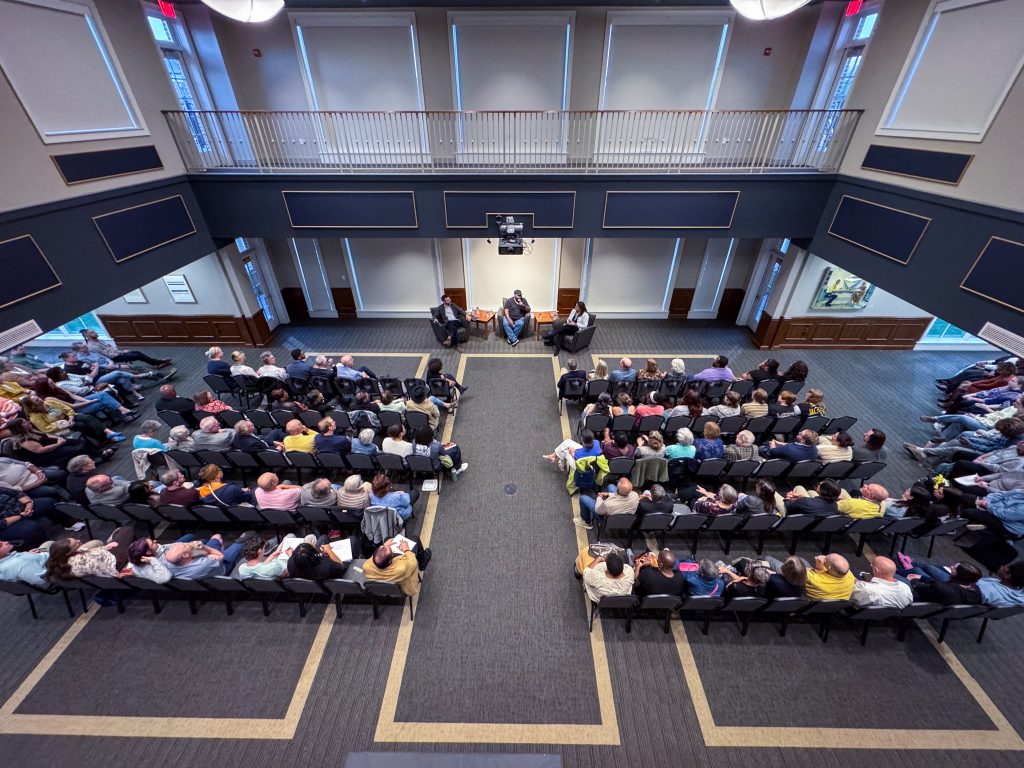
The Virginia Creators Series brings important voices in art and literature from across the state of Virginia to RMC’s campus, making Wednesday night’s conversation inside a packed Birdsong Hall particularly relevant. The series is part of the broader RMC Humanities Initiatives, a bold presidential priority aimed at elevating the profile of the humanities at RMC and ensuring their continued centrality to a 21st-century liberal arts education.
Beyond the Commonwealth, Cosby also discussed being a Black author of Southern crime fiction. While crime fiction has historically been a genre dominated by white writers, he explained how writing through the lens of the South allows him to explore and express the different dimensions of his identity.
“Growing up in the South, it creates this sort of monopoly of feelings, but it also creates this sort of camaraderie,” Cosby said. “The food, the culture, going to church on Sundays, going to a juke joint on Saturday night, that allows me to talk about both my identity as a Black man, as African American, but also my identity as a Southerner, and so I put that into my writing.”
As a crime writer, Cosby’s novels inevitably include violence. While his characters sometimes meet grisly ends, he emphasized that he never writes violence to be gratuitous, instead using that violence—and its consequences—to tell us about his characters.
“Violence, a lot of times, is an expression of grief, of anger, of loss, of misunderstanding,” Cosby explained. “Violence reveals something about the perpetrator and the victim, and so I want to take both sides of it.”
“I like to say that crime fiction is the gospel of the dispossessed,” he continued. “Crime fiction allows you to understand things on a very basic human level…Everybody understands what it’s like to be hungry. Everybody understands what it’s like to be with your back against the wall. Everyone understands what it’s like to be lied to.”
Cosby also recounted his journey as a writer, working on his book during his lunch break as an assistant store manager at Lowe’s and having his first book rejected 63 times, to now having his novel All the Sinners Bleed optioned for a Netflix series. When prompted for advice for those looking to write themselves, he listed several writer friends who had other jobs before getting started. “Don’t be afraid to change course,” he said.
His perseverance paid off. All the Sinners Bleed (2023) was on more than forty Best of the Year lists, including Barack Obama’s, while Razorblade Tears (2021) was an Edgar Award finalist and Blacktop Wasteland (2020) won the Los Angeles Times Book Prize.
Before fielding questions from the crowd and signing book copies, Cosby was reflective on the influence of his family and on the impact of his books.
“The thing that I really learned is when I write a book and it goes out in the world, it doesn’t belong to me. It belongs to people that read it,” Cosby said. “It’s nice to get awards. I got two whole shelves of them back home. But what’s really nice is writing a book that you feel like connects with people, that you feel like means something to people.”