

Fear in Literature: “Midnight Tales” Course Explores Horror

This semester, students in Dr. Jen Cadwallader’s Midnight Tales course are bringing the spookiness of Halloween into the classroom with their discussions of fear in the horror genre. In this literature class, students explore why people throughout history have harbored irrational fears by dissecting texts from Mary Shelley’s Frankenstein to modern stories by Stephen King.
“We look at what things have changed in terms of our cultural fears, and then what things have stayed the same,” Cadwallader, the A.G. Ingram Professor of English, said. “It’s fun because it’s a genre that lots of people like, but it’s also a way to examine who we are as a culture.”
Linsea Martz ‘27, an English major and Writing minor, recalled a recent class conversation. “A lot of what we’re afraid of is of the unknown and the uncontrollable. Something we talked about when we went over Frankenstein was the way our fear grows when we lose power over a situation,” she said. One of the questions covered in the course is whether all these supernatural creatures are manifestations of the same fear, but Martz asserts that the sources of these fears can vary. “Fear comes from many different places,” she said.
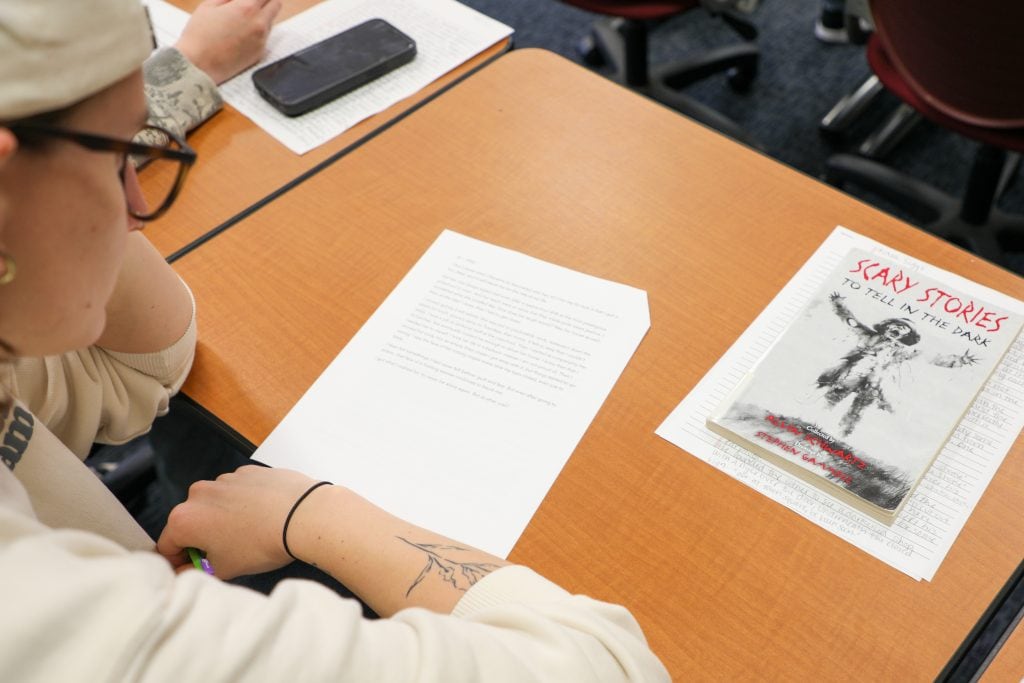
In addition to class readings and discussions, students complete group presentations on a topic related to the course. In a presentation about urban legends, Sociology major and Theatre minor Kara Suggs ‘27 and her group will dive into the origin of specific urban legends, taking into account the cultural values and messages they are trying to get across. Students also taught the class about the presence of vampires in the media and pop culture. Vampires have a dark backstory but have evolved into modern forms like the romantic vampires in books like Twilight.
The class will culminate with students contributing to the horror genre with their own stories. During the second half of the semester, students complete practice exercises to prepare. A recent exercise involved describing an emotion using the “show don’t tell” principle. “Often the story that they write will emerge from some of these shorter exercises and things that other people responded really well to,” said Cadwallader.
What students learn in class is not only beneficial for the final project but potentially for future writing endeavors outside of the classroom. Martz would like to write her own horror thriller novel. “I’m taking mental notes of what’s working and what’s not working in the different horror novels we’re reading, and I’m bookmarking people’s responses to the different things that occur in them for my own future career use.”
By taking Midnight Tales, students satisfy the Human Condition pillar, examining fear as one of the basic parts of being human. Studying the horror genre also relates to what students are learning in other classes. “There were themes that, as a Sociology major, I started picking up on,” said Suggs. She concluded that a character may be trying to escape reality based on his behavior.
As a way to further engage with the material, the class will visit The Poe Museum in downtown Richmond this month. With experiences like this one, students may feel a little more excited for Halloween. For Cadwallader, Halloween is permission from society to play around with what we are afraid of. “But it’s also a way to create community around Halloween, and this class creates a community around social fears … and gives us an opportunity to explore them together,” she said.