From Bacteria to Beer: RMC Students Explore Microbiology
Randolph-Macon College students in Biology Professor Grace Lim-Fong’s Microbiology class have spent the semester researching the microbial communities in wild beer and making analogies between the control of microbial growth in beer and the use (and sometimes overuse) of antibiotics to treat human infections. They also partnered with Ashland’s Origin Beer Lab (a sister brewery of Center of the Universe Brewing Co.), and with Agriberry Farm, located in Hanover County.
“Most of the beer consumed in the U.S. is made by using a domesticated strain of brewer’s yeast in an enclosed vessel,” says Lim-Fong. “However, wild beers, which are beers made from spontaneous fermentation by microbes from the air of the brewing environment, are gaining popularity. The most well-known wild beer is Belgian lambic, which is made in the Brussels region in Belgium.”
Collaboration
Matt Houle ’17, one of Lim-Fong’s students, contributed to the first RMC beer on tap at Origin. He kicked off the collaboration with Origin last fall as part of his research project. Houle mimicked the lambic process by collecting wild microbes from the air at Agriberry Farm by placing containers of wort (sugary water made from steeping malted grains) under different fruit trees and berry bushes. He did this because Origin and COTU owners Chris and Phillip Ray wanted to gather microbial strains at the local level in order to create Ashland- and Hanover-specific beers. Houle isolated a wild Saccharomyces yeast from under a raspberry shrub that was used to brew a Raspberry Wild Ale.
Houle, a biology major and chemistry minor who is following a pre-med track, was recently accepted to George Washington University School of Medicine and Health Sciences in conjunction with an Early Acceptance Agreement between RMC and GWU.
“Neither Professor Lim-Fong nor I knew what to expect from this experiment,” says Houle. “After months of advanced lab work isolating wild yeasts, it was nice to have a beer that represented my research. Being able to represent myself and the college in the surrounding community was also a rewarding benefit of this class.”
Testing + Evaluation
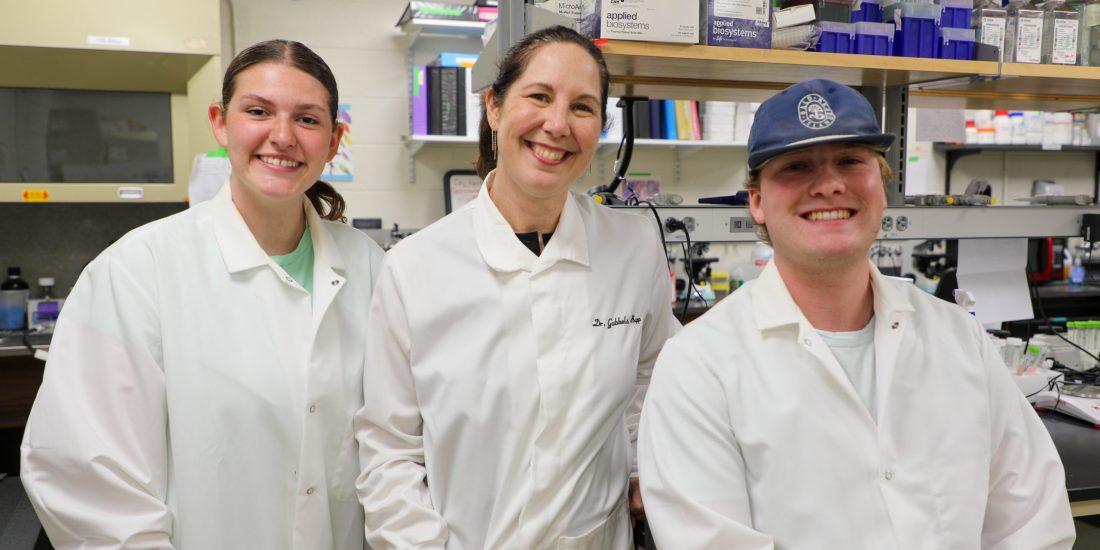
This spring, Microbiology students followed up on the wort samples and cultured the microbial strains on agar plates in Copley with an end-goal of isolating more strains that could be used in brewing beers. They tested the fermentation capabilities of their isolates and evaluated how tolerant the bacteria were to hops (a bittering ingredient that contributes flavor and aroma of beer but could inhibit bacterial growth). Students also used DNA analysis to investigate how the microbial community in the wort changed over time, a process known as ecological succession.
The students’ research was featured in the February 1, 2017 issue of the Herald-Progress.
Research Day
Lim-Fong’s students will be sharing outcomes of their projects at RMC’s Research Day, which will take place on campus on May 12, 2017. In addition, a tasting event will take place that same day at Origin at 5:00 p.m. for those 21 and over. The beers featured in the “Randolph-Macon Tap Takeover” event were brewed by the students, who used their knowledge of beer biology to craft their own brew.
“My students did a fantastic job in isolating microbes that they ultimately used in brewing their original beer recipes,” says Lim-Fong. “They learned classical and contemporary microbiology by doing. My course, while highly beer-centric, aims to provide students with hands-on experiences, which should be valuable in their post-graduate study, whether it be a nursing or dental program, or in graduate school. Their presentations on Research Day will highlight their findings of their lab studies and compare them to published research on the microbiology of wild beer.”