

Student Research Continues to Advance Discovery in Immunology Lab
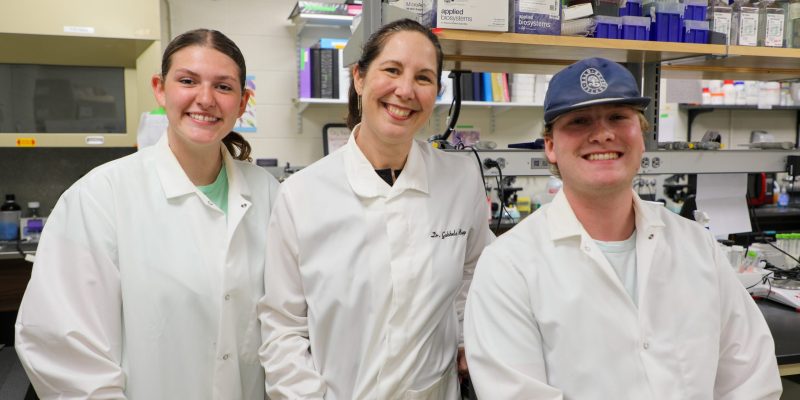
In 2009, Dr. Melanie Gubbels Bupp had recently arrived as a Biology professor at Randolph-Macon College and was conducting an experiment with her first research student, Whitney Edwards Beck ‘12, when the duo got a counterintuitive result. When immune cells from malnourished mice were put in an incubator, those immune cells died at a lower rate than those from the control group mice.
Malnourishment is typically understood to have a negative impact on both the total number and the functionality of these cells; so why were they surviving in these conditions?
This unknown has sparked a line of research that she has pursued for well over a decade, and along the way has helped dozens of students get valuable lab experience that has kickstarted their careers. This summer, Biology majors Kelly Hotaling ’28 and Josiah Lester ’27 pushed the research forward by completing Schapiro Undergraduate Research Fellowships (SURF) in Dr. Gubbels Bupp’s lab, searching for more answers.
“It feels good to be part of something that’s been going on for a long time, contributing to research that could potentially make a difference in what we know about immunology,” Lester said, explaining the project’s importance despite its specificity. “This is less than 1% of what’s happening in our body, but it could still give us some insight into what’s going on.”
The subject at the heart of this research is the T cell, a crucial part of the body’s immune response (HIV/AIDS can be deadly because it kills T cells, rendering that immune response non-functioning).
“T cells’ job is to patrol lymph nodes and if we have an infection, other immune cells capture the pathogen and bring it to a lymph node for a T cell to recognize and start an immune response against it,” Gubbels Bupp explained. “So, it’s kind of a surveillance job.”
A breakthrough discovery, which set the stage for this summer’s work, was that T cells were going to an unexpected place while an organism was malnourished: the bone marrow. Gubbels Bupp hypothesizes that malnutrition could be triggering T cells to “hibernate” and be readily available to resume their duties when proper nutrition returns to their host organism. Now, the lab’s focus is on understanding the mechanisms that are keeping the T cells alive in the bone marrow and what’s reducing their function.
“If we can understand what’s causing those two things, then we might be able to take advantage of that understanding to change how vaccines are administered for malnourished kids,” Gubbels Bupp explained of the downstream impact of this research.
During a sabbatical last year, Gubbels Bupp ran an experiment to compare the genes being used in T cells isolated from the bone marrow of malnourished mice compared to those of healthy mice. Expecting to find hundreds of different genes, she found just two that were different between the groups.
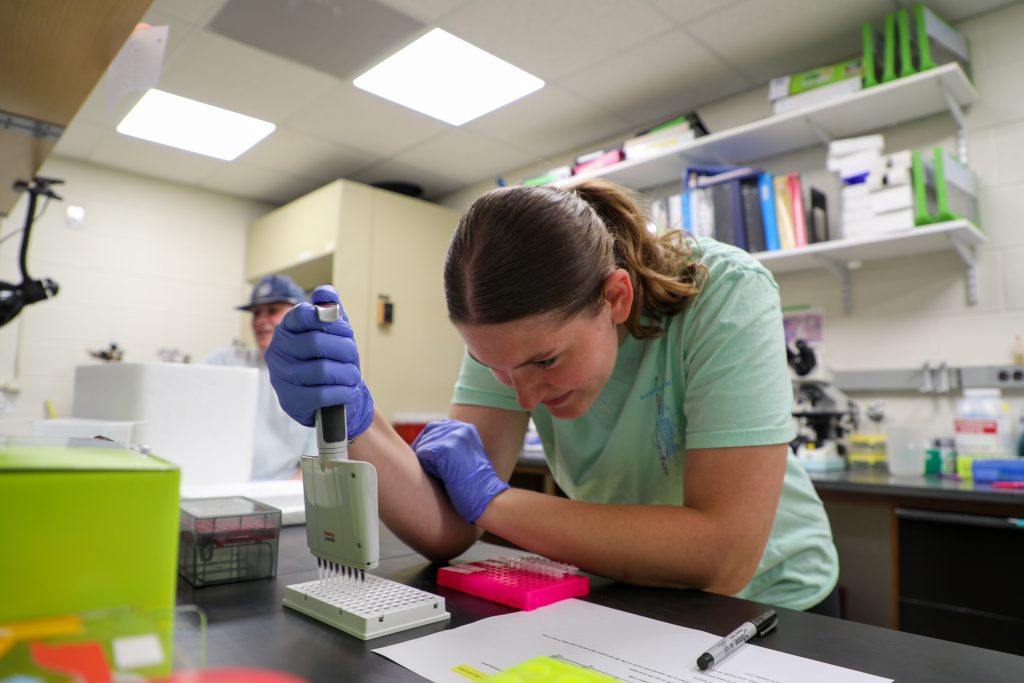
Hotaling and Lester worked this summer to confirm the expression of those two genes, then started experiments to explore the importance of these genes in what happens to the immune system during malnutrition. Gubbels Bupp hopes that these findings can serve as evidence for National Science Foundation funding to extend the research further.
From intense literature reviews, to growing skills in the lab, to presenting at the SURF Symposium, the experience was both immersive and rewarding for the students.
“I came in nervous that I wasn’t going to be smart enough, because I didn’t really have any background in immunology,” Hotaling said. “But [Gubbels Bupp] is really awesome to work with.”
While both students were conducting research for the first time this summer, by the end of the term, they had become experts on the subject, easily rattling off facts and descriptions of the genes KLF11 and TSC22D3.
Gubbels Bupp has witnessed firsthand how that experience can boost prospects for jobs and grad school for graduates who worked in her lab. For a recent sampling, Jacob Hanes ’26 is enrolled at VCU’s medical school, Madeline Smith ’26 is pursuing a Ph.D. from the Georgetown University-National Institutes of Health Graduate Partnerships Program, and Clay Phillips ’25, ’27PA is completing RMC’s Physician Assistant Studies program.
“I definitely think from a resume perspective it helps students stand out from their peers when they’re applying to those sorts of programs,” she said. “The reason why is because they can actually talk about what they did at a pretty deep level.”
Going into his senior year, Lester echoed the feeling of personal growth.
“I never thought I would even know that much information and that in that much detail.” he reflected. “I know that having this experience gives me confidence in whatever else I decide to pursue, just because I’ve exceeded my own expectations of what I can learn.”