






Accounting is essential for a thorough understanding of finance, business, and markets. Learn to organize and analyze quantitative data for essential business decisions as an accounting major at RMC. Through an active learning environment that incorporates accounting, business, and economics theories, you’ll gain fluency in the language of business while enjoying the unique setting of a liberal arts education. Randolph-Macon accounting majors are well-prepared to take the CPA exam and for a career in all business environments. Students graduate with an excellent understanding of the complexity of business organizations and a strong foundation for graduate studies in accounting, business, taxation, and law.

Major/Minor Accounting
Accounting
up Close In and Beyond the Classroom

global education
The study of accounting isn’t all about numbers. While studying in residence at Wroxton College, students discovered how the cultural and historical events of a tumultuous time in Great Britain impacted the practice of accounting. The travel course combined student cohorts enrolled in International Accounting (ACCT 481) and The Industrial Revolution and Early Management in Great Britain (BUSN 390) to offer a holistic learning experience that shed new light on the interconnectedness of business, culture, and world history.
high-impact internships
Accounting majors complete valuable internships that secure relevant work experience while also providing opportunities to explore positions and industries you’d could pursue after completing your degree.
Recent RMC accounting internship sites include:
- Keiter CPA
- Richline Group
- PricewaterhouseCoopers
- Virginia State Corporation Commission
- WellsColeman

advising and mentorship
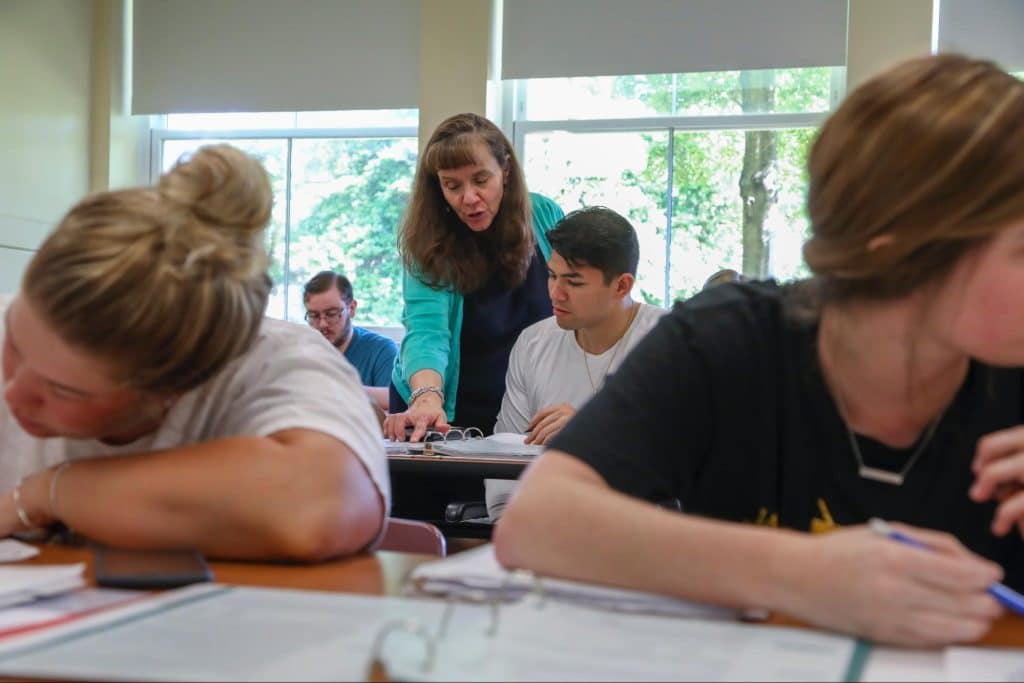
Randolph-Macon accounting faculty work closely with you, providing one-on-one support and guidance from your freshman year through graduation, and even after you’ve moved on to the workforce or graduate school. In addition to this personalized support, RMC’s nationally ranked Edge Career Center is a key resource, with services like self-assessment, professional development, internships, on-campus jobs, and career search.
After RMC
Paving the way to a CPA or graduate school
preparing for a cpa exam
Planning for a career as a CPA? Accounting majors at RMC considering taking the exam should plan to take auditing, taxation, and accounting information systems in order to meet Virginia State Board of Accountancy requirements. New in 2025, Virginia accountants need just 120 hours of coursework completed to sit for the exam. (Students planning to sit for the Uniform Certified Public Accountant (CPA) examination in other states should consult with their individual state Board of Accountancy to determine the requirements for admission, which might include additional courses best accomplished through summer or graduate school.)
For more information, consult with Professor Kathy Simms at kathysimms@rmc.edu.
direct pathways to grad school
RMC accounting graduates have the opportunity for direct admission to the master of accounting program at Virginia Commonwealth University.
In addition, the Randolph-Macon Department of Economics, Business, and Accounting recommends up to five students each year for admission to the Master of Accounting program at the College of William & Mary. Both programs offer qualifying RMC accounting students with direct educational pathways to excellent graduate school programs in Virginia.
-
$90,780the average annual salary for accountants and auditors
-
$636Bthe 2024 value of the global accounting services market (source)
-
1942the year Wroxton College, RMC’s education partner in England, was founded
Accounting
in full Courses You Won’t Want to Miss
(A very small sample)
ACCT 372
tax accounting
Study taxation and learn the theory, structure, measurement, and significance of the federal income tax as it affects the decision-making process of households and businesses. Learn about the development of tax planning techniques and issues surrounding tax compliance.
ACCT 380
Financial Investigations
Learn the accounting techniques used in financial investigations that uncover money, tax, and other financial fraud. Using case studies, explore the outcomes of accounting investigations including legal penalties and court processes; and apply learned accounting techniques toward your own financial investigation case study.
ACcT 440
Contemporary Topics in Accounting
Learn about pensions, leases, revenue recognition, international accounting, and financial statement analysis. Achieve proficiency in the Accounting Codification System; the financial accounting resource database developed and maintained by the Financial Accounting Standards Board (FASB).
Clubs and Other Opportunities
Popular activities and programs among accounting majors

Sigma Beta Delta Honor Society
for students in business, management and administration
Phi Beta Lambda
Student professional organization
From Here To What you can do with an Accounting degree from RMC

charleita richardson ’00
President and Chief Executive Officer
Christo Rey Richmond High School
“Randolph-Macon College has been instrumental in my success. RMC helped me to further develop my critical thinking skills and instilled in me that with a liberal arts education, my professional journey can take many paths. The value of my experiences in college, the lessons taught by my professors (who are among the best in the country) and the opportunities afforded me have made my transition from Corporate America to local government and now nonprofit work worthwhile, easy, and meaningful.”
Bo Garner ’08
Partner, Not-for-Profit Team Leader
PB Mares CPAs
Michelle Kutcher Mertens ’08
Controller
Sportsbackers

Rachel Benson Pisarz ’20
Staff Accountant
GRF CPAs and Associates
“The professors at RMC not only teach you the core mechanics of your major but provide you with lifelong lessons. They also care for their students in a way that goes beyond their educational development which is what I think gives RMC the edge.”
Brian davies ’17
Financial Services Assistant Manager
Ernst & Young London
BUZZWORTHY The latest from RMC Accounting
News Story categories: Accounting
Behavioral Neuroscience
Environmental Studies
Randolph-Macon Honors Retiring Faculty Members with Bruce M. Unger Awards
Six faculty members who represent a combined 167 years of service at RMC will be honored at Commencement.
News Story categories: Accounting
Communication Studies
Computer Science
RMC Interns Experience Summer in New York at Richline Group
Jenna Shaughnessy and Sarah Wilsey were the latest in a decade-long line of RMC students to complete internships at the global, vertically integrated company.

News Story categories: Accounting
Economics, Business, and Accounting
English
HAC Honors Professors with Student-Nominated Awards
Each year the College’s Higgins Academic Center honors professors with awards recognizing their exceptional support of advising and tutoring. The…
More to explore 55+ areas of study to discover at RMC


Get Ready Discover Accounting at RMC.
Loading…
Frequently Asked Questions: Accounting
What does an accountant do?
It’s impossible to define a “typical” accountant, because there really isn’t one. While many people think accountants simply record, report, and monitor business transactions, today’s accounting professionals serve in a variety of functions with broad impacts:
- Produce and evaluate financial statements as internal financial accountants or independent auditors.
- Research tax law and prepare tax returns for individuals and organizations as tax specialists.
- Improve companies’ internal systems to increase efficiency and reduce risk as internal auditors.
- Investigate financial crimes as forensic accountants.
- Determine the value of businesses as forensic accountants.
- Engage in data analytics as managers, external and internal auditors, and forensic accountants.
- Evaluate and formulate key operational decisions and strategies as managerial accountants.
- Facilitate mergers and acquisitions as financial accountants or consultants.
What can I do with an accounting degree? What jobs can you get with an accounting degree?
Accounting knowledge is a high-demand skill that lends itself to a number of careers. In addition to various accounting roles described above, some other common industries for accounting majors include management, government, real estate, and consulting services. Additional non-accounting careers for accountants include medical billers, private investigators, fraud investigators, financial advisors, information technology specialists, business analyst, investor relations managers, and more.
How much does an accountant make?
The U.S. Bureau of Labor Statistics reports the median salary for American accountants and auditors as of May 2023 as $79,880, with the top 10% making upwards of $137,280 per year. Careers website Indeed.com shares a similar normal salary range for an accountant of $45,000 to $96,000 in 2025.
What degree do you need to be an accountant?
A bachelor’s degree (and often at least one accounting certification–namely a CPA license) is required for most accountant positions. Often, more specialized roles require further credentials, such as a master’s degree and/or additional certifications.
At Randolph-Macon College, the B.A. in Accounting program includes 48 credit hours of required coursework. The initial 15 hours of coursework provides a comprehensive review of critical subjects related to accounting, including statistics, economics, business, quantitative analysis, and (of course) accounting. An additional five elective courses in advanced accounting topics enable in-depth study of more specialized concepts. In addition to major requirements, RMC students must complete the general College curriculum to be eligible for graduation.
How to become an accountant–what steps should I take?
The journey to becoming an accountant, especially a Certified Public Accountant, includes a number of important steps.
- Research: Learning more about the requirements and potential careers in accounting is a great place to start. The Bureau of Labor Statistics’ fact sheet provides helpful information about the cognitive and mental requirements, education and training process, and working conditions for accountants.
Better understanding the various types of accounting–and which you might want to practice–will help you understand next steps in your journey. For example, to be authorized to file a report with the Securities and Exchange Commission (SEC), you must be a licensed Certified Public Accountant (CPA). Many employers require their accountants to hold this license, and may even finance employees’ CPA exam costs. Specialized accounting roles may require additional education or certifications; keep reading for additional information. - Education: Since more than 90% of accountant positions require a bachelor’s degree in accounting or a related field, studying accounting in college is an important next step. Majoring in accounting is particularly important to students wishing to pursue their CPA, since many states require a minimum of 150 credit hours–or, starting in 2026, 120 hours in Virginia–of higher education instruction as part of the licensure process.
To achieve this goal, many aspiring accountants choose to pursue a master’s degree–most notably the Master of Accountancy (MAcc) or Master of Business Administration (MBA). However, coursework at accredited two- and four-year colleges and universities also qualifies. Higher-level coursework and/or an advanced degree may be required for certain accounting positions, such as forensic accounting or tax accounting.
Due to scheduling requirements, RMC students interested in majoring in accounting should begin mapping out their coursework during their freshman year, with major coursework beginning no later than the fall of their sophomore year. For students interested in becoming a CPA in the Commonwealth of Virginia, the Virginia Board of Accountancy requires specific coursework. - Internships: Hands-on work experience provides practical experience and training for accounting students. Accounting majors at RMC benefit from the support of our award-winning Edge Career Center to find paid and volunteer internship opportunities in industries of interest. Students may also earn academic credit for their internship through the Bassett Internship Program.
- Certifications: As mentioned previously, many accountants choose or are required to obtain a CPA certification, which includes meeting state-specific licensure requirements (some of which include an ethics exam) and passing the national Uniform CPA Examination. The CPA exam is a four-part test that includes three core sections and the test-taker’s choice of one of three discipline sections, all of which must be passed within a set amount of time that varies by state. After passing the CPA exam, the candidate must apply for CPA licensure through their state’s board of accountancy. To support their understanding of current regulations, CPAs must complete ongoing professional development to maintain the license.
As mentioned previously, there are numerous certifications that support greater specialization and career growth for accountants. The American Institute of Certified Public Accountants (AICPA), which develops and grades the CPA exam, additionally offers the Chartered Global Management Accountant (CGMA) designation and other specialty credentials. Additional accounting credentials offered by other organizations include the Chartered Financial Analyst (CFA), Certified Management Accountant (CMA), Certified Internal Auditor (CIA), and Certified Fraud Examiner (CFE) designations.