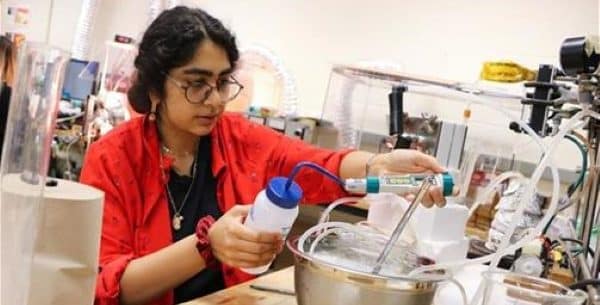


Summer Internship Combines Field Work and Data Collection
This summer, Randolph-Macon College student Maddie Farmer ’17 is spending most of her time on the shoreline or in a lab. And that’s just fine with her.
The environmental studies major and biology minor is doing an internship in conjunction with the Research Experiences for Undergraduates (REU) program. REU is sponsored by the National Science Foundation and is conducted at many universities, research institutions and laboratories. Farmer applied to several REU programs, from Maine to Florida, that meshed with her main research interest—the study of crabs. She was awarded an internship at The Duke Marine Lab in Beaufort, North Carolina, which is part of the Nicholas School of the Environment.
The Habitats of Fiddler Crabs
Through the REU program, Farmer works closely with two professors from Wittenberg University who conduct research at the Duke Marine Lab every summer. They have been conducting research on fiddler crabs for more than two years. Together they are studying three different species of fiddler crabs in North Carolina, all of which live in different habitats with varying salinity and sediment grain size.
“To provide some context: Females will carry their eggs for about two weeks, then the eggs hatch into the first larval stage, which are transported out of the estuary for development,” explains Farmer. “They progress through five larval stages, then molt into megalopae and return to the estuary to settle in species-specific habitats.” Farmer says that the process behind to what extent fiddler crabs settle in species-specific habitats is not known.
“It is possible that this behavior occurs because they are stimulated by certain salinities or by an environmental cue, such as an odor of a fiddler crab,” she says. “I’m trying to find answers to some of these unknowns. My first objective is to determine the effect of lower salinity on the time of metamorphosis. Secondly, I hope to determine the effect of lower salinity, plus chemical cues of different species of adult fiddler crabs on the time of metamorphosis.”
A Day in the Life of a Researcher
Farmer collects the megalopae at night during rising tide as the megalopae come into the estuary. She then sorts through the plankton to collect the megalopae. After placing megalopae into individual vials with brine shrimp larvae for food, she monitors them every six hours to determine the time it takes for the megalopae to molt to the first crab stage.
“The megalopae of all three species of fiddler crabs look identical, so I use molecular techniques to identify their species,” she says. “After the megalopae molt or die, I preserve them in ethanol and later extract their DNA to determine their species.”
With the end of the program fast approaching, Farmer is also busy writing sections of her final report, which she’ll present to her REU peers and advisors at the end of the program.
“I have enjoyed the variation throughout this research,” says Famer. “It has been a great balance between field work, molecular work, and data collection.”
Preparing for the Future
This is Farmer’s second internship. During January Term (J-term) 2016, she interned at the Virginia Institute of Marine Science (VIMS) in Gloucester Point, Virginia, where she participated in the Winter Dredge Survey and worked in the VIMS lab. She also learned how to use oceanic and lab equipment and developed the discipline and perseverance necessary to conduct research. Her J-term experience helped her secure the REU internship. Both of her internships are helping prepare Farmer for the future.
“Perhaps I’ll work for an organization that combines marine science research needs with community outreach through education,” she says. “But it’s early in my decision-making process. I want to stay flexible and open to all opportunities in the field of marine science.”