

Research and Creativity on Display During Student Symposium

Many Ashland residents can tell you that the intersection at Ashcake Road and Maple Street is a challenge. The two-way stop often sees traffic backed-up onto Maple. That problem was at the heart of a research project that a group of RMC engineering students tackled this semester, in collaboration with the Town of Ashland. On Friday, May 9, Grant Bennett ’25, Kannon Jewell ’25, and Matthew Romero ’25 formally presented their findings during Randolph-Macon’s Student Symposium of Research, Scholarship, and Creative Work.
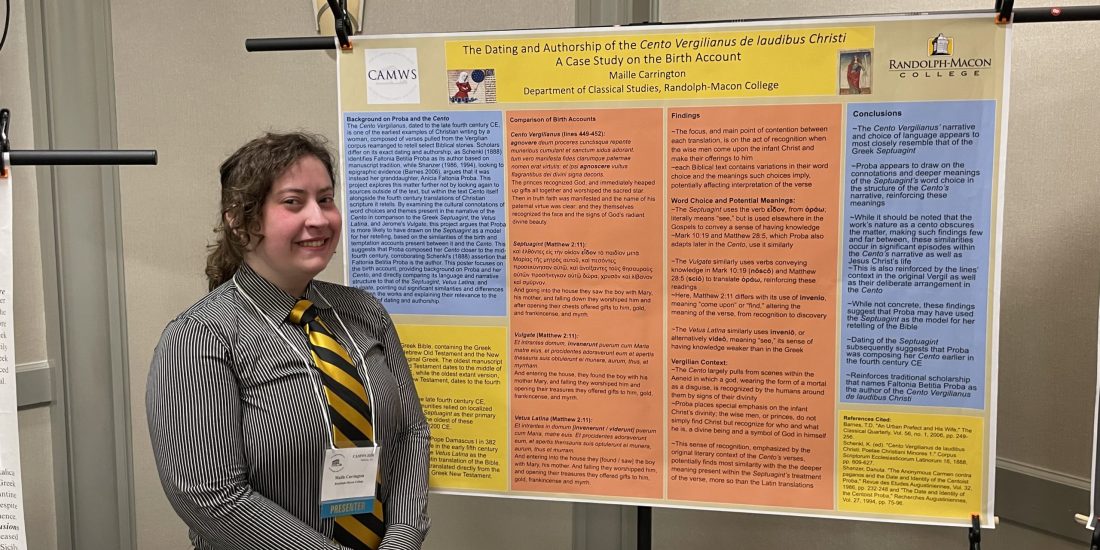
Asking questions is at the heart of the annual symposium event, which showcases the many hands-on projects that students complete during the academic year.

As for answers, at Ashcake and Maple, the RMC seniors bucked the conventional wisdom of a four-way stop or a stoplight. Their observations and calculations led them to a different conclusion: a traffic circle. While traffic on Ashcake would have to slow slightly to navigate the traffic circle, the group showed that the decrease in queuing time on Maple would actually increase how quickly the average driver makes it through the intersection. And a decrease in crossing points—where most accidents occur—would make it safer for everybody.
“People are having to slow down to yield to somebody in the intersection, so they’re already going to be going slower to let pedestrians through,” Bennett explained.
The question of pedestrian and driver safety was just one of many posed and answered across campus during the symposium, offering 213 students the opportunity to showcase a broad range of scholarly and creative pursuits.
How do we balance personal responsibility against systemic structures while making policy? How can a bionic hand show us what the future holds? What happens when we ferment lemons? Research posters, presentations, and displays represented a diverse set of disciplines that ranged from biology to cybersecurity to Asian studies and more.

Students demonstrated their artistic prowess as well, with recitals for wind, percussion, and string instruments, a presentation of Chinese calligraphy, and a presentation of “Science as Art.”
During the Hugh Scott Oratory Competition, named for the former U.S. Senate Minority Leader and member of the Class of 1919, students gave persuasive speeches with skill and passion. Fitz Wreaks ’26 won the gavel trophy for his remarks advocating for more accessible pathways to legal immigration.
Students’ work was also displayed in interactive ways. Members of the robotics club demonstrated their bots’ capabilities from their inaugural year of competition, while Honors students provided snacks that were produced from their experimentation in fermentation.
A full list of student presenters and projects can be found on the Student Symposium webpage.