



Holocaust Course Explores Vitally Important Subject—And Its Relevance Today
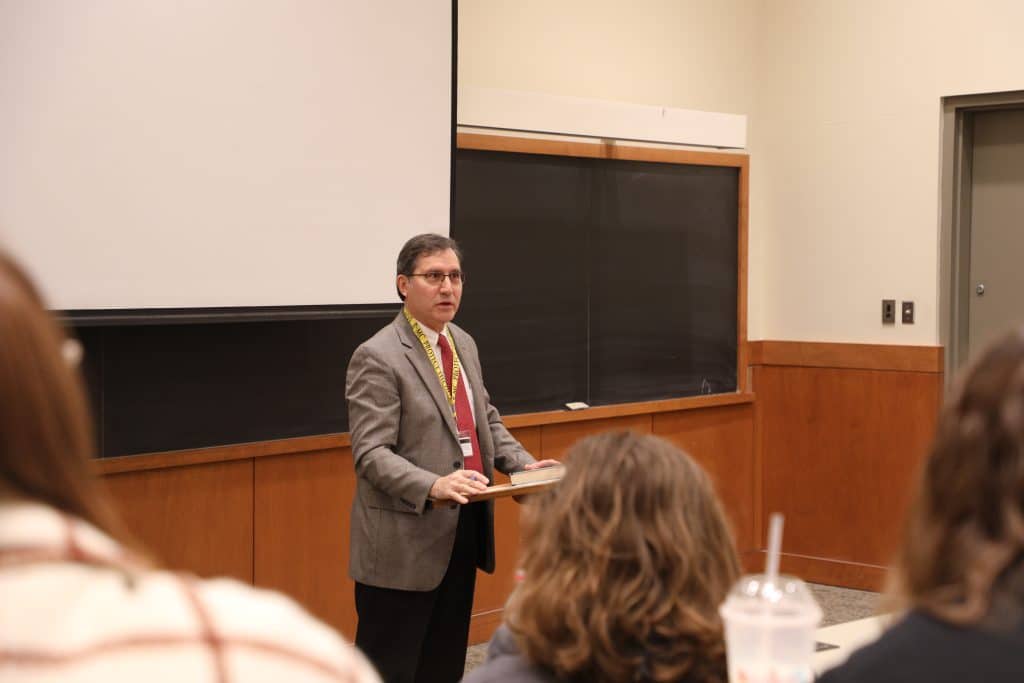
Since he joined the faculty in the 1990s, there is one course that religious studies professor Dr. Hal Breitenberg feels that he has a moral obligation to teach.
Titled simply “The Holocaust,” the course is not part of any major requirement and is among the most challenging—both intellectually and emotionally—offered at Randolph-Macon College. But it’s always filled—no matter which semester it’s taught in.
“I’m impressed that so many students have taken a course in the Holocaust,” Breitenberg said. “It’s not for the faint of heart. It’s not for folks who are looking for an easy A. You’ve got to be willing to take a course such as this.”
The course, originally titled “Literature of the Holocaust,” was developed by late RMC professor Willie Chappell. Several years after Chappell’s retirement, Breitenberg, then a new adjunct faculty member at RMC, took over and distilled a vast and multifaceted subject into one of RMC’s most impactful classes.
Breitenberg remains true to the original title of the course: after covering the basic history and geography of the Holocaust, the class examines literature, textbooks, poetry, historical memoirs, articles by scholars of the Holocaust, and short stories on the subject, all from a myriad of sources. But the course material also expands to films and visual art, with the professor noting that a textbook can’t necessarily capture the thoughts and emotions showcased in fiction or drawings.
Students take the course for a variety of reasons, and in class offer varied points of view. Emily Carter ’26, a business finance major, took the course this past J-Term, seeking the different perspectives she had enjoyed in a previous religious studies course. “You see a lot of human stories about people who struggle during the time, and it shapes your perspective of how fortunate you are in your own life,” Carter remarked.
“I thought it would be really interesting to take this class that obviously plays a large part in the history of Judaism, but also just in history in general,” said Mason Goldstein ’27, who is Jewish and also took the course this past J-Term. “I also wanted to hear other people’s perspectives on it. I’ve been around the Jewish perspective, but I wanted to see what other people thought and hear why they wanted to take the class.”
The course, by its nature, is intense. It’s also engaging. A class period this January started by viewing a short film that chronicles the story of a woman who made the difficult choice to jump from a moving train headed for the Auschwitz concentration camp and leave her ailing father behind, then transitioned to a thoughtful discussion where students analyzed the symbolism in different paintings and drawings that depicted concentration camps.
While the coursework digs deep into the tragic human impact of the Holocaust, Breitenberg also illustrates the breadth of impact of the state-sponsored genocide, its continued relevance today, and the historical context around it. Throughout any given class period, a lecture may touch on the Israel-Palestine conflict, Thomas Jefferson’s interpretation of the separation of church and state, or the usage of “C.E.” and “B.C.E.” versus “A.D.” and “B.C.” for year notations.
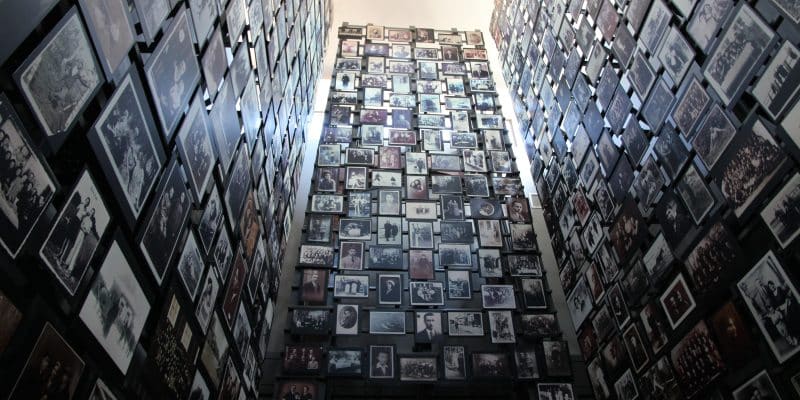
Towards the end of the month, the class traveled to Washington, D.C. to tour the U.S. Holocaust Memorial Museum, further helping to put the material of the course into perspective. “By positioning it in the course where students have had maybe two thirds or three quarters of the class before going there, they see a lot of stuff they’ve read about,” Breitenberg explained. “It makes it more real to them.”
Even for students undertaking an intense study of the subject, the Holocaust Memorial Museum is described as an “overwhelming” experience. While the exhibits are raw and emotional, they effectively drive home the main points of the course. “If this course doesn’t make you feel a little uncomfortable, then you’re doing something wrong,” Goldstein said.
Emily Carter also took the opportunity to visit the Virginia Holocaust Museum in Richmond for extra credit, bringing a local relevance to the course material. “I didn’t realize how many stories of the Holocaust were connected to Richmond itself,” Carter said. “People from Richmond who were helping Jews, people who were willing to take in Jews who were trying to escape. It was interesting to see that and think about how close something like this was to home.”
Ultimately, Breitenberg hopes students walk away from the course with the knowledge that an event like this could happen anywhere, and the knowledge of how to prevent it from happening again.
“I point out to students, if it happened in Germany, in one of the most liberal societies in the world at the time, the most advanced scientifically, artistically, et cetera, there’s no law of nature that prevents it from happening anywhere else,” Breitenberg said. “You oppose it, and similar forms of genocide, by studying and acknowledging it. It’s not pleasant; I don’t like reading about this stuff. But I think it’s important enough that it ought to be done.”