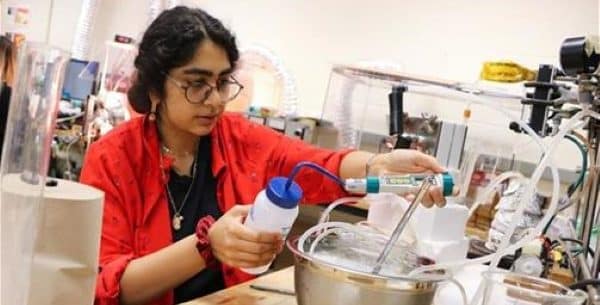


Doctor-in-Training: Farah Hatoum ’18
In the summer of 2014, Randolph-Macon College student Farah Hatoum ’18 was driving to her home in Aley, Lebanon from a nearby town. At an intersection, she saw a young Syrian girl who was selling gum on the street. Hatoum parked and rolled down her window. The green-eyed girl asked Hatoum to buy gum so that she could help pay for her younger sister’s medicine.
“At that very moment, I realized that I wanted to do everything possible to make sure that refugees receive proper medical care,” recalls Hatoum. In 2016, she participated in a medical brigade trip to Esteli, Nicaragua, where she and other volunteers provided medical aid to those in need. That experience further cemented her desire to help others.
Inspired by the pressing needs she had witnessed, and aided by a $10,000 grant from the Davis Projects for Peace program, Hatoum recently returned to Lebanon to implement a project she created: “Alleviating the Refugee Crisis in Lebanon.” The Davis Projects for Peace program, a global initiative, supports and encourages youth to create and test their own ideas for building peace.
Raising Awareness
Hatoum, a biology and Spanish major who will graduate this fall, had a clear goal in mind when she created the project: to provide immediate medical and hygienic care to refugee children living in the mountains of Lebanon. She spent nearly two months in Lebanon, where she organized and implemented two healthcare clinics—one in Aley and one in Kfarselwan.
“I want others to know about the plight of the large refugee population,” says Hatoum, who has had a lifelong interest in medicine. “There are more than a million Syrian refugees in Lebanon, and I want to help make a difference.”
Collaborating Toward Sustainable Peace
In planning her project, Hatoum quickly learned that time management, flexibility and organizational skills were essential. Before heading to Lebanon, she spent months researching how best to make her project a success.
Hatoum partnered with a team of healthcare workers—doctors and medical students she knew in Lebanon who agreed to work with her. She also had to meet with and get approval from the mayors of Aley and Kfarselwan before implementing her projects. Thanks to the generous funding from the Davis grant, she purchased medications in Lebanon and delivered them herself to the two clinics.
“Planning this kind of project in a developing country was very challenging,” she says, “but the gratitude that I received from the patients made all of my efforts worth it.”
Although at times Hatoum worried that she was not doing as much as she could to help the refugees, she realized that her project was worthwhile—and that it is indeed sustainable. One of the doctors Hatoum worked with referred all of the patients she saw during the two clinics to her own clinic at a nearby town.
“Those patients will receive discounted medical treatment and medications from here on out,” says Hatoum proudly.
Looking Ahead
After she returned to campus, Hatoum received phone calls from several non-profit organizations asking if she would be continuing her project next summer.
“These organizations were very supporting of this endeavor and are willing to provide donations for next year,” she says. “It’s exciting to think that I may be returning to Lebanon next year to continue my work with the refugees—this time, with more experience under my belt.”
In spring 2017, Hatoum studied abroad for five months at the University of Almeria in Spain. A recipient of RMC’s Dr. and Mrs. Marshall and Alice McCabe Pre-Medical Scholarship, her future plans include medical school and a career in pediatrics.
In a final report that she submitted to the Davis Peace Projects program, Hatoum reflected on her experiences in Lebanon:
This project was one of the most valuable experiences I have ever had the honor of organizing and partaking in. It gave me hope that through organizations such as the Davis Project for Peace, there truly is a possibility for a more peaceful tomorrow. There are people in need of immediate relief and aid whether it be in Lebanon, Syria or right here in Richmond, Virginia. Once one person tries to spread the peace they have within themselves, awareness is created, and that peace radiates. One action can cause a chain reaction.
The Davis Projects for Peace Program
Projects for Peace was created in 2007 through the generosity of Kathryn W. Davis, a lifelong internationalist and philanthropist who died in 2013 at 106 years of age. She is the mother of Shelby M.C. Davis who funds the Davis United World College Scholars Program currently involving over 90 American colleges and universities. Mrs. Davis’ legacy will live on through the continuation of Projects for Peace in order to spark initiatives for building prospects for peace in the world.
Undergraduates at 90 partner schools of the Davis United World College Scholars Program, as well as those at International Houses Worldwide, Future Generations, the Graduate Institute in Geneva, and the University of Maine are invited annually to submit plans for Projects for Peace. Winning proposals selected from competitions at all these campuses are funded through Davis’ generosity.
RMC students were also the recipients of Davis Projects for Peace grants in 2014, 2015 (Haiti) and 2016 (Ghana).