

Baroque Traditions: RMC Students Learn Chamber Music in J-Term Course
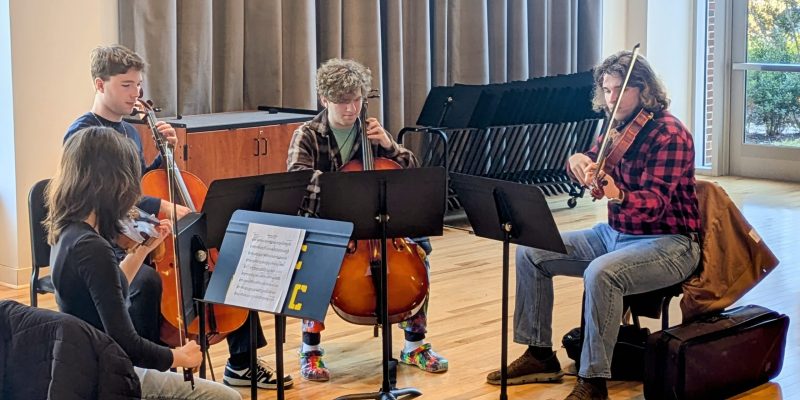
While some RMC students went out of the country and others gained career experience through an internship, if you passed by Larry S. Haun Rehearsal Hall during January term, you’d hear the music of Bach and Onslow coming to life.
With pages turning, bows flying, and strings playing, the sound might draw you to a time of baroque courts with lavish fashions, elaborate balls, and ornate chamber music.
Carrying on this classical tradition, RMC musicians are keeping chamber music alive in the Applied Chamber Strings course taught every J-Term.
For most non-musicians, the idea of a string ensemble may look grand with multiple players per section and an elevated conductor leading them through, but chamber groups look a bit different. They are much smaller ensembles with usually four to five players, known as quartets and quintets, but what truly sets them apart is the lack of a conductor.
“We’re following each other and it’s more reliant on other players,” said Elias Masten ‘28, who plays first cello. Each player is responsible for knowing their music, but also the music around them, learning how they all weave and interact with each other into one cohesive piece. “We have one person on each part. So, if that one person messes up, then you lose the significance of that part.”
“You have to play confidently, play out, and if you mess up, you just got to keep moving,” Hayden Beldon ‘28, second cello, pointed out.
When it comes to a small ensemble, the glue that keeps them together is communication.
“It’s just a matter of how we all mesh together,” said Masten.
When performing, the group can’t just yell out what’s next, so they must find non-verbal ways to cue each other. That means eye contact, smiling back, and moving their bodies towards one another.
“You need to know what’s happening and what parts to listen to,” Masten said. “It helps if you know what exactly is happening and you can bounce off of someone else.”
The majority of the players in this chamber course are not Music majors. Among them, they represent the departments of Biology, Business, Classics, and Chemistry. While their fields are varied, music is something that ties them all together.
“Music has always been a gateway to de-stress,” first violin Daniela Owens ‘28 said. “I always go back to it, and I’m always learning. I’ve learned so much from these guys.” Even though music might not be their primary focus, that most fundamental element of community through music calls to each of the players here. “I saw it as a social opportunity to meet new people,” Beldon said.
The music community at RMC may be relatively small, but it’s a community that wants to see musicians new and old come together to share, practice, and play together, to make music together.
“We all play an instrument, we all know the challenges and effort that goes into learning,” said Masten. “So, we all connect.”