At RMC, pre-med students are carefully guided by experienced faculty members to create an academic plan designed around your plans for medical school. Focused staff advising also begins early and helps connect you to opportunities to gain direct patient care, health-related, and community service experience. Later, faculty and staff work closely with you to preparing your medical school application.

Each academic journey is different, and you’re encouraged to pursue your interests outside of the physical sciences and take advantage of Randolph-Macon’s excellent humanities programs, which helps equip graduates with an even greater problem-solving skillset in their journey to becoming an empathetic and insightful physician. 

pathways to your medical career The Future is Bright

(And we’re looking straight toward it!)
RMC Premed student sitting on steps

medical school Admissions

RMC graduates have been admitted to top medical schools across the country including:

  • Virginia Commonwealth University School of Medicine
  • Macon & Joan Brock Virginia Health Sciences at Old Dominion University (ODU)
  • University of Maryland School of Medicine
  • University of Virginia School of Medicine
  • Edward Via College of Osteopathic Medicine (Virginia and South Carolina Campuses)
  • University of South Carolina Greenville School of Medicine
  • Drexel University School of Medicine
  • Arkansas College of Osteopathic Medicine 
  • Alabama College of Osteopathic Medicine
  • Medical University of South Carolina

medical school early admission agreements

Pre-med advising track students have the incredible opportunity to gain provisional acceptance to the following medical schools with which Randolph-Macon has early admission agreements including: 

  • The Virginia Commonwealth University (VCU) School of Medicine
  • The Macon & Joan Brock Virginia Health Sciences at Old Dominion University (ODU)

To be eligible to apply, pre-med advising track students

  • must perform exceptionally well academically throughout the first year and into the fall semester of sophomore year, with a cumulative GPA of 3.5 or above
  • must begin taking medical school prerequisite courses including biology, chemistry, organic chemistry and physics
  • engage in medical-related experience and/or community service experience 
  • take the MCAT admission test and achieve a minimum score
RMC Premed student talking with RMC Physician Assistant grad students

The Dr. Paul Wornom Pre-Medicine Fellowship 

The Dr. Paul Wornom Pre-Medicine Fellowship provides a full-tuition scholarship for up to two exceptionally talented incoming first year students who have demonstrated a commitment to complete pre-med coursework and go on to medical school. Wornom Fellows have the same opportunities available to all RMC students pursuing the pre-med advising track including access to a dedicated pre-med advisor, opportunities to engage in shadowing and internships, and guided research with faculty members that may result in a summer research experience and in many cases, presentations at a conference and even publication in a journal.

advising and mentorship

At RMC, all pre-med advising track students meet with the Pre-Medical Advisory Committee, a dedicated group of faculty advisors from the biology, chemistry, and physics departments, who provide helpful feedback and guidance on your preparation for medical school. Committee faculty members work closely with you to help you become a more competitive medical school applicant, and gain the skills and experience to help you ultimately become a better physician. During the application process, the committee provides valuable support by drafting and submitting a letter on your behalf to your preferred medical schools. 

Their support is augmented throughout your journey by a staff advisor from the Edge Career Center, whose expertise and focus is on health careers.

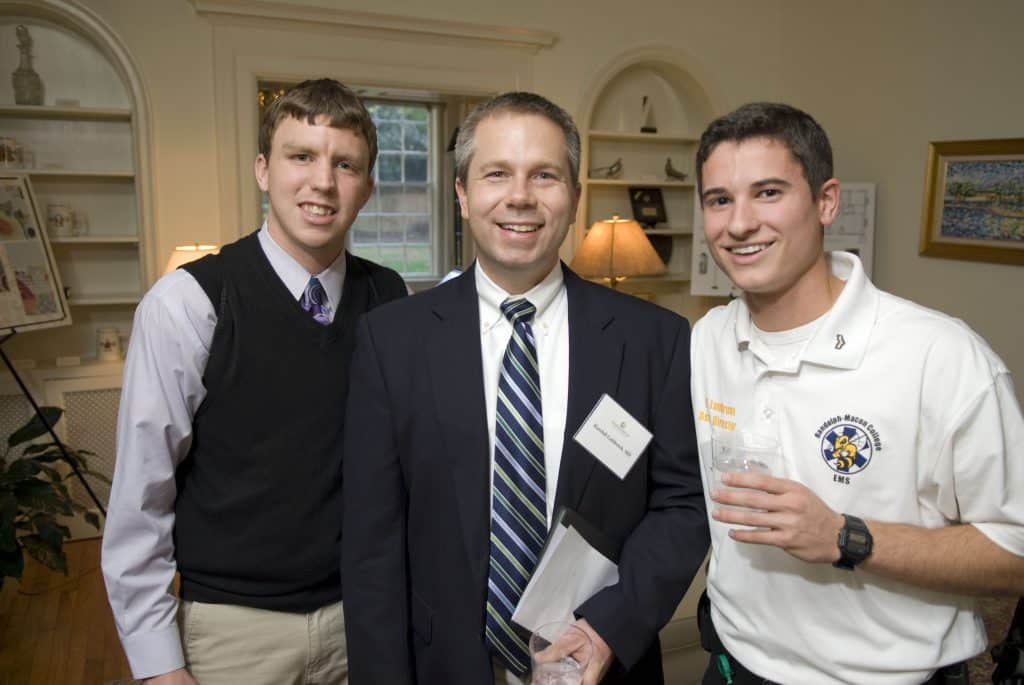
RMC Premed students with a doctor alum at a networking event
You’ll also find community in the Pre-Health Society, a group that brings together students and alums to learn more about medical career options, the application process for professional schools, and opportunities to gain medical experience. 
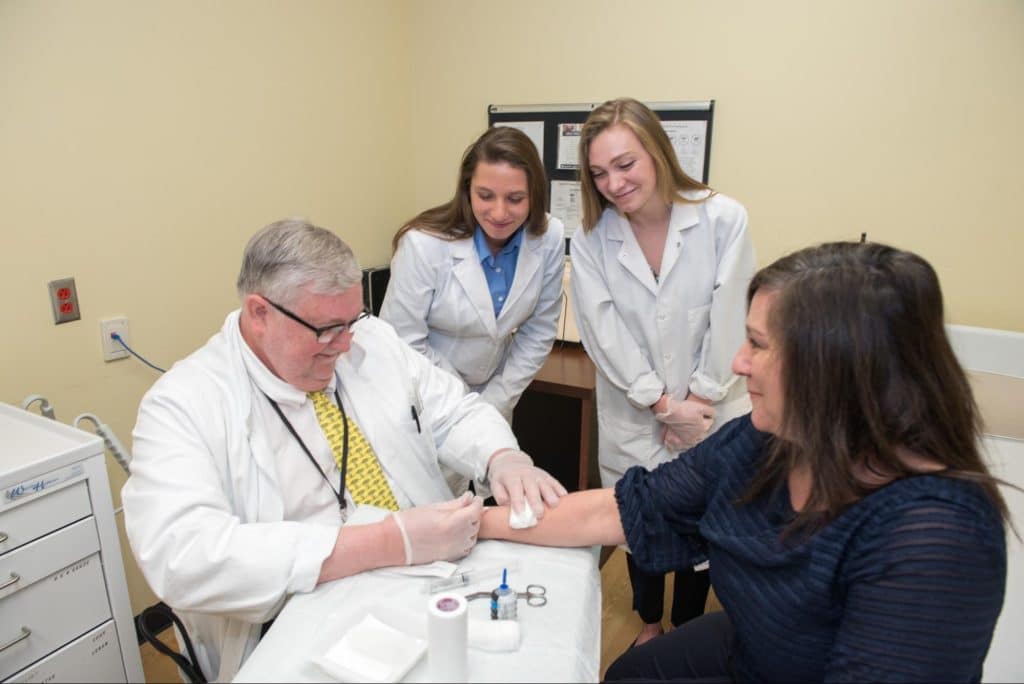
Pre-med students observe a medical procedure

High-Impact Internships

Pre-med students commonly participate in internships, like one with Bon Secours.  As a student intern, you will observe on a rotation in departments throughout the Bon Secours health system. This program provides an incredible opportunity for you to engage directly with healthcare providers, learn more about the healthcare delivery system, and how each member contributes to patient care. 

Students also get hands-on experience as volunteers at a local free clinic or as EMTs. RMC offers an Emergency Medical Technician (EMT) certification course (included in the cost of tuition) for interested students, which is great way to gain the direct patient care experience that is often a crucial component to prepare for medical school programs. 

Student conducting a lab procedure


courses to consider
Pre-med students choose a variety of majors

(And that’s okay!)

BIOL 121

FOUNDATIONS OF EXPERIMENTAL BIOLOGY

Develop the values, habits, and practices of a scientist. Learn how to make scientific observations and form hypotheses; plan and conduct experiments; display and interpret data; and communicate scientific results. Focus on major topics in biology such as organismal biology, evolution, and ecology. What are genes and how do they and their products work? Learn essential principles of biochemistry and molecular biology and study genetic diseases, gene therapy, cancer, and traits. 


Chem 261

ORGANIC CHEMISTRY

Learn the fundamental facts, theories and nomenclature of organic compounds and their reactions. Study topics including structural theory, stereochemistry and reaction mechanisms, as applied to basic physical, chemical and spectroscopic properties of aliphatic, alicyclic and aromatic hydrocarbons, mono-, di-, and polyfunctional compounds.

MATH 111

INTRODUCTION TO STATISTICS

Learn statistical inference and sufficient probability theory. Study elementary data analysis, elementary probability, discrete and continuous random variables, distributions, correlation and regression, sampling distributions, point and interval estimation, confidence levels, and tests of significance. 

From Here To What you can do as a Pre-Med student at RMC

Ruth Shoge ʻ02

Ruth Shoge ’02

Associate Clinical Professor/Director, Diversity, Equity, Inclusion, and Belonging
UC Berkeley School of Optometry

“What stays with me the most from my time at RMC are the lasting relationships I made, leadership training, and time management… I always worked at least one job as a student and the ability to be able to juggle multiple tasks (in both your professional and personal life) becomes more useful as a working adult. RMC provided the right conditions that allowed me to thrive – small campus, dedicated professors, and friends with common interests and goals.”

Jeremy Sauer MD ’97

Medical Director, Physician Assistant Program
Randolph-Macon College

Steve long MD ’82

President
Commonwealth Spine and Pain Specialists

KETHELYNE BEAUVAIS ’15

Family Physician

Rebecca Byrd Swan MD ’86

William Long Director in Pediatric Medical Education Professor of Pediatrics Vanderbilt University Medical Center

Buzzworthy News from pre-med

News Story categories: Career Preparation

Eight RMC Alumni Start Their Medical School Careers

In fall of 2020, eight Randolph-Macon College alumni entered medical school to begin their studies. “This is by far the…

News Story categories: Biology Career Preparation Chemistry

On her Way to Medical School: Ria Khandpur ’20

“As a pre-med student, seeing the inner workings of a hospital and shadowing doctors helped me understand what my future will…

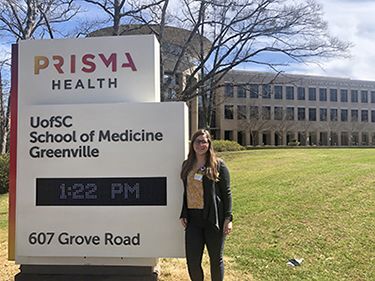
Ria Khandpur posing for a picture in front of a bon secours sign
News Story categories: Biology Career Preparation Chemistry

A Scholar-Athlete Standout: Abbie Winkelmann ’20

An athlete and scholar, Abbie Winkelmann ’20 knows the importance of collaborating with others. Winkelmann, a biology major and chemistry and religious…

Get Ready Discover Pre-Med at RMC.

Loading…

Frequently Asked Questions: Pre-med

How to get into medical school? What steps do I need to follow?
The road to becoming a physician or surgeon includes significant education and hands-on training that starts at the undergraduate (and sometimes even high school) level. For individuals wanting to apply to medical school, pursuing specialized coursework and extracurricular opportunities in the medical field will help to build a strong resume for the medical school admissions process. The Association of American Medical Colleges (AAMC) provides many great resources for students interested in applying to medical school, including this helpful Timeline for Application and Admission to Medical School, which outlines a plan beginning 4+ years before you start medical school. This includes:
  • Working with a pre-health advisor and building relationships with faculty and mentors
  • Taking the required coursework for pre-med students
  • Getting involved in campus activities for pre-med students
  • Seeking out work and volunteer opportunities in the health field
  • Leveraging the AAMC’s resources for aspiring medical school applicants
  • Studying for and taking the Medical College Admission Test, or MCAT Exam
  • Securing the necessary letters of evaluation and/or a committee letters
  • Completing and submitting the AMCAS application (or AACOMAS for DO schools) and any secondary applications
  • Take part in admissions interviews and campus visits
There are many resources at Randolph-Macon College to help pre-med students navigate the rigorous process of preparing and applying for medical school–especially our Pre-Medical Advisory Committee, which is made up of faculty advisors from RMC’s biology, chemistry and physics departments. Our Director of Health Careers, Josh Quinn, from RMC’s nationally-ranked Edge Career Center provides invaluable knowledge and career advice for students interested in the medical field. What’s more, our Pre-Health society provides great networking opportunities for current students and alumni.
Is pre-med a major?

No, pre-med is not a specific major that you’ll find at most colleges or universities. Instead, students are encouraged to pursue a major of their choice while also completing requisite coursework (generally a year of biology, a year of english, two years of chemistry, up through organic chemistry, and a year of physics) and other activities to prepare themselves for medical school.

At RMC, students interested in medical careers are encouraged to engage in a specialized advisory track to help them prepare them for medical school.

What is pre-med?

Broadly, “pre-med” describes the path that undergraduate students take as they pursue entrance into medical school. As described above, pre-med generally isn’t a specified major but rather a track that students can elect to pursue to access special advisory and networking resources at their college or university.

At Randolph-Macon College, pre-med students work with our dedicated Pre-Medical Advisory Committee to create a personalized academic plan, find opportunities for hands-on medical experiences (i.e., internships and volunteer work), and prepare their application for medical school. This specialized support ensures RMC pre-med students are well-positioned when they apply to medical school, and can even open the door for early acceptance into medical school.

What is the best pre-med major?

Contrary to popular belief, the American Association of Medical Colleges reports that there’s no “best” undergraduate major for students pursuing a medical degree. In fact, the AAMC and many medical school admissions representatives advise that whatever major a student feels best showcases their unique interests and strengths is the right pre-med major. Nearly 40% of students who take the MCAT report a major outside of the biological sciences, and selecting a specific major does not appear to increase a student’s chances at admission to medical school.

Many pre-med students prefer to pursue a math- or science-related major because many of the pre-requisite courses for medical school fall within these departments, and they feel a solid understanding of these topics will provide a stronger foundation to succeed on the MCAT and at medical school. Others prefer a humanities major to bolster their communication and critical-thinking skills. At the end of the day, major choice is a personal decision that should be discussed with your pre-med advisor.

What are the requirements for medical school?

Nearly all American medical schools require applicants to successfully complete a set list of pre-med coursework along with their undergraduate degree, as well as the MCAT Exam–in addition to the primary medical school application and school specific supplemental applications, of course. Medical school admissions officials are also often looking for further health-related activities on applicants’ resumes, such as school clubs, clinical experience, internships, and volunteer work. Some schools require letters of recommendation and (often virtual) admissions interviews as part of the application process, as well.

Because specific requirements vary from school to school, it’s best to proactively familiarize yourself with the application requirements of the medical schools in which you’re interested in applying. Pre-med students at Randolph-Macon College can rely on our Pre-Medical Advisory Committee to help them identify potential medical schools and ensure they’re meeting–and often exceeding–the expectations of admissions committees.

Do most students go to medical school right out of undergrad?

According to the AAMC, two-thirds of of matriculants into medical school reported that a year or more had passed since graduating from college.

There are multiple reasons for students to pursue a gap or bridge year after completing their undergraduate career. It could be that a student needs to improve GPA or MCAT score. Or that a student needs to engage in more direct patient care contact and community service. Whatever the reason, RMC and the Pre-Medical Advisory Committee will continue to work with RMC alumni until they reach their goals.