






The fast-paced global economy of the 21st century demands innovative, forward-thinking leaders. Economics majors and minors at RMC learn the essential skills for analyzing and understanding economic problems in a variety of contexts. Our comprehensive curriculum provides a solid foundation in macro and micro concepts and statistics, and develops important skills in analyzing, reporting and understanding economic data. You’ll graduate well-prepared to contribute to all business environments, and with an excellent foundation for future graduate studies in economics, business, public policy, and law.

Major/Minor Economics
Economics
up close In and Beyond the Classroom
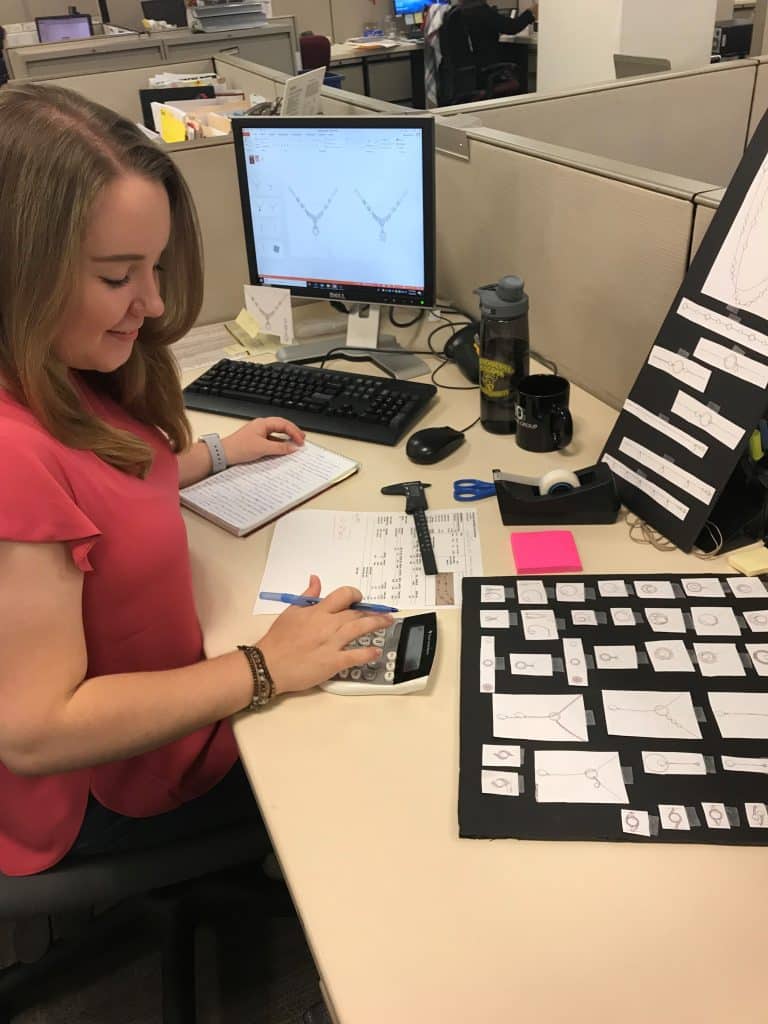
high-impact internships
Economics majors and minors gain critical business skills in internships at values-aligned businesses and organizations. This first-hand experience is not only beneficial for future employment and graduate studies, but also helps you expand your knowledge and apply classroom learning in a real-world setting. Recent RMC economics majors interned at:
- Northwestern Mutual
- Chmurra Economics
- Chain Bridge Bank
mentored research
As a Randolph-Macon economics major, you are also encouraged to expand your knowledge and pursue research areas of personal interest with the support of a faculty mentor in either semester-long research opportunities or through the Schapiro Undergraduate Research Fellowship (SURF) summer program. Examples of recent economics research projects include:
- Hannah Mercer ’19 – “The Neglected Gender Dimension of Brain Drain,” supervised by Dr. Steve Lang
- Tyler Dunn ’21 – “Competitive Balance in Pro Sports During the COVID Seasons,” supervised by Dr. Steve Lang
- Melissa Pritchard ’21 – SURF project, “The Quantitative Relationship between Maternal Education and Child Nutrition in Pakistan,” supervised by Dr. Melanie Fennell
- Luna Tran ’17 – SURF project, “The Acceptance of the Vulnerable: Explaining the Employment Situation and Poverty of People with Disabilities in Cambodia,” supervised by Dr. Melanie Fennell

global education
The interconnectedness of the global economy comes to life in travel courses, led by RMC professors abroad. In Britain in the International Economy (ECON 383), Randolph-Macon students explored economic theory from a British perspective while staying full-time at RMC’s partner institution in England, Wroxton College. Students studied international trade theory and finance focusing on the development of the European Union and the theory of optimal currency as it relates to the EURO.
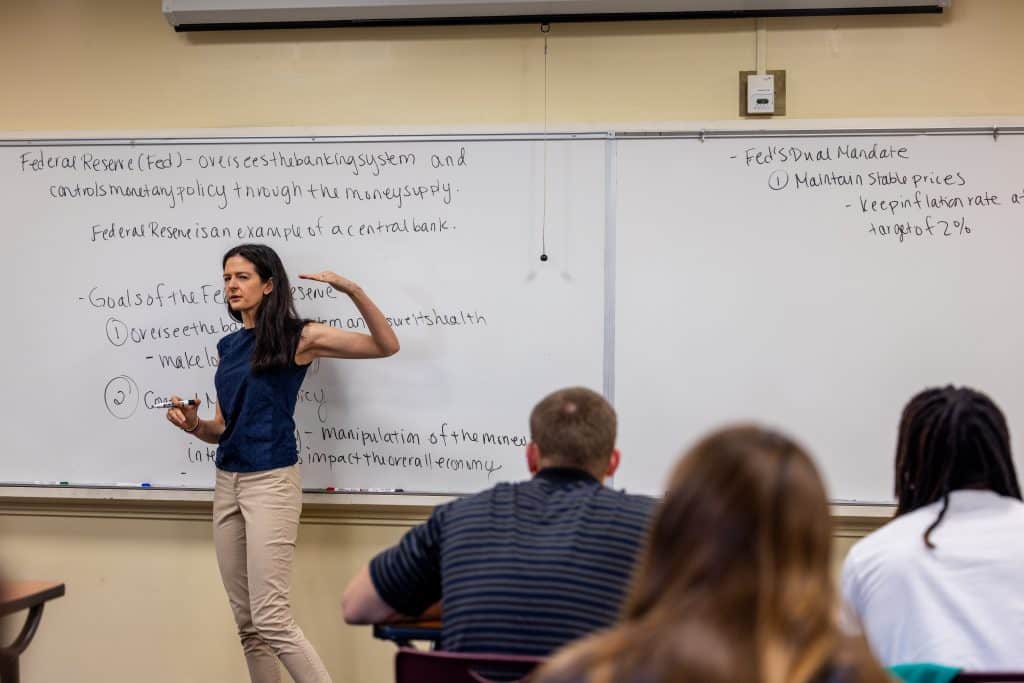
ADVISING AND MENTORSHIP
You’ll learn from experienced economists who are also mentors and know you by name to support you in pursuing your future career or graduate studies. Whether working through a thorny statistics question or presenting original research at an international conference, you’ll get up-close to RMC’s outstanding economics faculty.
-
40%of people in economics-related job positions have a bachelor’s degree in economics
-
28%of all economists work for the U.S. Federal government

Economics
in full Courses You Won’t Want to Miss
(A very small sample)
ECON 340
Urban Economics
Apply the analytical tools of microeconomics to model the spatial and economic organization of cities and metropolitan areas. The model is then used to study issues facing cities such as urban transportation, housing, poverty and segregation, and urban public finance.
ECON 374
International Economic Development
Through an economic lens, analyze problems and policies to improve economic development in less developed countries. Use economic theories and empirical evidence to compare and contrast different growth experiences, development levels, and economic development challenges across countries.
ECON 312
Econometrics
Complete a semester-long research project by applying statistical techniques to economics data. Analyze data sets and use regression analysis and hypothesis testing, including the Ordinary Least Squares technique.
Clubs and Other Opportunities
Popular activities and programs among economics majors

Omicron Delta Epsilon
International Honor Society in Economics
Phi Beta Lambda
Student professional organization
From Here To What you can do with an Economics degree from RMC.
Tyler Dunn ’21 MBA

Associate Wealth Management Advisor
PB Mares Wealth Management LLC
“Randolph-Macon gave me an opportunity to build my future, in my own way. My professors were accommodating and supportive of my responsibility as a student-athlete but pushed me to be great in both. Coach Hedrick, Dr. Lang, and Dr. Staples were a large reason for my success on the baseball field and in the classroom. Randolph-Macon provided me with the resources to have a great experience in both areas.”
Richard Gearhart ’07 Ph.D.
Associate Professor of Economics
California State University Bakersfield
Fidele Ntumba ’18
Private Equity Associate
ICV Partners
TRENT WALKER ’15
Senior Manager, Financial Accounting Advisory Service
Ernst & Young
Bridget Maas ’20
Associate Attorney
Willcox Savage
Hannah Mercer overby ’19
International Training Manager
Virginia Economic Development Partnership

Melissa Pritchard ’21
Senior Analyst
Virginia Economic Development Partnership
“During my time at RMC I completed a year-and-a-half long internship at an economic consulting firm in Richmond, as well as a SURF Project with Dr. Fennell. The professors at RMC were and continue to be great mentors, and my experiential and classroom learning gave me the skills I needed to be successful in a dynamic and fast-paced career in economic development. RMC is the best place to garner a diverse set of experiences and learning that sets up students for success in their careers.”
BuzzWorthy The latest from RMC Economics.
News Story categories: Economics, Business, and Accounting
Academics
Faculty
Q&A: The Economics of Sports
For much of his career, Dr. Steven Lang has applied both macro- and microeconomic principles to a subject popular among generations of students: sports.
News Story categories: Economics, Business, and Accounting
Academics
Alumni Stories
RMC Celebrates 2026 Class of 10 Under 10 Awardees
The 10 honorees, who all graduated in the last 10 years, have established themselves as pillars in their communities and leaders in their professions.
News Story categories: Economics, Business, and Accounting
Academics
Biology
RMC Welcomes 12 New Full-Time Faculty Members
Randolph-Macon College recruited and hired 12 talented tenure-track teacher-scholars to join the faculty at the start of the 2025-2026 academic year.
More to explore 55+ areas of study to discover at RMC



Get Ready Discover Economics at RMC.
Take the first step toward your Economics major or minor by contacting us.
Loading…
Frequently Asked Questions: Economics
What is economics?
Per the American Economics Association, economics can be defined in several ways: It’s the study of scarcity, the study of how people use resources and respond to incentives, or the study of decision-making. It often involves topics like wealth and finance, but it’s not all about money. Economics is a broad discipline that helps us understand historical trends, interpret today’s headlines, and make predictions about the coming years.
At Randolph-Macon College, the study of economics looks at economic problems in various contexts and introduces the many tools economists can use to better understand and solve these problems. RMC’s economics major requires 33 hours of coursework, including foundational courses on microeconomics, macroeconomics, and statistics, plus six additional elective courses from the economics, mathematics, and business departments.
Is economics a social science?
Yes, economics is considered a social science, along with subjects like psychology, sociology and anthropology, political science, and others. The Bureau of Labor Statistics reports that, as of 2022, approximately 28% of social sciences majors in the U.S. are economics majors.
What can you do with an economics degree?
As outlined below, there are many potential careers for economics majors. In addition, graduate school is an increasingly popular path for economics majors, whether they’re pursuing an MBA, a law degree, or a Master’s/PhD in economics (i.e. for those interested in research or teaching positions).
In an economist role, graduates can expect to perform research and data collection, analyzing their findings to study and forecast economic trends. Economists’ work is often used to guide businesses, governments, and individuals on fiscal policy or other economic matters, depending on the industry.
What jobs can you get with an economics degree?
Economics is a versatile science with principles that apply across a broad variety of industries and roles. While nearly half of economists work within various levels of government, the National Association for Business Economics (NABE) reports opportunities across academia, think tanks, consulting, financial and investment services, tech, media, non-profits, and more.
Per the career website Indeed.com, some of the most popular non-economist roles for economics majors include lawyers, finance professionals (including personal finance advisors, loan officers, portfolio managers, and financial analysts), business reporters, statisticians/actuaries, various types of analysts (i.e. credit, policy, supply chain, market, and quantitative), product managers, and compensation managers. Check out their 18 Top Economics Degree Jobs for more information about these opportunities, including average salaries and examples of hiring organizations for each.