


What is pi used for? The world’s favorite irrational number
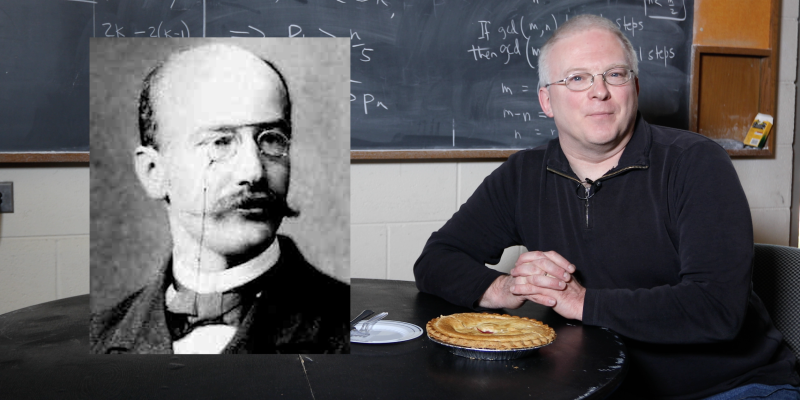
Every March 14, the world celebrates Pi Day. But what exactly is pi? Dr. Adrian Rice, The Dorothy and Muscoe Garnett Professor of Mathematics, answered all our questions about the lovable irrational number.
Pi is a real number, but more specifically, it’s what we call an irrational number. Now, what’s an irrational number? Well, to define an irrational number, I need to tell you what a rational number is. So a rational number is a number like 3/4 or 2/5 or 27/4, any number that can be represented as a fraction where you have a whole number over a whole number. Any number that cannot be represented like that as a fraction is an irrational number, and pi is the most famous irrational number there is. So, because the decimal expansion for pi goes on forever with no discernible pattern whatsoever, that’s one of the hallmarks of an irrational number, it was suspected for many years that pi was irrational. It wasn’t until 1761 that the Swiss mathematician Johann Lambert actually proved it was irrational, and it wasn’t until 1882 that the German mathematician Ferdinand Lindemann proved that pi was even higher than that, it was a transcendental number, which meant, in effect, that the ancient Greek problem of squaring the circle was actually impossible.
Well, we use the symbol π for pi because it was introduced by a Welsh mathematician called William Jones in a book he published in 1706. Now, the reason he used the symbol π to represent the ratio of the circumference to the diameter was because he called the circumference the periphery, and he used the Greek letter P to stand for periphery. And the Greek letter for P is π.
Gosh, where do I start? Obviously in math, anything involving geometry, involving areas, volumes of circular based shapes, trigonometry, calculus, anything like that. But because of those uses in math, it’s also incredibly useful in physics, engineering, astronomy. In physics, for example, you’ll find it in certain forms, like Einstein’s field equations, Maxwell’s equations, and Heisenberg’s uncertainty principle. And you’ll also find it in statistics as well, if you’ve ever seen the normal distribution, finding an area under a normal curve. Well, the formula for that, which involves calculus, also involves the number pi. So, pretty much everywhere in science and technology where you need to do those kind of calculations.
Pi Day is March 14 every year. That’s because, of course, we represent March by the number three. So 3/14, 3.14. It was first introduced on March 14, 1988 by Larry Shaw, a physicist in San Francisco, who started the very first Pi Day back then. But ever since then, it’s taken off with school teachers, educators, scientists in general, and of course, has been adopted by NASA. In fact, in 2009 the United States Congress officially declared March 14 to be national Pi Day.