


Two Art History Interns Forge Pathways to Museum Careers

Through internships in two of Richmond’s most respected museums, seniors Milly Mach ’26 and Allison Seiberling ’26 are each getting experience that will lay the groundwork for curatorial careers.
Mach, a triple-major studying Art History, Archaeology, and Sociology/Anthropology, has been interning at the Virginia Museum of Fine Arts (VMFA) since November 2025. Her responsibilities include registering data on objects in the collections and assisting with the ethical handling of Indigenous American artifacts. Her classmate Seiberling, an Art History major and Archaeology minor, recently completed an internship with the Valentine. Her primary project was creating a guided walking tour of Manchester, which is now available to the public.
Both women’s projects have clear and tangible deliverables for the museums and the public. What’s more, Professor of Art History Dr. Evie Terrono explains, it is a direct application of their learning and training in Art History courses at Randolph-Macon.
“In Art History, we emphasize visual and historical literacy. But we also practice research and writing intended not only for an academic audience, but also for general audiences,” explained Professor of Art History Dr. Evie Terrono, “These practices are part of ‘applied art history,’ focusing on the applications of art history beyond theory, including curating and public programming.”
Investigating Provenance
Milly Mach’s curatorial experience at the VMFA, a relative rarity for undergraduate students, came to fruition through VMFA Curatorial Assistant Katie Domurat ’11, one of several RMC Art History alumni working in the field and a former student of Dr. Terrono.
Mach has been cataloging objects in the museum’s collection—everything from Egyptian mummies to Renaissance painting to Fabergé eggs—in the museum’s database. Museums have been increasingly scrutinizing their collections to make sure that they can account for the provenance of all artworks and artifacts.
This process is particularly relevant for Native American objects. The federal Native American Graves Protection and Repatriation Act mandates that museums work with tribes to repatriate cultural items. With a lack of proper documentation for many of the artifacts, a proper analysis is crucial. “It’s really important to do your research and due diligence to make sure that when a tribe contests an object, that you know for sure this is the tribe’s object before you hand it back,” Mach explained.
The experience, including valuable interaction with the VMFA’s Indigenous American Art Curator, has been helpful for Mach. Her senior thesis in art history focuses on female Native American artists who through their artworks reinforce the spiritual connections to ancestral practices and interrogate the impact of colonization on the tribal displacement and deracination of Native Americans from their ancestral lands and customs.
“Being able to take the things that I’ve learned in the classroom and be able to do that here has been so amazing,” Mach reflected. “It’s been a really well-rounded experience. It’s not just centered in the curatorial, I’ve been able to look at all the different departments [of the VMFA] while I’m there.”
History on Hull Street
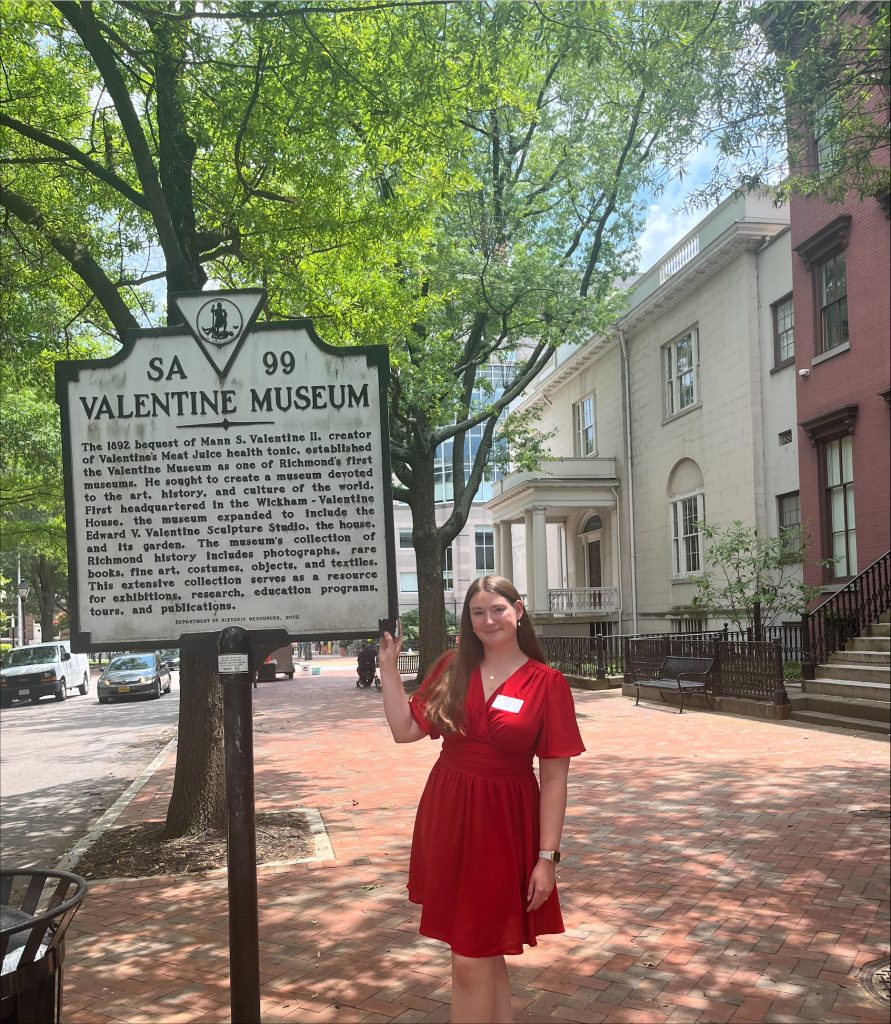
As Richmond’s history museum, the Valentine offers a variety of guided walking tours through Richmond’s iconic neighborhoods. For example, “Warehouse to High Rise” tours Scott’s Addition, while “Roots of Revolution” does the same for Shockoe Bottom. As Public Programs and Tours Intern in the summer of 2025, Allison Seiberling’s project was to research the history of Manchester, the Richmond neighborhood on the south bank of the James River, and write the content for a public tour.
“I was starting completely from scratch, but [Manchester] had a much richer history than I had anticipated,” Seiberling said.
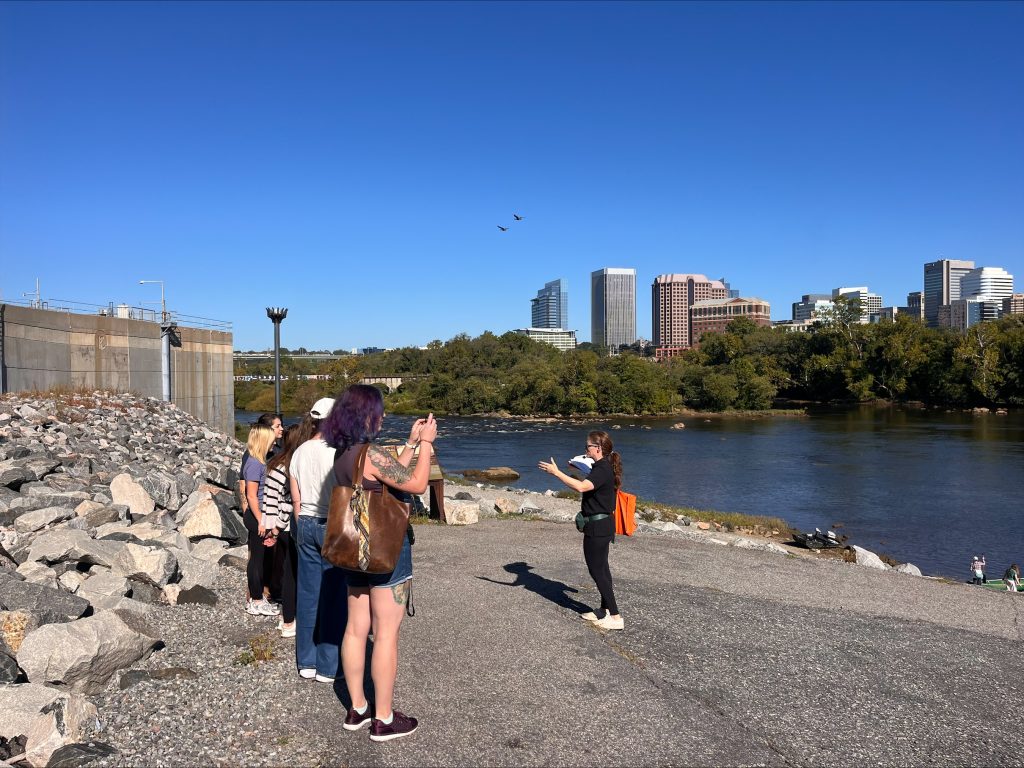
Seiberling narrowed her research to a list of potential stops and stories, poring over archival newspaper records and walking through potential routes. Ultimately, she created a sequential narrative that wove chronologically through several eras. Beginning with the Monacan Indian Nation that inhabited the land, the tour explores the port city’s role in the slave trade, its industrialization, the period of Reconstruction after the Civil War, the transition from an independent city to annexation into the City of Richmond, and its modern development and gentrification.
Undertaking research that uncovers hidden histories and results in public programming is important to Seiberling. She is currently writing her senior thesis in art history on the contributions of descendants of those enslaved on Virginia’s plantations to telling inclusive stories about American plantations, a topic that she began exploring during a Schapiro Undergraduate Research Fellowship (SURF).
“That’s something that art history trains you for: how to make arguments, find evidence to support them, and use critical thinking throughout that process,” Seiberling reflected. “I got the same kind of practice doing that this summer with this internship, but it was really fulfilling to have a final product that was for the public.”
The guided tour debuted during the fall, with large attendance numbers. With the Valentine’s peak tour season forthcoming, look for the 90-minute “History on Hull Street” on the museum’s events calendar this summer and fall.
Developing Their Resumes
Both seniors will be attending the College of William & Mary for graduate school; Mach in Anthropology and Seiberling in the American Studies program. Both students aim for careers in museums, using the skills gained through their art history scholarship to provide educational resources to the public.
“Art history is not only for art historians, and it’s not only for those few who are in the know,” Terrono said. “We [art historians] are debating matters of historical consequence that are relevant to the broader public.”