






Study Strategies: Tips to increase productivity
Procrastination can be a major obstacle to productivity, but with the right techniques, you can overcome it and get more done. These productivity tips will help you stay focused, manage your time effectively, and accomplish your goals.
Setting goals, getting organized and holding yourself accountable will help you tackle any task. If you are battling procrastination, try some of the tips below to help you crush the task at hand.
- Eisenhower Matrix: Define the urgency and importance of each task you have to help you be mindful of your priorities.
- Pareto Analysis: Use the 80/20 rule to maximize your output with minimum effort and input.
- Parkinson’s Law: Use the power of a deadline to complete tasks faster.
- Pomodoro Technique: Use a timer to break down work into intervals and take regular breaks to reduce the number of distractions.
- 2-Minute Rule. Crush procrastination and eliminate distraction by creating momentum in just 2 minutes.
1. The Eisenhower Matrix
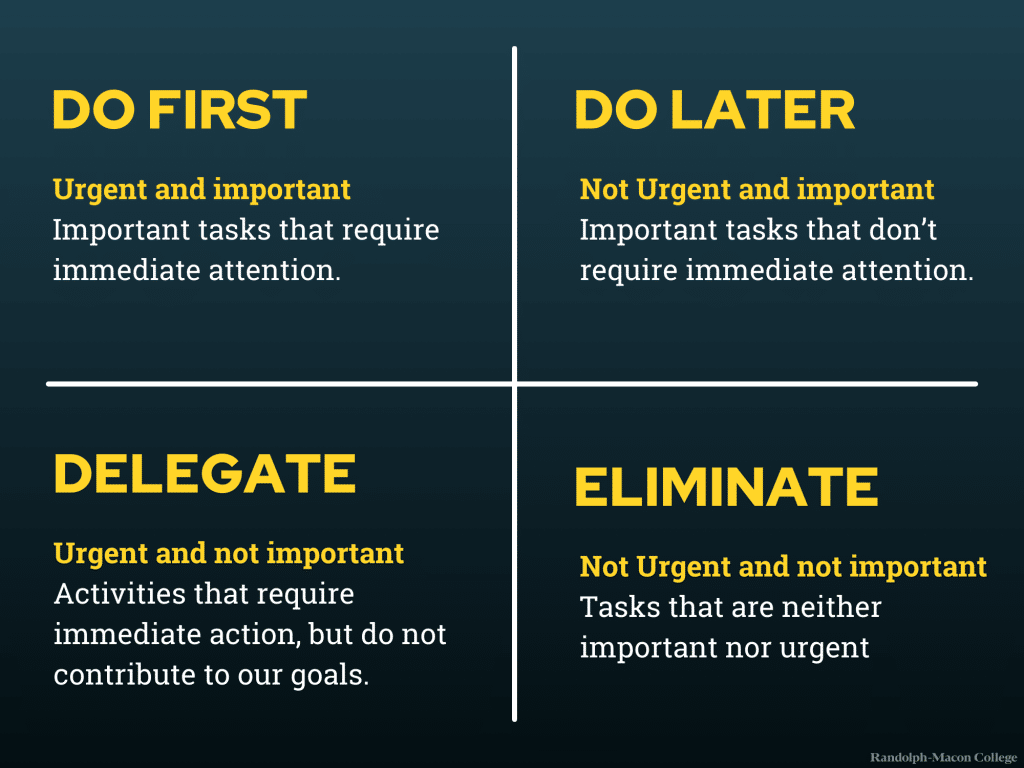
The Eisenhower Matrix, also known as the urgent-important matrix, is a method of prioritizing your tasks on the basis of their urgency.
The matrix categorizes tasks into four (4) quadrants:
- Urgent and important: things to do now.
- Urgent but not important: things to do now but you should try your best to delegate or eliminate this.
- Not urgent but important: things to focus on. When you do this, you will have less urgent tasks.
- Not urgent and not important: things to ignore or eliminate.
The Eisenhower Matrix not only helps you manage the time spent on each task, it also provides you with an extra layer of awareness and clarity for what you should and shouldn’t be doing.
2. Pareto Analysis
Vilfredo Pareto suggests that 20 percent of your routines lead to 80 percent of your outcomes, and 80 percent of failures are caused by 20 percent of bad habits.
To better manage your time, Pareto’s Principle is a helpful tool to analyze the impact your routines have and optimize them so they generate the best possible output. Here is the two-step process:
The 80/20 Principle shows how we can achieve much more with much less effort, time, and resources, simply by identifying and focusing our efforts on the 20 percent that really counts.
Create two lists. The first list is the 20 percent of your routines that produce 80 percent of your results. Then, create another list of the 20 percent of your routines that lead to 80 percent of your undesired results.
Focus on the first list and eliminate the second. Try to eliminate or minimize your destructive routines, and focus your time and energy on the top 20 percent of your habits that support your goals.

3. Parkinson’s Law
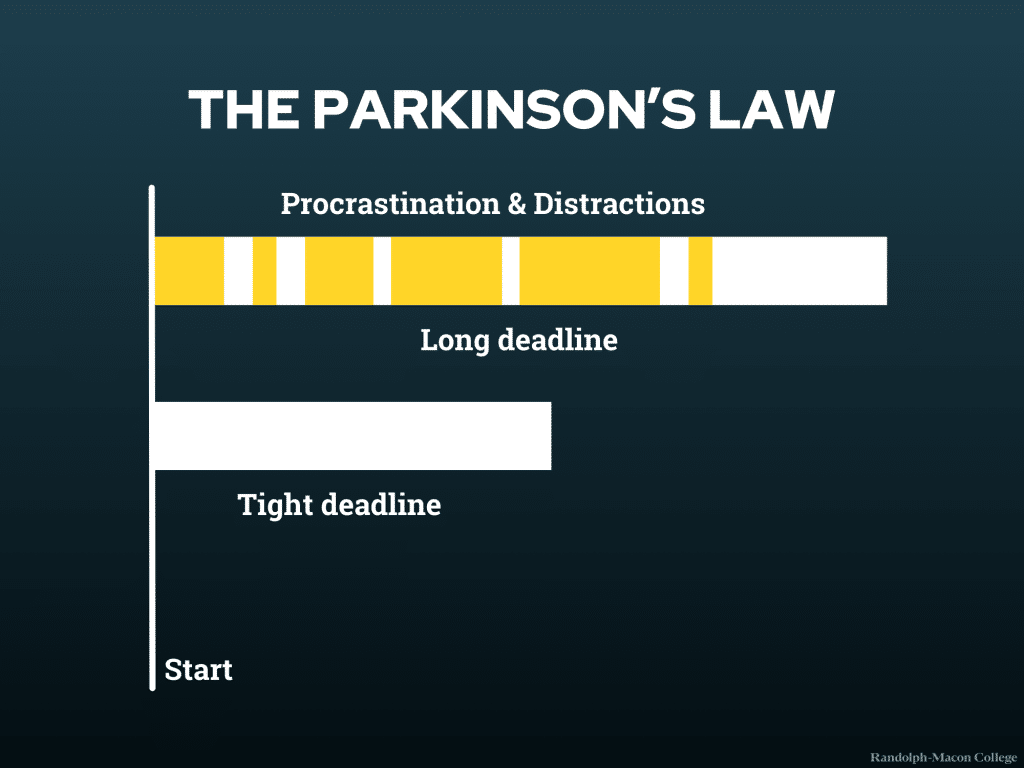
Cyril Northcote Parkinson observed that work expands to fill the time available for its completion. He called it the Parkinson’s Law.
Parkinson’s Law encourages you to give yourself time constraints on everything you do, even if it’s not needed. This self-imposed deadline acts as a cue to focus on your work rather than procrastinating. For example:
- If you have eight weeks to complete an assignment, try to force yourself to finish it in six weeks so you can begin working on it earlier and have more time to review.
- If you usually take two hours to complete your homework, try finishing it in an hour.
A self-imposed deadline not only forces you out of procrastination and into actually doing the work, but it also forces you to look at your task more efficiently. By having a shorter window to complete your work, you’re more likely to come up with a better system that makes you more efficient.
4. The Pomodoro Technique
The Pomodoro Technique uses a timer to break down work into intervals and taking regular breaks to reduce the number of distractions.
- Before working, decide on the task you want to get done.
- Every 25 minutes work with total focus and take a 5 minute break from the work. This is the first set.
- After the 5 minute break, get back to the task and give total focus for another 25 minutes.
- Repeat these sets until the task is complete.
- After three to four sets, you can take a longer break of 15 to 25 minutes and repeat the routine again.
Taking regular breaks in between intervals of work help to reset and refocus on the task rather than give in to distractions. This method is most effective when using a timer to track your time and writing down your sets on paper.

5. The 2-Minute Rule
Attempting to force yourself to do a task you don’t want to do can add stress and resistance that can lead to procrastination. The next time you feel resistance to a certain task, try implementing the 2- Minute Rule.
The 2-Minute Rule works on these three (3) simple algorithms:
- When something takes less than two minutes to complete, do it immediately.
- When something takes more than two minutes to complete, start on the first two minutes of the task and focus only on that.
- When you get distracted, stop and spend two minutes to think before you give in to distractions.
To make ourselves start something, we need momentum that is bigger than our resistance to the task.
The 2-minute rule lowers the resistance because rather than thinking about the task at hand, you’re focusing only on the first 2 minutes of the task. Once the first two minutes is completed, the momentum will carry you forward to finish the entire task.