



Q&A: The Biology of Cancer
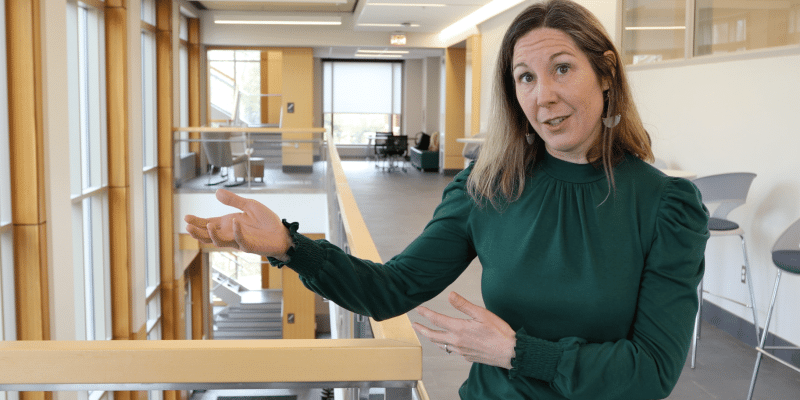
A discussion with Dr. Melanie Gubbels Bupp on the science of cancer, therapy, and cures
A deeply personal search for a cure for a friend with cancer first led Dr. Melanie Gubbels Bupp to explore some of the cutting-edge immunotherapy work being done in cancer research. It led to her 300-level course, Cancer Biology, which she taught in Spring 2024. We sat down for a crash course.
Q: Your course “Cancer Biology” tackles a topic that, unfortunately, touches so many humans worldwide. How or why did you come to choose it?
A: Cancer has almost certainly touched our students in one way or another, so there’s a personal motivation for students to understand it. But also, my training is as an immunologist, and one of the most exciting horizons in the field of immunology is cancer immunotherapy. Because it’s such a big new frontier, I really wanted them to be aware of that field so that they can pursue those career pathways, if they’re so interested. That practical piece plus the personal piece really makes it an important course for our students.
Q: Tell us about what they learn.
A: The biology course is broken up into three modules. The first one is an introduction to cancer — What causes cancer? What is cancer? And how does it work at a sort of basic level? Then, we really narrow in on the genetic causes of cancer. It turns out that all important cancer mutations fall into 10 different pathways or categories. Finally, in the third module, which is my favorite, we talk about cancer treatment – both traditional cancer treatments and these new immunotherapies that really rely on an understanding and usage of the immune system to treat and even cure cancer.
Q: You say your first few lessons – on the topic of cancer risk – delve into some areas that are really interdisciplinary. Why is cancer risk so complicated?
A: It’s important to me that my students understand that an understanding of biology alone can’t prevent or cure cancer. This understanding opens the door to many different disciplines and lenses on the environmental component of cancer risk. Genetic and environmental factors both influence cancer risk. Environmental causes primarily involve social determinants of health, such as the accumulation of generational wealth, which are largely shaped by historic events and government policies.
Q: Though not exclusively so, of course, why is it that cancer diagnoses are more common later in life?
A: In order for cancer to develop, one single cell has to have at least 10 mutations in 10 different core pathways. The body has checks and balances that prevent cells from becoming cancerous in our daily course of living, so it’s statistically unlikely that a cell will have that sweet spot of 10 mutations all at once in one cell. The longer you give it, the more likely it is that mutations stack up. Therefore, more people develop cancer as they age.
Q: How do the various types of treatments work, biologically speaking?
A: Traditional cancer treatments are surgery, chemotherapy, and radiation. Obviously, surgery removes the tumor to the best of our ability. Radiation and chemotherapy, by and large, work to damage the DNA of the tumor cell to such a great extent that the tumor cell must undergo cell death or apoptosis. The problem with these common treatments is that any dividing cell is sensitive to them, which is why the side effects of our traditional cancer treatments are so terrible. I focus a lot of my teaching on a whole range of immunotherapies that we can use to treat and cure cancer. What’s exciting about those is they take advantage of how specific our immune system can be at targeting a dangerous cell. This means the potential side effects of immunotherapies are considerably less. They work by helping our immune system to develop memory for the cancer. If you can get the immune system involved, it’ll target that tumor the first time, and if there’s remnant tumor cells somewhere else in the body that pop up again later (which is a relapse), the immune system will be ready and quash that.
Q: This is an upper-level biology course. How will your students carry this information into their futures?
A: Most of us are going to have a loved one develop cancer at some point, or perhaps even do so ourselves. Knowing what’s possible might help them work with their clinicians to find the best treatment for themselves or for their loved ones. But for my students especially, many of whom want to be in health care, I know they’ll use this knowledge with their patients; it may be that it strengthens their empathy for patients undergoing therapies that have a lot of negative side effects or makes them aware of new treatments on the horizon that they can share. I also think that many of them might actually consider a career in researching immunotherapies. Some of them have already demonstrated interest, which I think is really exciting.