

SURF Kicks Off Summer Undergraduate Research
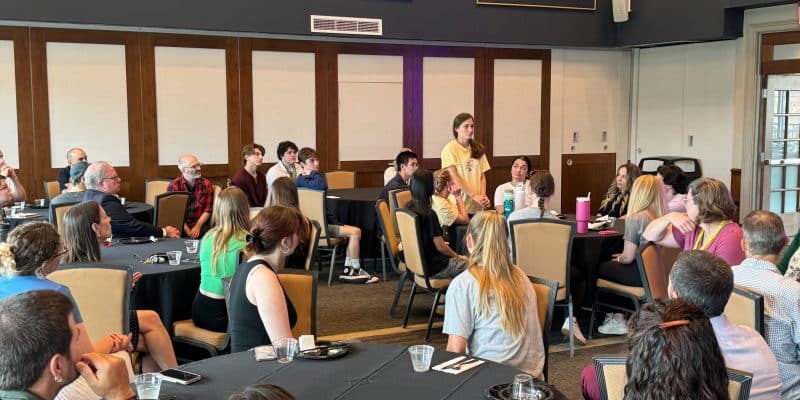
The 2024 season of Schapiro Undergraduate Research Fellowship (SURF), Randolph-Macon’s signature summer research program, officially launched on Monday, June 3.
Under the guidance of faculty mentors, 27 student participants will conduct original research during the nine weeks of SURF, in addition to other learning and social events as a campus cohort. Eighteen students are funded through SURF, while nine also received funding from other sources, including the National Science Foundation and the Klein-Maloney Fellowship for Women in the Sciences.
This summer’s research projects span a broad range of subject areas including chemistry, computer science, history, and communications studies. Students will explore pancreatic cancer treatments, the environmental impacts of the removal of Ashland Mill Dam, and the works of Latin poet Tibullus.
RMC student researchers in Dr. John Thoburn’s chemistry lab will also be joined by two rising seniors at Hermitage High School and Dr. Nabila Haddadine, a chemistry teacher at Richmond Community High School. The collaboration aims to get young scholars interested in careers in research and chemistry, and to provide research experience for high school teachers to bring back to their classrooms.
Below is an additional sample of SURF 2024 projects:
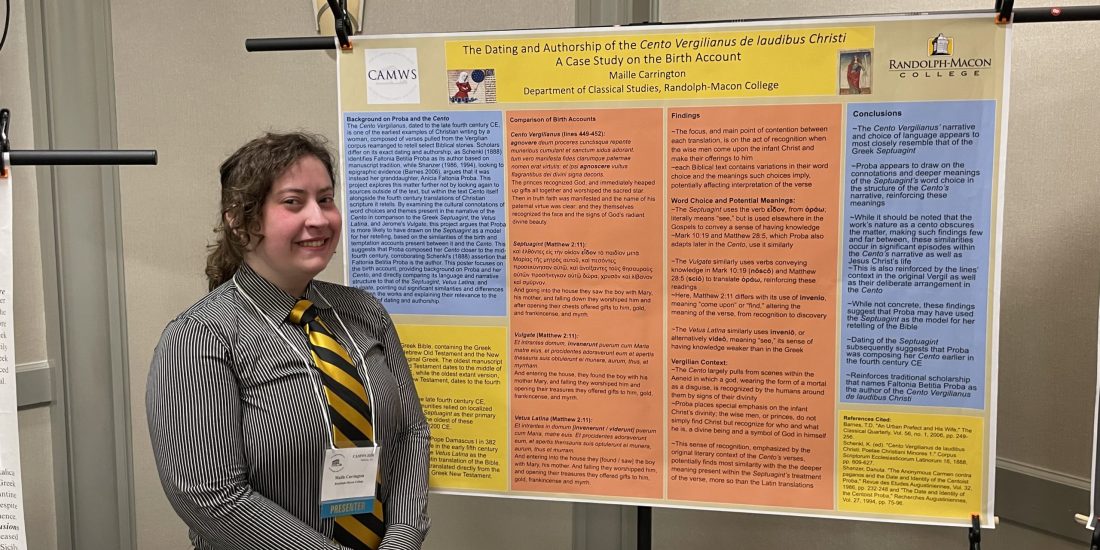
- Taylor Bennett ‘25, Professor Natoli (Classics) “Sound Plat and Authorial tyle in Tibullus Book 3”
- Sydney Blanks ’25, Professor Conners (Communication Studies), “What Do Gendered Advertisements Look Like Today? A Content Analysis on Advertisements Within Women’s Magazines”
- Caroline Campbell ‘25. Professor Gerecke (Psychology and Behavioral Neuroscience), “Does a trkB agonist rescue the neurotoxic effects of maternal deprivation, a form of early life stress? An examination of memory functionality through visualizing the expression of CaMKII following a trkB agonist treatment after long-term maternal deprivation in C57/BI6J mice.”
- Allison Carey ‘25, Professor Foster (Biology), “Is the ACRV1 Protein a Component of the Sperm Acrosomal Matrix?”
- Kathleen Connor ’27, Professor Thoburn (Chemistry), “Using oligo-ethylene glycol to solubilize large supramolecular complexes”
- Matteo DeLuca ’26, Professor Thoburn (Chemistry), “Synthesis of dicyanoazulene, a guest capable of probing the interior structure of metal-organic supramolecular complexes”
- Shane Hale ’27, Professor Taylor-Cornejo (Biology), “Determining the RNA Splicing Capability of the IRE1 Stress Sensor of the Model Amoeba Dictyostelium discoideum”
- Isaac Kwong ’27, Professor Thoburn (Chemistry), “Synthesis of a crown-ether based supramolecular host with a positively charged interior”
- Jacob Langley ‘25, Professor Gowan (Environmental Studies), “A proposal for pre-project monitoring related to removal of Ashland Mill Dam”
- Emily Matthews ’26, Professor Bergmann (History), “Caesar had his Brutus, Charles the First His Cromwell, George the Third. The Political Memory of the English Civil Wars and the Interregnum in Revolutionary Virginia”
- Teaghan McNeill ’27, Professor Thoburn (Chemistry), “Synthesis of ‘sulflower’, an electron-rich guest for encapsulation in supramolecular hosts”
- Isabella McNulty ‘25, Professor Schreiner (Chemistry), “Synthesis, characterization, and anticancer activity of novel ruthenium (II) piano-stool complexes”
- Hanna Nash ‘26, Professor Elouni (Computer Science), “Robotics in Retail”
- Owen Partain ‘26, Professor Michelsen (Chemistry), “The Reactions of Acetic and Formic Acid with Calcium in Aqueous Droplets with Freezing”
- Yaniv Regev ‘25, Professor Thomas (Philosophy), “Where Conservatism Went Wrong: A philosophical analysis of the evolution of conservative thought”
- Riley Russ ‘25, Professor Gerecke (Psychology and Behavioral Neuroscience), “Acute effects of maternal deprivation on inflammatory microglial expression in male and female juvenile mice”
- Siri Sandford ’26, Professor Riener (Psychology), “Boredom Enjoyment and Daydreaming Frequency on Task Engagement”
- Allison Seiberling ’26, Professor Terrono (Art History), “More than Property or Politics: Diversity and Authenticity in Heritage Tourism at Plantation Sites in Virginia”
- Kelena Snipes ‘26, Professor Taylor-Cornejo (Biology), “Investigating the function of IRE1 in regulating the unfolded protein response from the model amoeba, Dictyostelium discoideum”
- A.C. Tetterton ‘26, Professor Foster (Biology), “Migration of GPR56 During Sperm Capacitation to Prepare Sperm for Fertilization”
- Dillon Van Gilder ‘25, Professor Necaise (Computer Science), “Connected but Not Secure: Development of IoT devices for an Open-Source Network Protocol”
- Bailey Wargo ’25, Professor Thoburn (Chemistry), “Kinetic isotope effects on nitrogen inversion: calculating the effect of quantum mechanical tunneling on rates of reactions”
SURF was introduced in 1995 and has been supported through a generous endowment by Ben Schapiro ’64 and his wife, Peggy Schapiro and other donors. In the following 29 years, around 875 students have participated in this transformative experience. The fellowship provides students with a stipend and housing on campus during the summer. Led by co-directors, Art History Professor Evie Terrono and Serge Schreiner, The Dudley P. & Patricia C. Jackson Professor of Chemistry, SURF is often cited by graduates as a most significant academic and professional development opportunity in their undergraduate studies.
The program will conclude in early August with a SURF symposium, where students share their findings in oral and poster presentations. SURF projects will be highlighted on rmc.edu throughout the summer months.