

Summer Online: A New Asynchronous Approach Yields Record Enrollment
Summer courses at Randolph-Macon College had a far different look and feel in 2025, with 18 courses offered completely online and asynchronous. The approach was born from one of the College’s strategic planning initiatives, which endorsed a deeper exploration of online teaching. With more flexibility for students, and an opportunity for faculty members to develop professionally and improve their online pedagogy, the new approach had benefits for all stakeholders. And the results were clear: RMC saw record summer term enrollment for its June and July course offerings.
Certainly, the new summer course format meets a demand from the student perspective. In contrast with previous years’ in-person summer courses, students don’t have to live on campus or nearby to take a class. The asynchronous nature of the courses also means that students can have a summer job or internship while having the flexibility to complete the course on their own time and schedule.
But it was the effort to use summer courses to help faculty improve their online teaching skills that made this shift both unique and strategic. Faculty members wishing to offer a summer course each took a training course from Quality Matters, an industry leader in online learning. After developing their course plan, each was vetted by a faculty peer reviewer, who offered feedback on how to improve and implement the class in the online and asynchronous format. While many RMC faculty members had experience with online teaching due to the pandemic, the process in place for this summer allowed for improved course design. Professor of Classics Bart Natoli, Assistant Professor of Criminology Brittany Freelin, and Professor of Chemistry Nora Green led the peer review process.
“We wanted to make sure that we were delivering high-quality online, asynchronous courses,” said Provost Alisa Rosenthal. “In general, our faculty are excellent teachers, and want to be excellent teachers, but also we want to make sure they have the tools in place to do that.”
The range of courses offered this summer was broad and diverse, which the Provost also believes helped the summer term succeed. In developing the summer schedule, her team was careful to ensure a wide variety of curriculum pillar requirements were available. Biological Diversity (BIOL 151), Elementary Latin (LATN 111), Understanding Music (MUSC 101), and Child and Adolescent Psychopathology (PSYC 353) is just a small sampling of classes taken by RMC students.
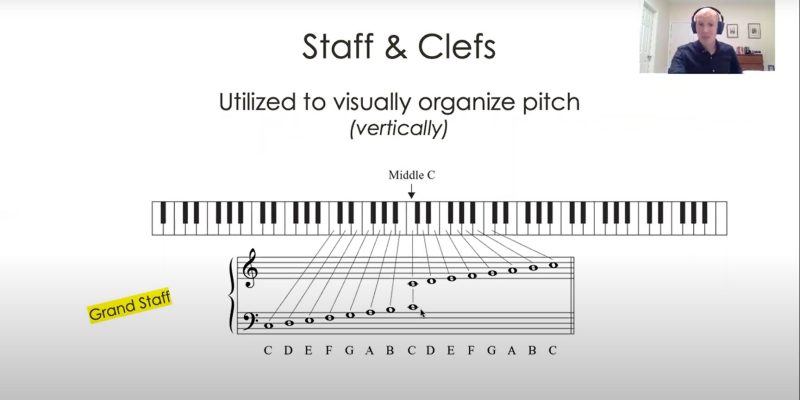
Associate Professor of Music Brian Coffill certainly experienced the difference between the pandemic approach and the summer term. He remembers how his band and orchestra classes struggled through the lag of internet connections and other issues. But Coffill has been dedicated to optimizing the online experience for Understanding Music, the discipline’s introductory course, even though music classes don’t typically lend themselves well to online education.
“We’re lucky that we were already utilizing a few online resources teaching it live in person, so that made a big difference for me,” Coffill said. A typical unit of his online course, guided through Canvas, included readings from the open source musictheory.net, a recorded PowerPoint presentation from Coffill, then screenshots and recordings of piano playing and singing to further explain concepts.
“This is an interesting subject to teach because you can’t really ‘AI your way through it.’ I treat it as an open book sort of thing,” Coffill explained. “I say to the students at the beginning: this is challenging. I want you to have your notes open, because your notes aren’t going to give you the answer. You have to figure it out.”
In addition to being a peer reviewer, Natoli also taught a pair of Latin courses this summer. He found that building out the asynchronous courses before the term began allowed for more personalized interactions with students as they progressed through assignments.
“Pretty much the entirety of my time in these classes is giving individualized feedback,” Natoli said. “I can see the growth happening for students from the beginning to the end because of the constant feedback that they’re getting.”
The crux of the Randolph-Macon experience remains the close student-faculty relationship in and outside the classroom, but the expansion into online courses during the summer has allowed for more students to access those connections, like those felt in Natoli’s Latin courses. And as opposed to taking a course at a community college, RMC summer courses count beyond just credit, they still impact a student’s transcript and GPA.
The shift is also a credit to the Randolph-Macon faculty, who put in the work to adapt their teaching to a new format.
“We’re having the same level of expectations as we have for effective teaching during the year,” said Provost Rosenthal. “And we’re providing the development and support for you to teach in this modality.”