

Summer of Undergraduate Research Culminates in SURF Symposium
Randolph-Macon College held its 26th annual Schapiro Undergraduate Research Fellowship (SURF) Symposium on Aug. 2, 2024. SURF provides RMC’s undergraduate students with the unique opportunity to conduct intensive professional research for a summer, under the close mentorship of faculty. The SURF Symposium gives students a platform to formally share findings from their research in oral and poster presentations.
The SURF program was founded in 1995 to encompass all disciplines, and has been supported through a generous endowment by Ben Schapiro ’64 and his wife Peggy, as well as other donors. The fellowship provides students with a stipend and housing on campus during the summer.
Susan Parker, Associate Provost and Dean of Academic Affairs, addressed the gathered crowd of students, faculty, staff, family, and friends, noting that SURF is a defining experience of Randolph-Macon College.

“SURF is a space where curiosity meets critical thinking and our students and faculty are encouraged to delve deeply into their passions,” Parker said. “From natural sciences to the humanities, from the social sciences to the arts, the work of our students reflects the diversity of thought and the depth of inquiry that drives intellectual progress.”
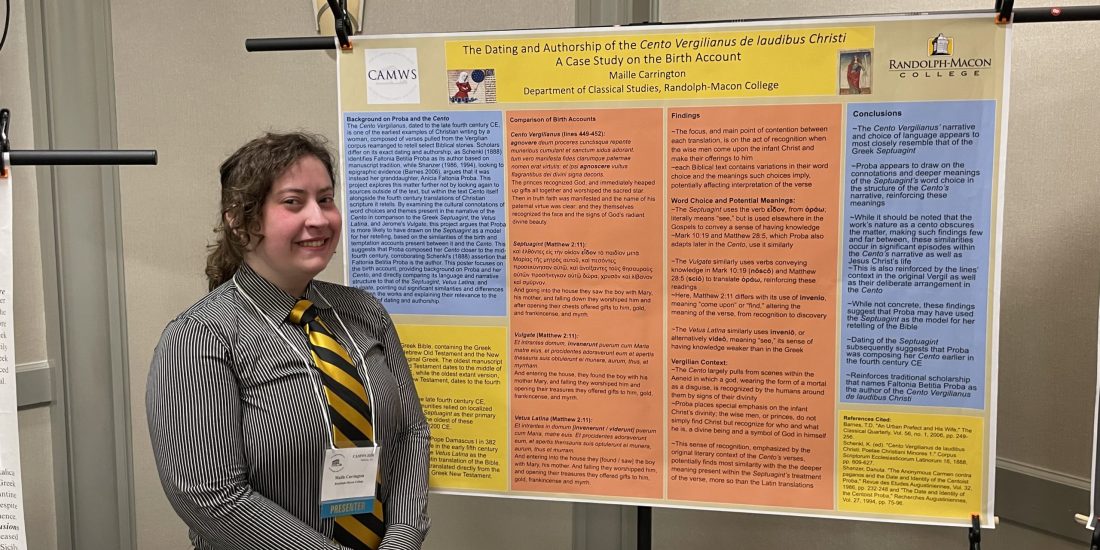
Friday’s presentations reflected that diversity of thought, with students sharing their work from a wide range of subjects, including how removal of the Ashland Mill Dam would affect fish in the South Anna River, an analysis of the content relating to gender in women’s magazine advertisements, and an attempt to determine authorship of ancient Latin poems.
See below for a full list of the 2024 SURF presentations:
- Exercise Rescues Females from Long Lasting Toxic Effects of Early Life Stress. Emily Aigner ’26 and Dr. Kim Gerecke, Department of Psychology and Behavioral Neuroscience.
- Sound Play and Authorial Style in Tibullus Book 3. Taylor Bennett ’25 and Dr. Bartolo Natoli, Department of Classics.
- Construction of a Bioinformatic Pipeline to Identify the mRNA Substrates of an Ancient Misfolded Protein Sensor in Dictyostelium Discoideum. Connor Bingham ’26 and Dr. Elias Cornejo-Taylor, Department of Biology.
- What Do Gendered Advertisements Look Like Today? A Content Analysis of Women’s Magazine Advertisements. Sydney Blanks ’25 and Dr. Joan Connors, Department of Communication Studies.
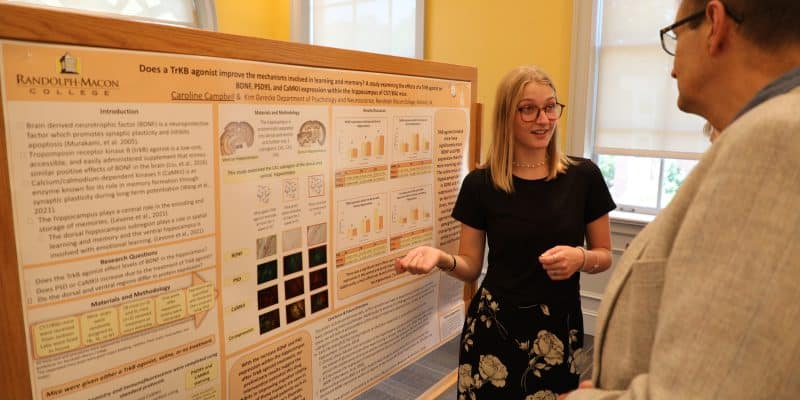
- Can a TrkB Agonist be Used as a Pharmacological Intervention in Aiding the Molecular Mechanism Involved in Learning and Memory? Caroline Campbell ’25 and Dr. Kim Gerecke, Department of Psychology and Behavioral Neuroscience.
- Acrosomal Vesicle Protein 1 (ACRV1) is a Component of the Mouse Sperm Acrosomal Matrix. Allison Carey ’25 and Dr. Jim Foster, Department of Biology.
- Determining the RNA Degradation Capability of the IRE1 Ortholog from Dictyostelium Discoideum Using a Bacterial Growth Assay. Jenika Carter ’26 and Dr. Elias Cornejo-Taylor, Department of Biology.
- Building Supramolecular Cages with Polyethylene Glycol Chains to Improve Cage Solubility. Kathleen Connor ’27 and Dr. John Thoburn, Department of Chemistry.
- Improved Synthesis of Dicyanoazulene for Use as a Probe of the Interior of Supramolecular Cages. Matteo DeLuca ’26 and Dr. John Thoburn, Department of Chemistry.
- Protein Expression Optimization to Purify Dictyostelium Discoideum Inositiol Requiring Enzyme 1 (IRE1). Shane Hale ’27 and Dr. Elias Cornejo-Taylor, Department of Biology.
- A New Synthetic Approach to Crown Ether-Based Cages. Isaac Kwong ’27, Duncan Helms, and Dr. John Thoburn, Department of Chemistry.
- Will Removing Ashland Mill Dam Save Fish and Turn a Profit? Jacob Langley ’25 and Dr. Charles Gowan, Environmental Studies Program.
- “Caesar had his Brutus, Charles the First His Cromwell, George the Third…”: Employing the Memory of the English Civil War Era in Virginian Revolutionary Print. Emily Matthews ’26 and Dr. Mathias Bergmann, Department of History.
- Synthesis of “Sulflower” as a Guest for Supramolecular Cages. Teaghan McNeil ’27 and Dr. John Thoburn, Department of Chemistry.
- Ruthenium(II) Anticancer Agents: Synthesis, Structure, and DNA Binding Studies. Isabella McNulty ’25 and Dr. Serge Schreiner, Department of Chemistry.
- The Future of Retail: Robotics in Retail. Hanna Nash ’26 and Dr. Maha Elouni, Department of Computer Science.
- Coordination Chemistry of Platinum-Phosphinoferrocene Complexes. Sarah Newman ’26 and Dr. Serge Schreiner, Department of Chemistry.
- An Investigation of the Aging of Aqueous Aerosols with Organic Acids and Calcium Chloride. Owen Partain ’26 and Dr. Rebecca Michelsen, Department of Chemistry.
- Where Conservatism Went Wrong: A Philosophical Analysis of the Evolution of Conservative Thought. Yaniv Regev ’25 and Prof. Robert Thomas, Department of Philosophy.
- The Development of Zerovalent Platinum Complexes as Potential Catalysts for the Hydrosilylation Reaction and Their Reactivity with Silanes and Alkenes. Kelly Rogers ’25 and Dr. Serge Schreiner, Department of Chemistry.
- Acute Effects of Maternal Deprivation on Inflammatory Microglial Expression in Female Juvenile Mice. Riley Russ ’25 and Dr. Kim Gerecke, Department of Psychology and Behavioral Neuroscience.
- Does Cell Phone Temptation Effect Experiences of Boredom, Mind Wandering, and Creativity? Siri Sandford ’25 and Dr. Cedar Riener, Department of Psychology and Behavioral Neuroscience.
- New Narratives from the Old South: Developments in the Interpretation of Enslavement at Virginia’s Plantation Museums. Allison Seiberling ’26 and Dr. Evie Terrono, Department of Arts.
- Interrogating the RNA Splicing Mechanism of the IRE1 Unfolded Protein Sensor of Dictyostelium Discoideum. Kelena Snipes ’26 and Dr. Elias Cornejo-Taylor, Department of Biology.
- Lurking Beneath the Surface: GPR56 in the Sperm Acrosome. AC Tetterton ’26 and Dr. Jim Foster, Department of Biology.
- Connected but not Secure: Development of IoT Devices for an Open-Source Network Protocol. Dillon VanGilder ’25 and Dr. Rance Necaise, Department of Computer Science.
- Quantum Tunneling Effects on Nitrogen-Inversion in Aziridine. Bailey Wargo ’25 and Dr. John Thoburn, Department of Chemistry.