

RMC Alumnus Completes Blue Origin Space Flight
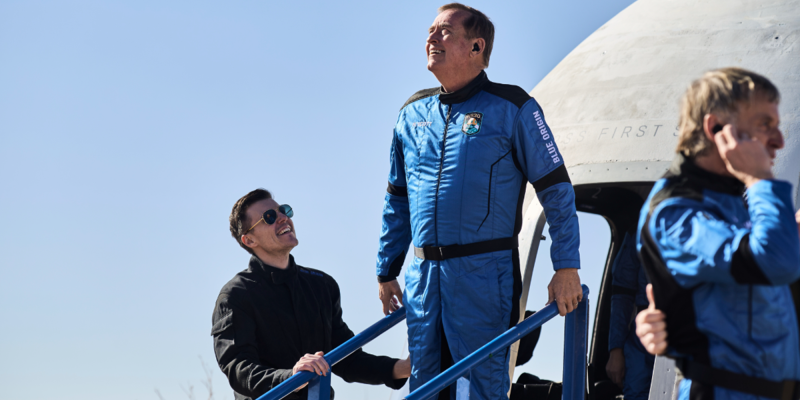
For centuries, humans have dreamt of traveling beyond our planet in the expanse of outer space. After a once-in-a-lifetime opportunity, Richard Scott ’79 can now count himself among the select few who have been there.
Scott, an accomplished embryologist and amateur pilot, was one of six crew members on a Blue Origin space flight in February. What was once an experience reserved for NASA astronauts, Scott is among the first few dozen individuals to complete a commercial flight to space.
“It’s a lifetime dream to go up in space,” Scott said. “I never thought I would have the chance.”
While it’s still an exclusive and expensive club, the opportunity to take a space flight is becoming slightly more accessible as Blue Origin’s reusable equipment logs more trips (the flight that Scott took was the 12th for that specific capsule and 13th for the booster rocket). He got connected to the opportunity through word of mouth from his own patients and colleagues of his daughter, who is a professor at the University of North Carolina at Chapel Hill.

Scott has been around aviation his entire life. His father was a test pilot in the Air Force, and Scott himself flies aerobatic planes. This experience, going beyond the atmosphere of the Earth, was the ultimate thrill-seeking prize. “Pilots always want to go faster, farther, and higher, right? They’re never happy, it’s never enough,” Scott laughed.
The launch of Blue Origin’s New Shepard rocket took place in remote Van Horn, Texas (so remote that the Blue Origin staff told Scott that rattlesnakes “aren’t tough enough” to live there) after several days of safety training to master emergency protocols and how to get in and out of the capsule’s seats in zero gravity.
The flight was brief—just 11 minutes before landing back in Texas—but still “pretty doggone fascinating” for Scott. True to form as a pilot, he paid close attention to the instruments and metrics of the capsule: they traveled at a speed of over 2,400 miles per hour to reach a height of about 352,000 feet, or approximately 107,000 kilometers, and the parabolic flight path registered a g-force of six g.
Many of his fellow passengers made sure to take advantage of zero gravity while up in space, floating around and doing backflips, but Scott had plenty of zero-gravity experience from his aerobatic flying background. Instead, he was much more focused on taking in the breathtaking views from the capsule.
“I did a couple little pictures, and then I sat in front of window. I was really boring,” Scott joked. “I wanted to see the blackness of space, and then the brilliant colors of the Earth. They’re extremely bright— almost fluorescent. They’re just really intense. I got to see so much of the surface of the Earth and its curve.”

The Kármán line, an altitude of 100,000 km, is widely accepted as the boundary of space, and those who go beyond it—like Scott and his New Shepard crewmates—are officially considered astronauts. While adamantly humble in deflecting that title, Scott did share the flight with an interesting crew, including a machine learning scientist, a cryptocurrency mogul, and a content creator that received a call from the president of Spain upon landing.
Scott has an impressive resume of his own. He was a founding partner and CEO of IVIRMA Global, the world’s largest fertility care group, from which he is now retired. He is a prolific medical researcher with hundreds of publications, and serves as an adjunct professor at Yale University and the University of South Carolina.
He transferred to Randolph-Macon in 1977, following a beloved professor from Kennesaw State University, Dr. Conrad Stanitski, and majoring in chemistry. In 1978, while he was an RMC student, Scott was fascinated by the birth of the world’s first in vitro fertilization baby. He went on to medical school and trained under a faculty mentor at the University of Virginia’s medical school who was a world-famous embryologist, setting him down a successful career path of reproductive medicine.
“I had a number of really profound influences during my time at Randolph-Macon that created a mindset that has driven much of what I’ve done in my career,” Scott reflected.
He pointed specifically to the influence of Dr. Stanitski and Dr. Stuart Monroe, who encouraged him to push the limits; an appropriate reminder for a man who would one day go to space.
“Yeah, I learned about P-chem and organic chemistry, but what I really learned is how to problem solve, how to overcome challenges, how to plan for the future, how not to be afraid,” Scott said. “It was an extremely empowering time for me.”