

Randolph-Macon’s Campus Officially Accredited as Arboretum
Trees are central to Randolph-Macon’s famously beautiful campus. So much so that they’re written in the first line of the College’s Alma Mater:
Bowered midst its oaks and maples, Beautiful to view.
Now, RMC’s oaks, maples, and dozens of other species are officially part of a Level I Arboretum, accredited through ArbNet and part of the Morton Register of Arboreta.
The distinction comes from the work of Jonas Fike ’24, who graduated from Randolph-Macon this spring with a Bachelor of Arts in Environmental Studies and minors in biology and political science. The project was an area of passion for Fike, who hails from Weyers Cave, Va., in the Shenandoah Valley.
“I grew up in a log cabin in the middle of the woods, so I was surrounded by trees my whole life,” Fike explained.
The idea came to him during a plant taxonomy course with biology professor Dr. Nick Ruppel, as the class toured the Lewis Ginter Botanical Gardens collecting samples for DNA analysis. The experience reminded Fike of when he was considering colleges as a high school student and toured Elon University, which is classified as a botanical garden: why not do the same thing at Randolph-Macon?
Fike was a tour guide on RMC’s campus while he was a student, and was also inspired to create something that would showcase the College’s natural beauty to prospective students.
He shifted his focus for accreditation to an arboretum because an arboretum is a specific kind of botanical garden focused on woody plants like trees and shrubs, which better fits the profile of plants on RMC’s campus.
To achieve Level I accreditation from ArbNet (a collaborative, international community of arboreta and tree-focused professionals), an arboretum needs to have at least 25 different species. So, the first step for Fike—armed with knowledge from his biology courses and apps like iNaturalist and PlantNet—was to simply start identifying trees once buds started blooming in the spring.
“I was really excited when he came to me with this idea,” said Ruppel, who guided Fike through the project.
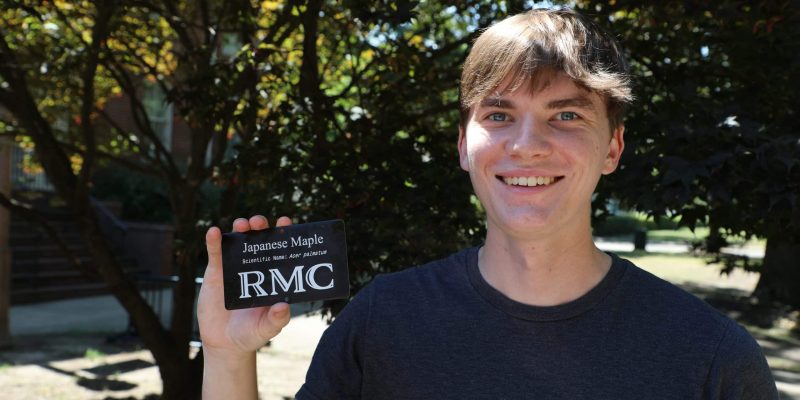
Fike cross-referenced his list with Ruppel and came up with 28 total species (27 trees and one bush). With the list finalized, he ordered labels that included both the species’ common and scientific names, and this summer returned to campus to affix them to the plants. With everything in place, the application to ArbNet was submitted and in October, RMC was officially granted Level I status.
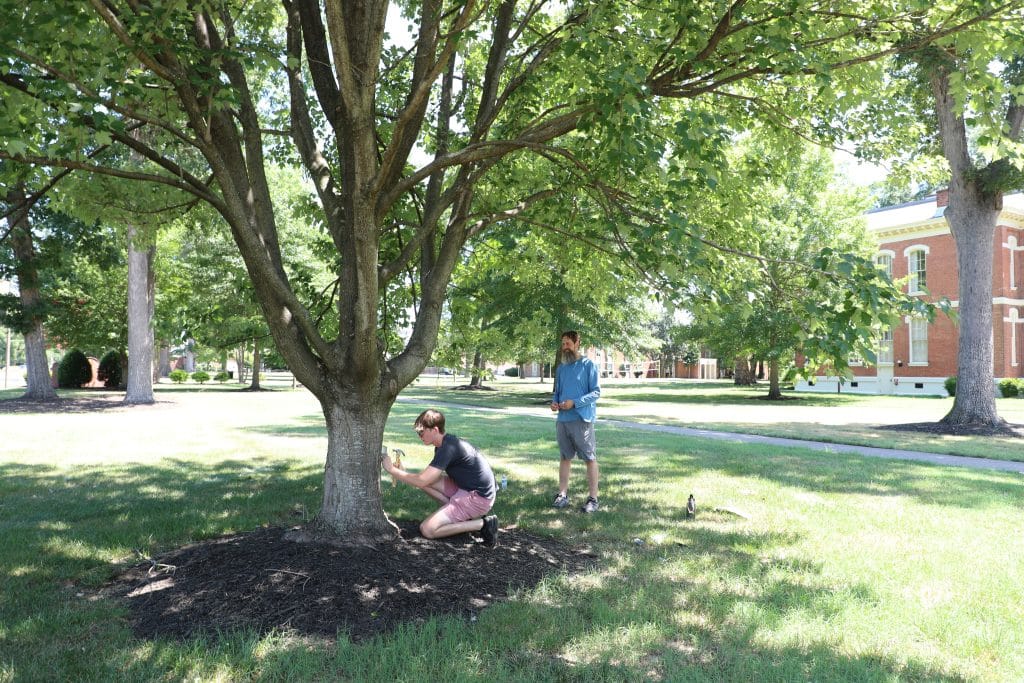
“It’s pretty cool to see it coming to fruition,” Fike remarked.
Of course, he has his favorites among the species classified on campus.
“One of them is in Mary Branch Circle, it’s an American Sycamore tree,” Fike explained. “The way that it grew, the base of it is twisted. It looks like somebody went to the top and just twisted it, and it’s so interesting.”
“Over the years when I’ve had students identify trees on campus, this is a fan favorite,” Ruppel added of the sycamore.
He also points out a Sassafras tree behind Estes Park and a young Gingko tree outside of the Brock Recreation Center. “It’s such a beautiful tree, I love it to death,” Fike said.
Now an RMC graduate, Fike is extending his passion to ecological restoration, doing seasonal work for the Utah Conservation Corps where he helps to restore natural areas in national and state parks.
RMC’s new status as an arboretum provides an opportunity for future students to expand the work, and potentially gain Level II status or higher with more species identified.
“Jonas’ efforts were an important first step in connecting our community with the campus flora,” Ruppel said. “There’s so much more to learn, which is why I’m excited to expand on this project with other students in the future.”
Ultimately, Fike hopes that the arboretum and its labels will help teach people more about the natural world around them on campus, and that that knowledge will inspire environmental engagement.
“I feel like you enjoy nature more when you know what you’re looking at,” Fike said. “I just want to educate people.”