

RMC Aquaponics Project Aims to Help Community
For several months, Randolph-Macon College Biology and Environmental Studies Professor Chas. Gowan and his students have been working toward an ambitious goal: using aquaponics to change lives.
Photos: Environmental Problem-Solving
Aquaponics is a method of growing plants without soil, but using nutrients carried to the plants via a water system. Gowan and his students have built a prototype of an aquaponics system at the Ashland Berry Farm in Ashland, Virginia. The ultimate goal of the project is to duplicate the aquaponics system in a prison greenhouse, and to help Ashland’s Family Restoration Network (FRN) achieve its mission of providing incarcerated men with marketable skills that they can use after returning to their families. Gowan’s students are learning how to work with clients, solve problems, and think critically.
A story about the project was featured in the April 5, 2016 edition of the Richmond Times-Dispatch.
Community Connections
In fall 2015, freshmen enrolled in Gowan’s Environmental Problem-Solving class studied various fish- and plant-growing combinations to determine which would be optimal in a prison greenhouse for training inmates on marketable skills. This semester, 25 upperclassmen enrolled in the same course worked together to build a prototype of the aquaponics project and to write the training manual that inmates will eventually use.
Students are also estimating all the costs involved in building and operating the system, are identifying all the specific job skills that the inmates will acquire and the potential employers they could work for, and are identifying additional “social partners” that could contribute to the project (such as granting agencies that could fund it, local food banks and homeless shelters that could take the fish and produce, and media outlets that could be involved in showcasing FRN’s efforts).
All of this material will be delivered to Family Restoration Network at the end of the semester so that FRN can market the idea to regional jails, including Peumansend Creek Regional jail in Caroline County, Virginia.
Problem Solving
“Environmental Studies is all about problem solving,” says Gowan, the Paul H. Wornom, M.D., Professor of Biological Sciences. “In this course, the client’s problem is the class. There is no syllabus. Students use their problem-solving skills to produce a tangible answer.” Gowan typically finds a client for students to work with, but in this case, “the project fell in my lap,” he says, when Samuelson contacted him. “The project has to be doable in one semester, and it has to include science, economics, public policy, sociology, and other disciplines,” he explains, “so that students must truly conduct an interdisciplinary analysis.”
Environmental Studies majors must take three problem-solving courses as part of the major, and all the courses follow the same basic format. The client comes to class at the beginning of the semester and explains the problem to the students. Students then spend about three weeks developing a detailed scope of work: a specific proposal explaining what the students will do in order to analyze the client’s problem. For the rest of the semester, the students “slog away,” says Gowan, learning as they go along, until the end of the semester when they present their analysis to the client in written and oral formats.
This semester, Gowan’s students will present the project to FRN on May 11, 2016.
Challenges and Rewards
Gowan says the course is an exciting, challenging way to deliver pedagogy.
“The first challenge is to identify a suitable client and project, and that takes a lot of work months before the class starts, because only certain types of projects can fit into a single semester and still involve very substantive interdisciplinary analysis.” Gowan then works with the client as they prepare their initial presentation to the class. After that, “the biggest challenge is to manage 25 or so students as they do the work. Because I don’t know what they are going to find out, in every class we assess what we have learned and what needs to be done next. We just keep making adjustments to our plan as the information comes in. Eventually, we run out of time and have to present to the client. It is nerve-wracking from start to finish.”
Gowan and fellow Environmental Studies professor Michael Fenster, the Stephen H. Watts Professor of Science, have been running these courses, always with new clients (no project is ever repeated), every semester for the past 10 years. Clients have ranged from small non-profit organizations, to major government agencies at the Federal and state levels, to giant multi-national corporations. The problems have included land use planning, endangered species, protections of shorelines, and fixing water-quality issues.
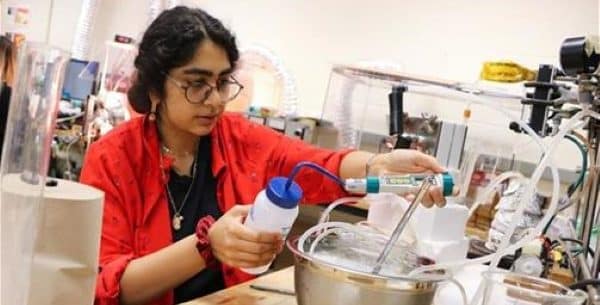
Austin Goyne ’16, an engineering physics major and mathematics minor, took the fall semester course about aquaponics as a way to complete a curriculum requirement. He liked it so much that he made it his senior project. His job was to finalize the design and to build the prototype at the Ashland Berry Farm. Goyne researched where to buy all the parts needed for the prototype and determined the costs necessary to bring the project to fruition.
“The course I took in the fall showed me the ‘real-world’ use of engineering in an environmental setting,” says Goyne, who will begin a Masters of Engineering in Civil Engineering program this fall at University of Virginia. “I was excited about the prospect of a prototype and I wanted to take it on. A course like this enriches the college experience by allowing students to apply what they have learned in the classroom to a real scenario. It was especially interesting to see how my Fluid Dynamics course in engineering physics applied directly to this prototype.”
Turnkey Operation
“We want to be able to deliver a finished product to FRN co-founder Eric Samuelson—what it costs, where to order parts, every detail,” says Gowan. “Our juniors and seniors are writing a training manual, so that Eric can go to the jail and say, ‘here is the manual, and here is how much the project will cost.'” Students are also writing a list of the skills that can be learned from participating in an aquaponics project, and they are listing the job skills that future potential employers may look for.
“Ultimately, we want to provide Eric a complete package—a turnkey operation for the jail,” says Gowan.