



Primary Purpose
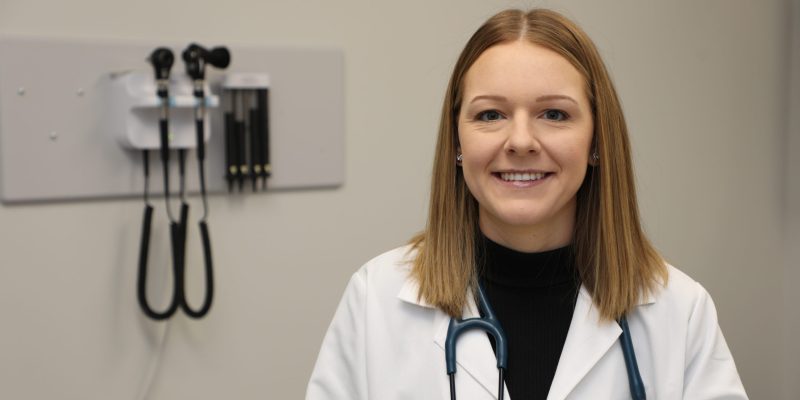
By 8 a.m., Madison Alderson ’24PA is ready to jump into action. Her day as a physician assistant at Chickahominy Family Physicians follows a steady, purposeful rhythm. She sees nine patients in the morning and nine more in the afternoon, with a small midday window—an hour and a half to two hours—for updating charts, following up with patients, and completing behind-the-scenes administrative work that keeps patient care moving forward. Typically, patients are booked in 10-minute blocks, though more comprehensive appointments may be required for things such as physicals or follow-up visits after a hospital discharge.
As a PA in a primary care practice, Alderson must be prepared to treat a wide range of conditions, from chronic high blood pressure, high cholesterol, and diabetes to acute illnesses like COVID-19, flu, and strep. She is also equipped to support patients managing mental health conditions like anxiety and depression. “Seeing patients for pretty much everything,” she says, is part of the job.
44% of Virginia neighborhoods lack sufficient access to primary care physicians, according to a recent study by researchers at Virginia Commonwealth University. The problem is most acute in rural communities. Addressing these gaps is central to the stated mission of the RMC PA program, says Professor Erich Grant, chair and PA program director. “As our graduates move into practice, we are hopeful that more and more will seek to bridge these gaps. This approach has been the foundation of the PA profession since the beginning.”
Every appointment for Alderson starts the same way: a knock, an introduction, and a conversation that helps create a space for honesty between patient and provider. For Alderson, taking a holistic approach to care is essential. A visit may be scheduled for a three-month follow-up, but if other concerns arise, she wants to address them. Though her days might be tightly scheduled, her priority remains providing high-quality care and building safe patient-provider relationships. It’s fast-paced, demanding work, but for Alderson, it’s exactly where she wants to be.
“I always had an interest in medicine because I got to see it as a patient very closely for many years,” Alderson said.
As a teenager, she underwent a series of knee surgeries, giving her an up-close look at the impact compassionate, competent clinicians can make. “[The way] my providers at that time handled me, and how they helped me work through those problems… it was pretty transformative,” Alderson said, noting that they not only helped her knee heal but also supported her as she grappled with the end of her dream of becoming a college soccer player.
Inspired by her experience as a patient, Alderson decided to pursue a medical career, starting at West Virginia University, where she earned a Bachelor of Science in Exercise Physiology in 2020. Shortly after graduating, Alderson, her husband, Ben, and their golden retriever, Macy, moved to the greater Richmond area, where she took a job as a medical assistant for Dr. Patricia Burkwall, a Hanover native who first made her aware of the burgeoning PA program at RMC.
After researching the program and visiting the College’s PA facilities inside Duke Hall, Alderson submitted an application, landed an interview, and received her long-awaited acceptance letter, beginning a two-year journey as a member of the inaugural class of PA graduate students at Randolph-Macon.
“It was so terrifying,” Alderson said of her first day as a PA graduate student. “It was a whole life shift again. You were going to have to make sacrifices to be able to get to that career,” she recalled thinking.
With the encouragement of her professors, Alderson gradually became more comfortable with her routine and increasingly confident in her abilities. As her confidence grew, so did her clarity about what she wanted from her career. While she initially landed a job in urgent care, the pull toward primary care practice proved undeniable.
“In family medicine, you really get to see a patient’s progress,” Alderson said. “In other specialties, you’re going to help the patients, and those specialties are all needed, but you’re not going to be able to see full circle moments and really be that patient’s source of comfort in the healthcare field,” she added. For Alderson, the opportunity to build long-term relationships and provide continuity of care ultimately led her to choose family medicine.
One year into practicing family medicine, Alderson says the past 12 months have been some of the most rewarding of her life. “I’ve come so far,” she said. “Just thinking back to entering the first day of PA school, and how little I knew, to being able to confidently diagnose and treat patients on the spot.”
This confidence, she says, is in large part thanks to Randolph-Macon’s emphasis on evidence-based, individualized patient care, an approach that trained her to rely on clinical data, trusted research, and established best practices when making treatment decisions.
“Looking back, I’m very happy with how they shaped me into being the physician assistant and the person I am,” she said.
Alderson hopes to have that same impact on future PAs. In fact, she recently helped establish a preceptor partnership between her practice and the College, with the first student set to begin a clinical rotation this spring. The goal, she says, is to create a safe space to educate, encourage, and mentor prospective physician assistants so they can feel fully prepared once they start practicing.