

Nursing Travel Course Explores Disaster Response in Japan

Collaborative J-term travel course pairs nursing and Asian studies departments for a unique interdisciplinary international experience.
Between the rigorous academic requirements and the hours involved in externships and other practical experiences, nursing majors at other institutions often can’t study abroad during their undergraduate education.
It’s even more rare for their time abroad to enhance their study of nursing.
Randolph-Macon’s January Term, combined with the College’s impactful relationship with the nation of Japan, helped RMC nursing students overcome those barriers by participating in a travel course this January that focused on the emergency response to Japan’s Great East Earthquake and Tsunami of 2011.
The course featured travel across the country, from Tokyo to Hiroshima in the south and the Miyagi Prefecture in the north. It also traveled across disciplines with a unique collaboration between faculty in the nursing and Asian studies departments.
“It just seemed like a natural fit with healthcare and nursing to look at emergency response, disaster responses, and do a comparison to what we do in the U.S.,” said Cindy Rubenstein, the Nursing Department Chair and Director. “And, we got to really expose them to another culture, to see that human connectedness, which I think is a huge part of that experience.”
Rubenstein partnered with Asian studies faculty member Kyle Maclauchlan in crafting the “dream experience” for students. Maclauchlan’s experiences uniquely qualified him to help lead the trip; he was an EMT for nearly a decade and worked in the Virginia Emergency Operations Center (EOC), before 11 years of living and working as an English teacher in Japan. In fact, Maclauchlan was living in the Miyagi Prefecture during the tsunami and lived through the disaster response.
“For me, keeping these memories alive and not letting the event be forgotten is my mission as well,” Maclauchlan said.
A comparative look at disaster response
Before leaving for Japan, the students spent a week on campus learning about Japanese culture and studying the 3.11 earthquake and tsunami disaster. The students also toured the Virginia EOC, which served as a preview of and comparison to a tour of an equivalent facility and a nuclear power plant in Japan.
The course had no nursing prerequisites, which allowed five students from other majors to join 13 nursing majors on the trip. The diversity of academic pursuits provided different perspectives on the four stages of emergency management (mitigation, preparedness, response, and recovery); a nursing student could share insight on triaging victims, but an engineer has expertise in designing buildings to withstand earthquakes and avoid collapse.
“Thinking about how those pieces intersect with health and wellness and disasters is pretty fascinating,” Rubenstein observed. “It was nice to have a mix of students to be able to bring those diverse thought processes together; it really helped engage with a lot of our discussions with the people in Japan.”
Likewise, the students explored the geographic differences of Virginia and Japan, and the ways they now intersect. Though Virginia’s emergency operation center is more focused on hurricanes than earthquakes and tsunamis, the group learned about changes they made based on lessons learned globally from the 3.11 disaster, like direct lines of communication with power plants.
In Japan, they studied the significant change in their mindset around preparedness.
“They acknowledged challenges that they faced during 3.11,” explained Kaitlyn Ahern ’24, a nursing major. “They ran out of fuel, they ran out of relief supplies. And the number of people that had been affected was way greater than what they had estimated. So now, they have essentially overestimated everything that they need.”
Resilience on display
While in Japan, the students’ experiences illustrated the resilience of the Japanese people, including firsthand accounts from the former Japanese ambassador to the U.S. and a doctor who had been assigned to the Fukushima nuclear power plant meltdown. They also visited the Hiroshima Peace Memorial Museum, which documents the disaster and recovery associated with the atomic bombing of Hiroshima in World War II.
Ahern felt the most impactful part of the journey was the time spent in the devastated Miyagi prefecture, which includes the capital city of Sendai and the coastal city of Ishinomaki.
“Right on the coast where everything got wiped out, they had really good visuals and maps of before 3.11, during 3.11, and currently rebuilt after 3.11,” Ahern said. “Being able to see the mass of area that was so populated, and then it’s just flat. It’s a lot of life, it’s a lot of everything, and it’s just wiped out in a couple of seconds. It helped round out the story for me, from what I had already known.”
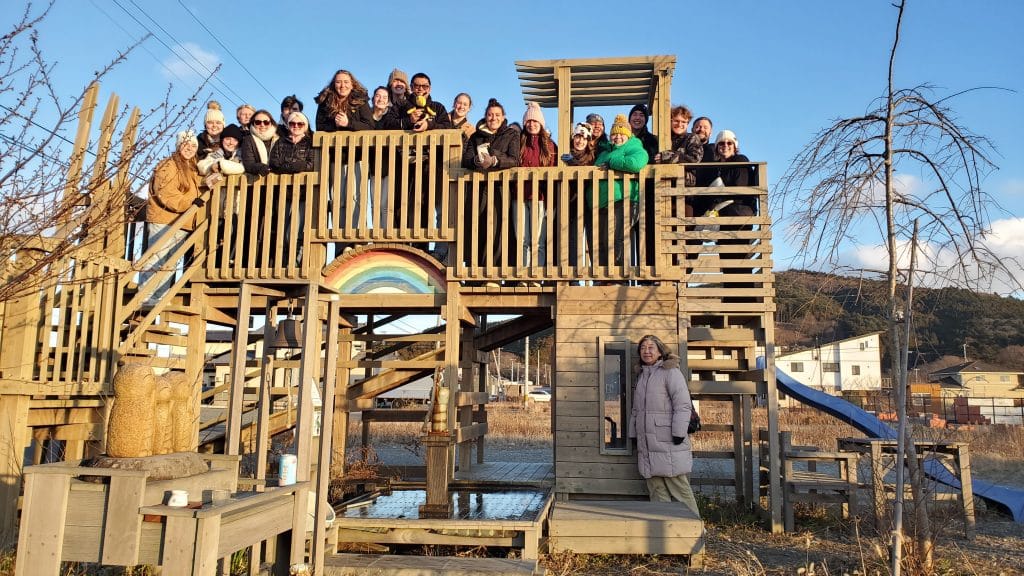
Along with that strong perspective on the tragedy, Ishinomaki also brought many students the strongest sense of hope and recovery. Before embarking on the trip to Japan, the group met with Andy Anderson, father of RMC alumna Taylor Anderson ’08, who died in the disaster while teaching English in Ishinomaki. During their time in the city, they also met with Shinichi and Ryoko Endo, who lost their three children, all of whom were students of Anderson, in the tsunami.
The Endos and Andersons have formed a profound friendship, honoring the lives of their children by working to install bookshelves, or “bunkos,” hand crafted by Shinichi Endo in schools across Japan. The 30th bunko was installed at Randolph-Macon’s McGraw-Page Library last summer.
Cultural experiences of all kinds
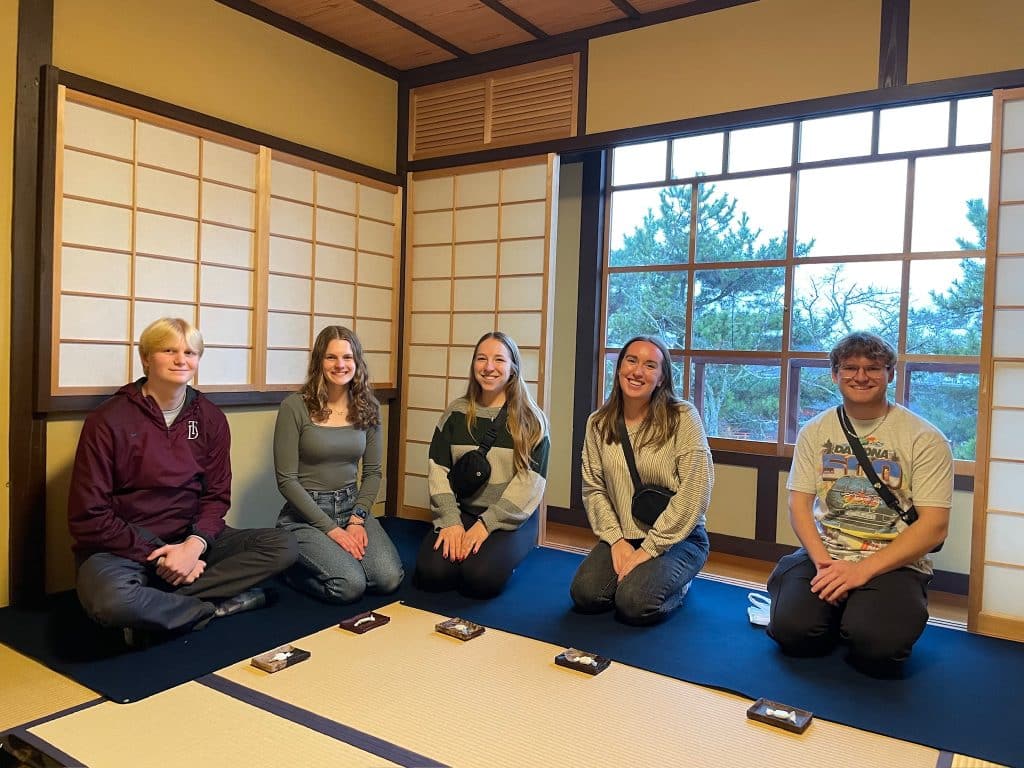
Throughout the journey, the group immersed themselves in the culture of Japan with experiences like a sumo wrestling tournament, visits to Shinto and Buddhist shrines on the island of Miyajima, and traditional tea ceremonies.
Maclauchlan and Rubenstein both believe these experiences also expand the perspective of the students both as professionals and citizens of the world.
“I really hope that it becomes something that they can use in real life,” Maclauchlan said. “That’s true even if all they got out of it was this perspective of being the foreigner in a place, or just the idea of loving another culture and having respect for it in a way that they didn’t have before.”
“As nurses, sometimes they’re thinking of the immediate patient need and I think traveling helps them see the bigger picture and the interrelated parts,” Rubenstein said. “I think it gives them the opportunity to really be leaders on their units or wherever they end up practicing.”