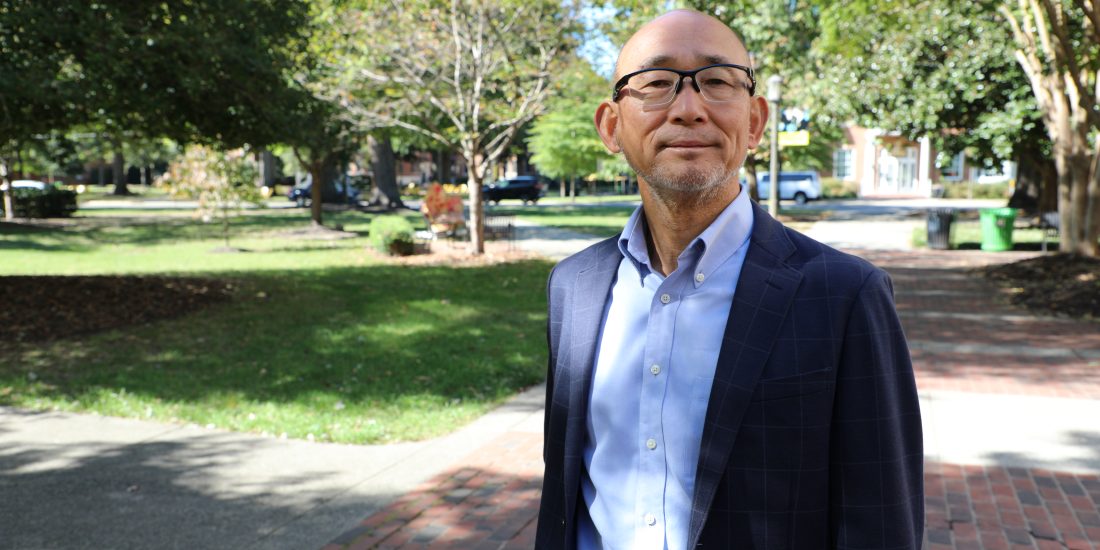


Mark Jones ’81 Named Fellow of the American Chemical Society
Randolph-Macon College alumnus Mark Jones ’81 was named a 2017 Fellow of the American Chemical Society (ACS). Dedication to communicating the value of chemistry, advocating for the role of industry in the profession, and technical leadership in lanthanide catalysis were cited as reasons for Jones being selected. Jones and 64 others formed the 2017 Fellows awarded at the ACS fall national meeting in Washington, D.C. in August.
Contributions to Chemistry
“It is a cherry on top of what has been a good career,” says Jones, executive strategy and communications fellow for Research & Development, Dow Chemical Company. “It is a great honor to be recognized for my contributions to chemistry and to communicating science.”
Jones joined Dow in 1990 and has spent most of his career developing catalytic processes. Since taking his current role in 2011, he has been a strong supporter of the role of chemistry and material science in advancing industry and the economy. He has hosted ACS webinars on the successful industrial applications of chemistry and material science, and is co-chair of the National Academies’ Chemical Sciences Roundtable.
During the Obama administration, he worked on the White House’s Advanced Manufacturing Partnership, looking at both technology options and improving scale-up of new technologies. He also serves as a Board member of the Biotechnology Innovation Organization, where he works with fellow 1981 graduate Joanne M. Duncan, president, Membership and Business Operations Division.
Friendships and Mentorship
Jones majored in chemistry at RMC, where he was a member of Alpha Epsilon Pi and Omicron Delta Kappa.
“I value the friendships forged during my years at RMC,” he says. “I remember the debates we had in the cafeteria. We’d have debates during lunch and dinner that went all over the place.” Jones says that Professor Conrad Stanitski, chair of the Chemistry Department, helped put him on his ultimate career path. The late Chemistry Professor Frank Boldridge ’39 was also a great influence. “I learned from him that you could make your own lab equipment—in fact, I made all the equipment I used in grad school and much of the equipment I have used at Dow,” says Jones.
A Well-rounded Education
Jones earned his Ph.D. in physical chemistry at University of Colorado at Boulder.
“I went from Randolph-Macon directly to graduate school, where I joined students from Berkeley, Cal Tech, MIT and other large schools,” he says. “I found myself doubting that I was equally prepared. Most had taken double the number of chemistry classes even offered at Randolph-Macon. One of the first hurdles is passing qualifiers. Turns out I passed the qualifiers and many of the big school graduates didn’t. It was confirmation that I received a quality education.”
The quality of his education paid off again when Jones joined the workforce.
“My liberal arts education prepared me better than most,” he says. “Communicating results and influencing others to act based on those results is critical to success in a career, whether industrial or academic. I write well and know the rules of grammar, thanks, in no small part, to my liberal arts background. It served me well.” He adds, “I also have a greater knowledge of art, philosophy, politics and other disciplines that the liberal arts education provided. I appreciate being well-rounded.”
Jones’ thesis work was in physical chemistry—gas-phase ion-molecule chemistry to be exact.
“I followed that with a brief post-doc at the Cooperative Institute for Environmental Science, where I was introduced to surface science and catalysis,” he explains. Jones joined Dow Chemical’s Heterogeneous Catalysis department and had many technical roles in Research & Development, rising to Senior Research Fellow before taking on his current role on the staff of the Dow CTO.
Yellow Jacket Connections
Jones recently returned to his alma mater, where he spoke to chemistry majors in RMC Chemistry Professor Nora Green’s class.
“I talked about the apparent paradox of the shale gas boom rejuvenating the chemical industry at a time when issues of sustainability loom large,” he says. “Shale and sustainability are certainly impacting the industry and all of us.”
Green says, “It’s always great that our alumni are willing to come back to Randolph-Macon and pay it forward by interacting with the next generation of scientists. Mark’s talk was eye-opening for many our students because he works in an area that they are less familiar with.”
Jones says it was great to return to Randolph-Macon, talk to current students, and see the changes taking place on campus—including the new science building, Macon F. Brock, Jr. Hall.
“It was nice to walk down memory lane, and, at the same time, see how the campus has grown,” he says. “The benches around the fountain, an integral part of a Frisbee game we used to play, are gone. That is pretty much the only change I experienced that felt even a little bit negative. The campus is different, but it still feels very natural to be here. My advice to Yellow Jackets is to aim high and feel confident that you are getting a great education.”