

Kryptographer
Artist Jim Sanborn ’69 is the man behind one of the world’s most famous unsolved codes, a sculpture named “Kryptos” at CIA Headquarters in Langley, Va.
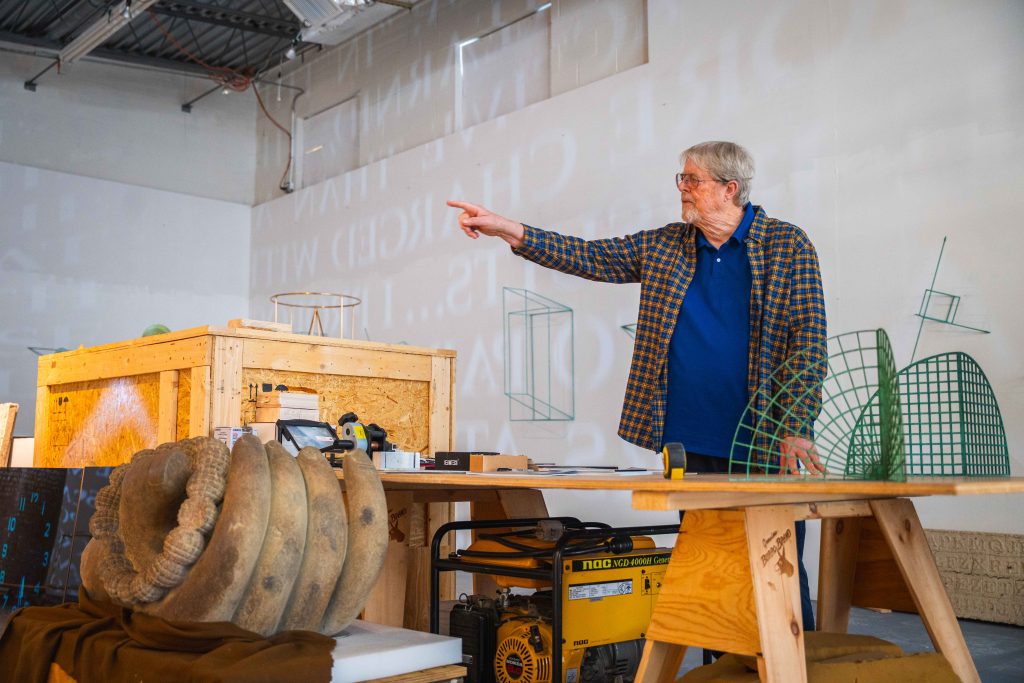
Seven days a week, you can find artist Jim Sanborn ’69 in a large structure next door to his home on the banks of the Potomac River. The building houses two studios, separated by a wall: one for him and one for his wife Jae Ko, a renowned artist herself. Sanborn has a tall frame—well over six feet—but fits naturally in the large space.
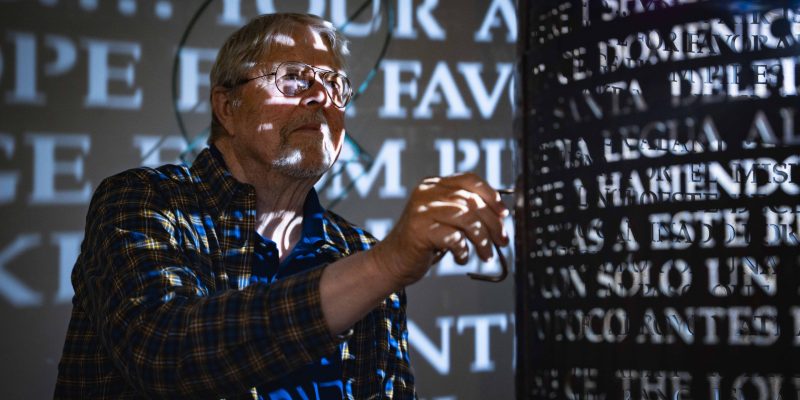
His studio is populated with both the tools to create and the products of a winding and prolific career as a sculptor: an industrial saw, statue replicas, metal crafted into geometric shapes. And at the far end of the studio, a cylinder with text carved into its metal and wrapped around its entire form. When a switch is flipped, light emanates from its center and casts the words onto the surrounding walls.
The engravings are reminiscent of Sanborn’s most famous work, Kryptos, located in the courtyard of the Central Intelligence Agency (CIA)’s headquarters in Langley, Va. At the home of spymasters and codebreakers, its S-shaped copper sheet contains engravings of four encrypted messages. Since its unveiling in 1990, the puzzle has captivated people both in and outside of the agency seeking to decode its words. Today, three of its four panels have been decoded, but over three decades later, the solution to the final panel, “K4,” remains a mystery.
The seeds of a 50-plus-year career as an artist were planted during Sanborn’s time as a student at Randolph-Macon College. He came from Washington, D.C., where his father was the Director of Exhibitions at the Library of Congress, inspiring an interest in archaeology and ancient history.
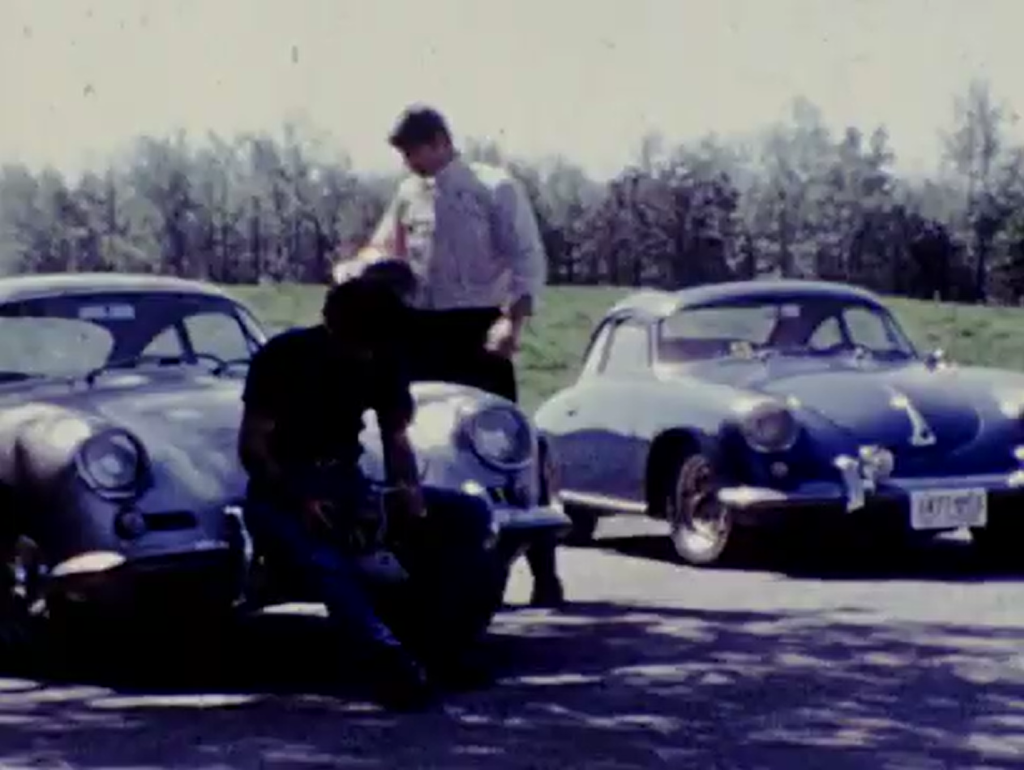
At RMC, as the proud owner of a classic MG TD, then later a Porsche 356, he became friends with other car enthusiasts, often turning the parking lot of the motel dorms into a makeshift garage. Tinkering with tools and machinery laid the foundation for the metalworking of Sanborn’s future career. “It was my training ground for learning how to build sculpture,” he explained.
During his years on campus, when he double-majored in Sociology and Art History, he attended a lecture by the Director of the American Art Museum. Upon shaking his hand afterwards, the speaker observed that Sanborn’s height and big hands were perfect for sculpture.
Sanborn took the advice to heart and started carving wooden sculptures, including a tiki for the Sigma Phi Epsilon fraternity house. As his young artistic career began to bloom, he spent time at Ashland’s Cross Mill Gallery, an artist’s space operated by Nancy and Jack Witt, who also taught at the College. There, he saw proof that one could make a living out of art.
Creating Kryptos
After graduation, Sanborn spent time making art back at home in Alexandria, Va., then earned a Master of Fine Arts from the Pratt Institute in New York. He taught college art courses and served as the artist-in-residence at Glen Echo Park before earning the commission for a public art installation at CIA headquarters.
Sanborn’s work had been exploring themes of the Earth’s invisible forces; the commission was awarded to him to highlight the agency’s invisible operations and the force of human intelligence. Presciently sensing that this assignment could be a career breakthrough, Sanborn dedicated over two years of work to make his vision come to life.
Inspired by a recent trip to Egypt, and his own love for archaeology, Sanborn wrote the prose for Kryptos’ message himself. He worked with a retired CIA cryptographer to encode it, meeting in secret locations and working with pencil and paper—nothing was discussed on the phone or put into a computer.
In 1988, the only way to cut letters out of a piece of copper was by hand or water jet, and Sanborn couldn’t afford the expensive services of a water jet company. So, he cut out 2,000 letters with the use of drills, jigsaws, and human hands.

“It took two and a half years of cutting every day in my studio in northeast D.C.,” Sanborn recalled. “Each letter had to be drawn on the copper, and you couldn’t make any mistakes; you couldn’t fix it if you messed up. It was really stressful. I went through nine assistants, 900 jigsaw blades, dozens of jigsaws, and a lot of noise.”
Installing the piece inside the courtyard also proved challenging, “like building a ship in a bottle,” Sanborn described. The encrypted copper was just one part of the whole installation, and dozens of tons of stone had to be moved through the building’s doors on dollies and gantries, with the help of assistants who all had to get security clearances to enter the CIA building.
Cracking the Code
When Sanborn took the commission, he consciously assumed the responsibility that many in the CIA do: keeping a secret for his whole life. Even then, he expected the code to be broken in five years, ten years tops.

James Gillogly, a California computer scientist, solved K1, K2, and K3 in 1999. (Both the CIA and the National Security Agency (NSA) later claimed they had solved the cypher years earlier but didn’t publish the results to uphold the secret.) K4, however, has continued to elude both professional and amateur cryptographers. The sculpture has gained a cult following and earned references in popular culture, from TV shows to Dan Brown novels.
For a while, Sanborn’s wife Jae would field phone calls from potential codebreakers with a simple set of questions that helped her know immediately if they had solved it or not. (They hadn’t). After tiring of the phone constantly ringing, Jim set up a website to field the guesses, but with thousands of people around the world taking their shot, that too became unmanageable. Eventually, Sanborn started charging $50 to review and reply to potential solutions, weeding out the entries to only the most serious codebreakers. Even that only whittled the steady stream down to around a dozen answers per week.
From Antiquity to Atom Bombs
While Kryptos is the work that Sanborn is most famous for, it’s far from the only notable one. His art has been displayed in museums near and far, including the Corcoran Museum of Art, Atlanta’s High Museum of Art, the Hirshhorn Museum, the Virginia Museum of Fine Arts, and many more. Sanborn describes the financial life of a sculptor as “feast and famine,” and credits his public art projects, which are also numerous (including a wave pool outside the Silver Spring, Md., office of the National Oceanic and Atmospheric Administration), for helping to fund his passion projects.
“Most of what I’ve done is not very saleable,” Sanborn said. “It requires a certain level of intelligence to understand what I’m up to.”
Sanborn’s works are as thought-provoking as they are wide-ranging. In the 90s, he worked on Analog Projections, using hand-built equipment to project light across massive stretches of the American West (imagine miles-long rock formations) and capturing the effects in stunning photographs.
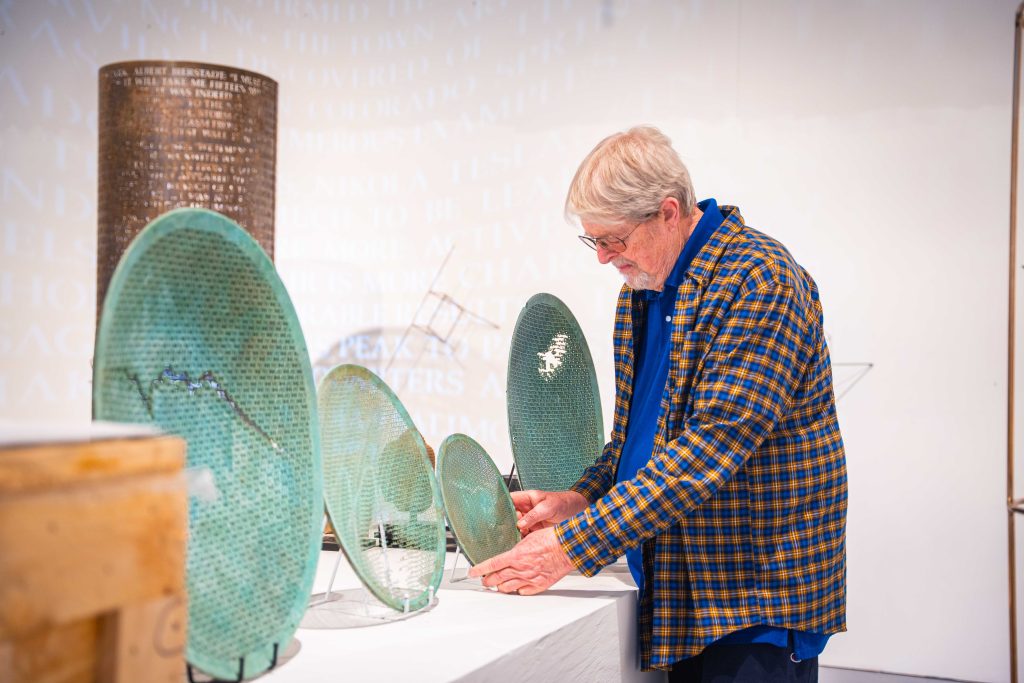
His travels inspired Atomic Time, a recreation of the lab at Los Alamos National Laboratory, where the Manhattan Project created the first atomic bombs.
He spent years in southeast Asia following forgers to learn how to create ethical replicas of Cambodian statues.
Most recently, he’s been playing around with Euclidean geometry, crafting three-dimensional sculptures of two-dimensional drawings, with their shadows completing the form.
Passing on a Secret
In August of 2025, Sanborn wrote an open letter to the community of Kryptos enthusiasts. It read, in part, “I decided several years ago that the best way to maintain the continuity of K4 stewardship after my passing is to have the plain text, the secret of K4, sold at auction to the highest bidder. This auction will in fact take place in November of this year, which will coincide with my 80th birthday and the 35th anniversary of my building Kryptos.”
Just two months prior to the auction, scrambled plain text included in a parcel of documents to the Smithsonian Archives was discovered by journalists. But the secret remained intact, and in November, the Kryptos files successfully sold at auction for just shy of one million dollars. The anonymous buyer has pledged to maintain stewardship of the K4 secret code, ensuring that Kryptos’ legacy as the world’s favorite unsolved code lives on.
Sanborn jokes that distaste for math led him down the path of art, a field in which he could still explore subjects that caught his interest without a proficiency in numbers or algorithms.
“I couldn’t be a physicist, I couldn’t be an astronomer, I couldn’t necessarily even be an archaeologist, because it all involved some form of mathematics,” Sanborn said. “I just sort of went around the system.”
Whenever he worked on a project, he poured himself into research of that subject, often traveling the world to do so. Ultimately, his dedication and craft led him to reflect a version of those things he thought unattainable: a nuclear physicist, an archaeologist, and even one of the world’s most famous cryptographers.