

Interdisciplinary Collaboration Creates Virtual Reality Classroom Management Tool
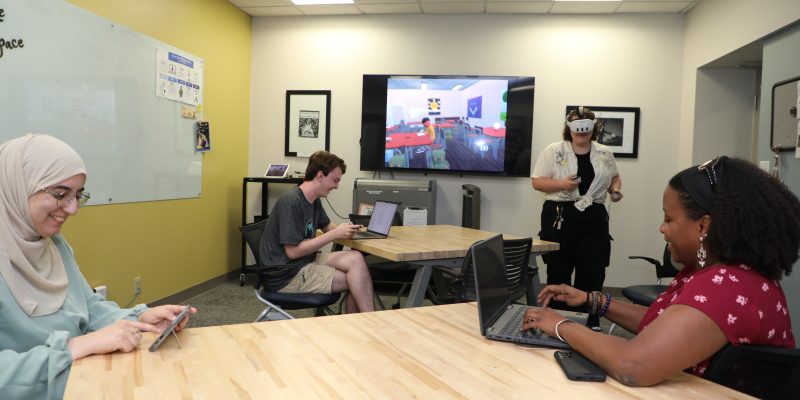
A joint SURF project with faculty and students from the Departments of Education and Computer Science produced a VR experience to help new teachers better manage classroom dynamics.
When Randolph-Macon’s education department asks its graduates what sort of instruction is most helpful for students as they become teachers, the overwhelming response—and one supported by research—is a need for practice in classroom management.
“A lot of people misinterpret it to be behavioral management, but behavioral management is what happens when the proactive classroom management piece doesn’t work as you intended,” Assistant Professor of Education Dr. Dyanis Conrad explained. “The idea with classroom management is that you create the kind of classroom environment that is very meaningful for learners, so they’re engaged in the lesson. They’re respectful with their behaviors, they know they can talk to you about challenges, so there’s limited space for students to need to act out, because they feel cared for and supported and valued in that space.”
Tasked with designing a classroom management course for RMC, Conrad started thinking about ways for students to apply the skills they learn. While role-playing scenarios within a college course can be a useful tool, it can be hard to suspend disbelief when a “disruptive student” is really your classmate and friend.
To produce more realistic and dynamic simulations, Conrad tapped her colleague from the Department of Computer Science, Assistant Professor Dr. Maha Elouni, to explore the possibility of a virtual reality classroom space. Last summer, the duo used a grant from the Walter Williams Craigie Teaching Endowment to explore what was feasible.
This summer, the professors served as advisors on joint Schapiro Undergraduate Research Fellowship projects to create their own virtual reality classroom. Emily Dixon ’27, a secondary education and theatre double-major with an English minor, and Carson Triplett ’26, a computer science and cybersecurity double-major, collaborated on the project.
“Carson looked at different platforms out there that we can use, and we found that Rec Room is the best,” Elouni said. The platform allowed Triplett and Dixon to create avatars, controlled by students in an RMC education class, which can represent a customizable population of simulated K-12 students. “We’re going to pay attention to all the details that we can have in the classroom.”
Triplett provided the technical expertise, while Dixon provided the educator’s perspective. For each student, it was an enriching experience to contribute to the project while learning from each other.
“It’s really cool getting to collaborate with somebody else,” Dixon said. “He shows me how he is creating these things, and while his gears are turning in that mindset, my mind is going ‘can we do that? Can we create this?’”
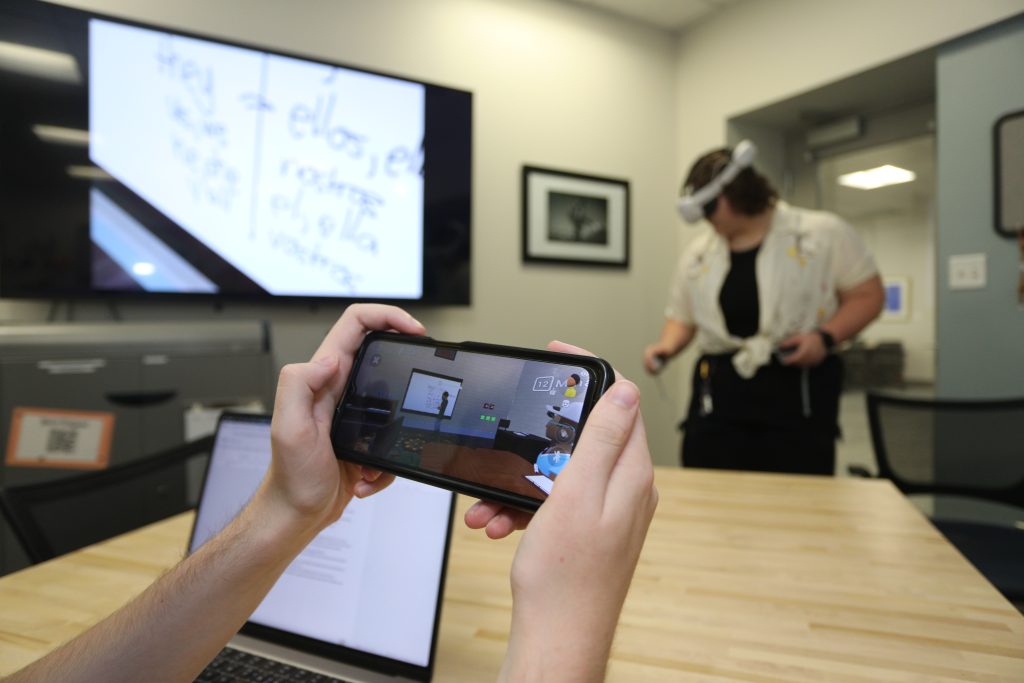
In general, the summer of SURF provided valuable experience for the students as they advance their careers. “This is definitely a game-changer for me, just having the experience and being able to put on my resume that I did undergraduate research,” Triplett reflected.
As for the virtual reality classroom, the technology will be piloted by an RMC education course, in which Dixon is enrolled, this fall. Conrad is excited about the new possibilities provided by virtual reality.
“Education students also do 10 hours in a real classroom, serving and assisting during the semester. They’re able to see what’s happening in an actual classroom, see how they’re applying that, and combine that with the theories we look at in class,” she explained.
Now, with this new platform created through this summer’s SURF projects, the experience is taken to the next level.
“That suspension of disbelief is really important in how students see themselves doing this,” Conrad said. “They don’t get to see the disruptions ahead of time. They happen in real time and they have to think on their feet and respond appropriately.”