

In Thoburn’s SURF Lab, Undergrads are the Teachers
The third-floor lab of Garnett-Lambert Professor of Chemistry John Thoburn has been teeming with activity this summer: five RMC students, two students from Hermitage High School, and a teacher from Richmond Community High School, all conducting chemistry research as a team.
Their work is a version of a Schapiro Undergraduate Research Fellowship (SURF) that supports faculty-mentored research across campus each summer. However, the collaboration in Dr. Thoburn’s lab is funded with additional funds from the National Science Foundation (NSF)’s Research in Undergraduate Institutions (RUI) initiative, which supports research opportunities at predominantly undergraduate institutions like Randolph-Macon College.
The team of researchers’ work on supramolecular chemistry (and one computational project), is, of course, a significant focus, but the inclusion of high school students and teachers helps fulfill an additional pillar of the RUI program: to make an impact on society. For this group, that impact is bolstering the future of the scientist community.
“Schools like Randolph-Macon College feed into a larger system,” Thoburn said. “Our students, after they graduate, will go off and get their doctorate or master’s degree in chemistry. The idea is to prepare the next generation of scientists through this grant.”
The connection to extend this experience to high school students first came through Hannah Dise ’12. After working in Thoburn’s lab as a chemistry major and education minor, Dise went on to teach chemistry at Richmond Community High School; her students from underserved backgrounds were the first to participate in this research opportunity. Dr. Nabila Haddadine, a chemistry teacher at RCHS, was part of the group researching with Thoburn both this summer and last.
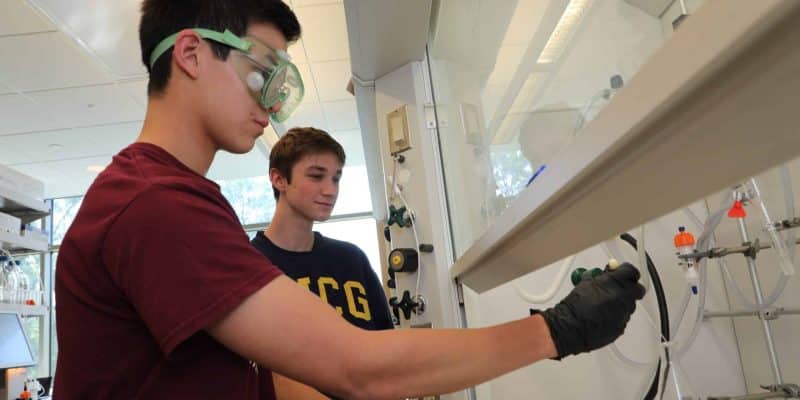
The two high school student participants are paired with undergraduate researchers like Isaac Kwong ’27, who is on a pre-med track. This summer, alongside Hermitage High School senior Duncan Helms, he is working on building a supramolecular tetrahedron cage.
These molecules are empty and container-like. A greater understanding of their basic properties, which lies at the heart of the lab’s research this summer, could potentially lead to medical applications. Their structure could be used to carry drugs through the body and release them when they reach a target tissue.
Working in a formal lab with sophisticated equipment, like taking nuclear magnetic resonance spectra, is an exciting opportunity for Helms, beyond what he’s been able to experience in high school classes. The experience is at another level for Kwong as well, advancing past lab exercises from his first year of college classes.
“Last year, we received set procedures and would go one-by-one,” Kwong explained. “Now we have to figure out the procedure for ourselves, we have to look through different articles and figure out one that works. And there’s always some sort of screw to be thrown into the plans, like if we’re not in the exact same conditions as some of the literature.”
That frustration—and the problem-solving to get around it—is a crucial part of the chemistry process, according to Thoburn.
“They’re really in the driver’s seat,” Thoburn said of the students. “Each of them has had things not go well, and all of them experienced moments of absolute joy when things all of a sudden click.”
For several weeks, Kwong and Helms were trying to replace two hydrogen atoms on a carbon benzene ring with iodine atoms.
“It took longer than expected, and we went through multiple procedures, then we finally got one and it gave us 99% purity,” Kwong said with visible satisfaction. “We were really happy with that.”
The undergraduates, having taken advanced chemistry courses, take the lead on running the experiments and designing procedures. But the high schoolers still get involved preparing samples and gain valuable perspective as they prepare for AP Chemistry and courses in college.
“I do a lot of observing, but it’s very helpful because I can see how you’re supposed to think about a procedure like this and how a typical day would go in a lab environment,” Helms said. Plus, having a summer on RMC’s campus is fun too. “I like just being on a college campus,” he added. “I think that’s pretty cool.”
An extra pair of hands in the lab certainly helps, but for the students completing SURF projects, the collaboration with high schoolers has even more of a positive benefit on their development as chemists.
“Any teacher will tell you the best way to learn anything is to teach it,” Thoburn said. “With these undergraduates, I think they get a deeper understanding of their project by teaching high school students.”