

In Remembrance of Professor Buster Ward
The following is shared with Randolph-Macon College by David Ward ’87 and his brother Paul Ward, sons of Professor Buster Ward.
Ronald David “Buster” Ward (b. November 26, 1932, d. April 4, 2022) passed away peacefully from natural causes in his sleep. Buster was a beloved and influential professor of music at Randolph-Macon College from the moment he arrived as assistant professor in 1958 until his retirement in the Spring of 1999. In his last few years, Buster was cared for attentively by his elder son, David Carl Ward (RMC 1987).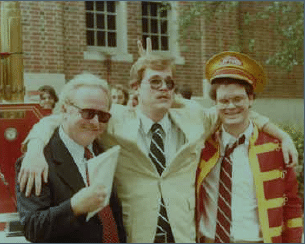
Buster’s experience in music began honestly and early as a red-haired young cornetist with Salvation Army bands, helping his parents, Harry Alfred and Ina Puffer, in their extensive music ministry for the Army. His father was also a cornetist, and his mother played most brass instruments (over time avoiding lower brass) as well as accordion, which she called her “shoulder Steinway.” As Buster grew up in this musically rich home, he moved down the brass registers to trombone and tuba. Recognized quickly as an outstanding musician in his youth, he decided that music was his calling, with important inspiration from his undergraduate experiences at University of Richmond in its choral program and with influential professors. Buster married Judith Carol Bond in 1957, and started his married life while earning his master’s degree in composition at the University of Illinois’ respected music program at Champaign-Urbana. Buster and Judy welcomed sons David (b. 1958) and Paul Kenneth Ward (b. 1959) after he and Judy moved to Ashland to accept his appointment at RMC. He obtained his PhD in music history from The Catholic University of American in 1973.
Buster built a robust music program at Randolph-Macon, establishing an award-winning all male glee club, and introducing classes in music history — including his popular history of jazz course — as well as theory, music appreciation, and composer-focused classes (Mahler being a favorite subject). Buster established the highest academic standards, while also encouraging students to more fully adopt the joy of great music into their lives. Not all of his musical engagement in the college community was academic: His development of the small, noisy, and famously joyous pep band — ever-present at college sports events — led to a fight song written by Buster with lyrics by Judy and Judy’s mother, composed over mid-afternoon refreshments on a trip to New Orleans. The tiny pep band once stood on the football field at a half-time show in the role of hyphen, joining the word Randolph on one banner and the word Macon on another.

He stayed busy with local dinner theaters, especially Barksdale Theater — the nation’s first true dinner theater — and Swift Creek Mill Playhouse, helping them produce musicals of memorable quality, impacting generations of regional performers and musicians. He was principal trombonist at The Richmond (VA) Symphony for decades, and played trombone with dance bands. A fine arranger, he prepared and frequently published music for brass quintet, brass choir, sinfonia and symphony orchestras. He adjusted arrangements for Broadway touring companies, and college and high school musicals. Buster composed extensively for live performance, and overcame technology phobias to write music on computer-based platforms. He was especially fond of composing for British brass bands and creating settings to accompany spoken word.
After RMC became a co-educational institution, Buster established successful, ambitious mixed choirs that engaged students, faculty, and sometimes local singers not affiliated with the college. His programming for special events at the school, especially graduation, were legendary in quality, performed by the region’s best musicians, and incorporating the beauty and humor of Buster’s arrangements.
He was perhaps at his best helping students and young performers expand their knowledge and love of the arts. His fine arts department’s January term arts programs took students to London, England, to be immersed in music, theater, and visual arts, with lectures, presentations, and shows filling an exhausting and transformative agenda for the students. He worked consistently with the American Institute of Musical Studies during summers in the 1970s. AIMS’ mission was to audition and select the best young opera talent in the United States, take them to Europe for a summer to perform and expand their repertoire, and find auditions for them in a European opera house to help launch their careers.

Buster was equally beloved for his zest for life. He hosted dinners for current and former students, never failing to stretch their culinary tastes while also proving in his habits of thought and behavior that a life lived well, with humanity, beautiful art and great music, is the best reward.
He is survived by his sons, David Ward and Paul Ward, and his brother, H. Alfred Ward. A memorial concert for Buster is currently being planned for the Fall, 2022. Please contact Paul Ward at paul@pkward.com if you would like more information or want to share your own testimony to honor Dr. Ward.