

In Centenary Year of Quantum Mechanics, RMC Physics Course Explores Quantum Computing

The year 2025 is the International Year of Quantum Science and Technology, celebrating 100 years since the initial development of quantum mechanics. A century after Werner Heisenberg and other scientists revolutionized the way we think about the world, students in Professor Rachele Dominguez’s Quantum Computing course are exploring what the future of quantum science can bring us.
Quantum mechanics is the physics of the very small. It studies how nature behaves on the molecular and atomic scale, which is often different from what we would expect from the principles of classical physics and our own intuition.
Dominguez has taught a 400-level course in quantum physics at Randolph-Macon for 14 years, but the high-level class has only been accessible to upperclassmen in science and engineering.
This 200-level course (PHYS 220 – Quantum Computing), offered for the first time this spring semester, aims to be more accessible to a broader range of RMC students. The class is naturally made up of physics and engineering majors, but also students studying computer science, cybersecurity, and even environmental studies.
“We’re going to need more workers in quantum fields, in fields like quantum computing,” Dominguez explained. “I really love interdisciplinary topics, so we’re really excited that we have such a diverse group of students who are interested in this sort of thing.”
Quantum computing specifically has the potential to harness the application of quantum physics to create a better type of computer. “We might be able to do things better, faster, more efficiently, and perhaps with less energy usage than classical computers,” Dominguez said.
One of the building blocks studied in the course is the qubit. A bit is the foundational unit of classical computing; it can be either a one or a zero. The qubit is the quantum equivalent of the bit, with a key difference. The qubit can be in a zero state, a one state, or a superposition of the two states.
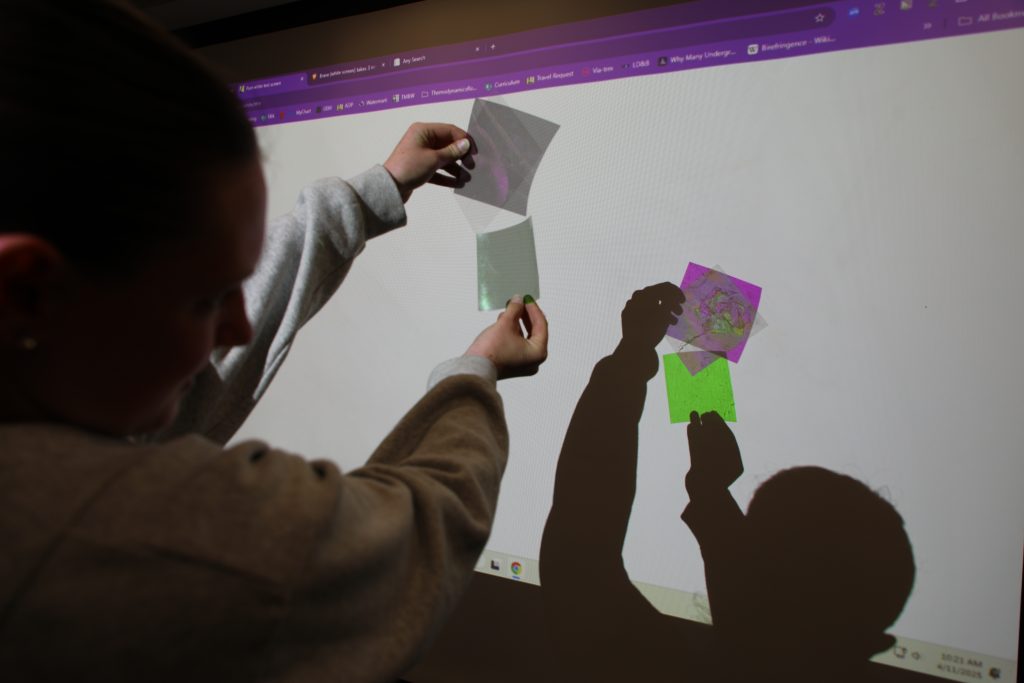
The students explore this concept of superposition in class with polarized light. By stacking sheets of polarizing filters and rotating their orientation relative to each other, they observe how the intensity of transmitted light changes. This models the probabilistic nature of quantum measurement, where the amount of light transmitted relates to the likelihood of a photon passing through a given polarization filter. The results can be colorful and creative.
“Fundamentally, when we do quantum mechanics, our normal intuition goes away, and we have to relearn how these things work,” Dominguez said.
Another key element of quantum mechanics is measurement. In classical physics, one can simply observe a sample and measure its properties. But measuring a quantum particle may require a photon to bounce off it, which will significantly alter its state.
“It’s a fundamental part of how we build the science,” Dominguez said. “We have to think very carefully about measurement and how qubits respond to measurement.”
The complexity of qubits has significant implications for cybersecurity. Eventually, quantum computing will be able to break through classic encryption. To protect against malicious users, new strategies, such as quantum key distribution, will need to be employed.
While quantum computing is still a developing field, the students also get hands-on opportunities to work with calculations on publicly available quantum computers through IBM. Ultimately, the experiences can help students get the foundational experience for a new frontier of science and innovation.
“I think there are going to be a lot of opportunities for these students who are interested to go into this at some level, whether it be the basic science research, all the way to the applied programming, cybersecurity aspect of it,” Dominguez said.