

Historian Jelani Cobb Discusses Latest Book, Racial Justice, and MLK’s Legacy
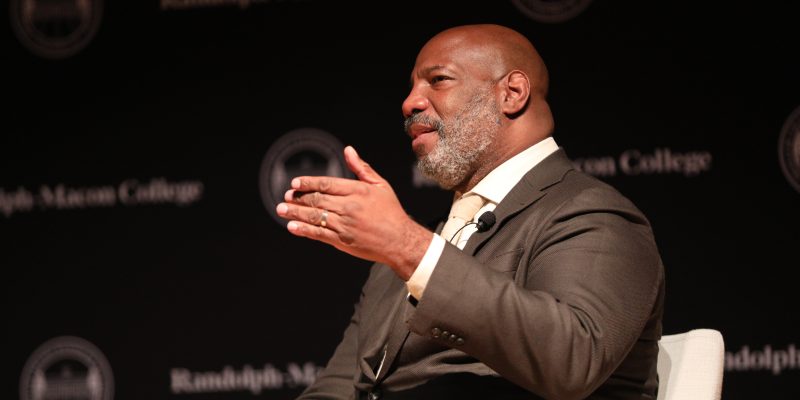
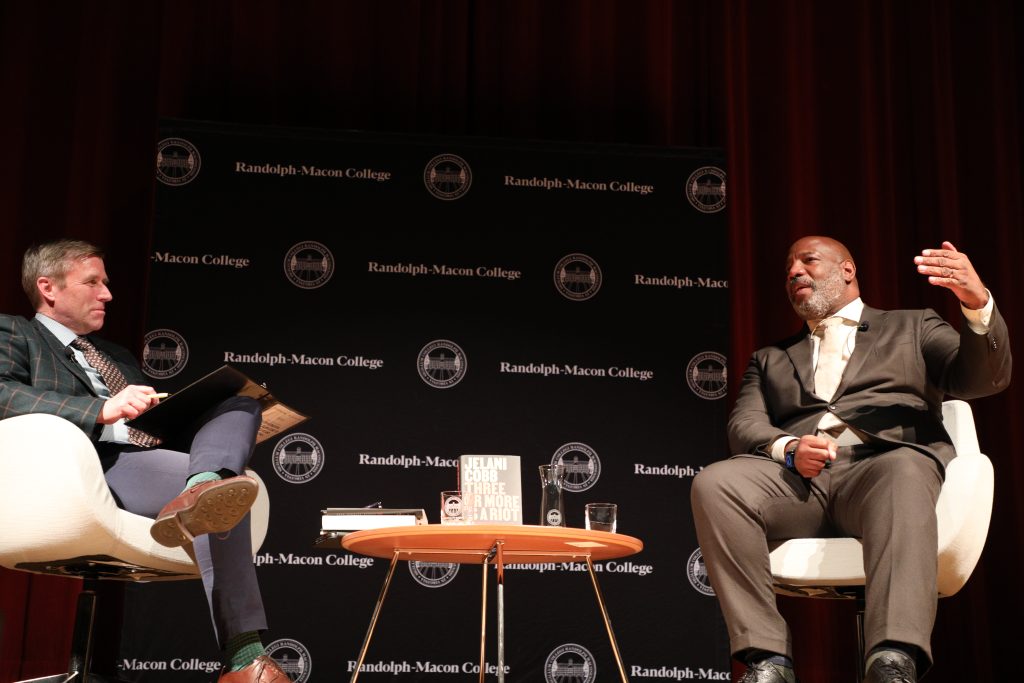
Award-winning journalist and author Jelani Cobb shared the Blackwell Auditorium stage with Randolph-Macon President Michael Hill Wednesday night for a wide-ranging conversation. The discussion was part of a week of programming celebrating the life and legacy of Dr. Martin Luther King, Jr.
In addition to serving as the Dean of the Columbia Journalism School, Cobb is a staff writer at The New Yorker, where he writes on history, justice, politics, and democracy. He has served as a correspondent for critically acclaimed PBS Frontline documentaries and has authored several books, including The Substance of Hope: Barack Obama and the Paradox of Progress.
Cobb’s most recent book, Three or More Is a Riot (2025), was a key topic of discussion Wednesday night. Cobb explained that the title of his book came from a law in 18th century South Carolina that, following the Stono Rebellion, defined an assembly of three or more enslaved people as a revolt.
The first chapter of Three or More Is a Riot juxtaposes the shooting of Trayvon Martin with the 2008 presidential campaign. Cobb reflected on the continuing thread from that moment through our current political landscape. “That was the first piece I ever wrote for The New Yorker,” Cobb said. “[My editor] said ‘this is interesting, why don’t you keep following the story to see where it goes?’ I feel like I spent 13 years doing that, there were so many things that were connected. What happened with Trayvon Martin was this inception point.”
Expanding the conversation and reflecting on King’s legacy, and its impact today, Cobb praised his “brilliant” rhetoric and characterized his leadership during the Civil Rights movement as a “backroom operator.”
“He took a particular set of entrenched social policies, and rather than describing them as racist— which he did, but that’s not what he led with—rather than describe them as barbarism, he described them as sin,” Cobb explained. “He spoke in the theological language that Americans of many stripes could understand, could grapple with. Saying it is sinful for you to treat your fellow Christians in this way. And look at all these Christians who I have with me in their Sunday best. It’s sinful to bomb the church.”
Further, Cobb argued that we should remember King not as a mythologized figure, but as a human striving and working for change.
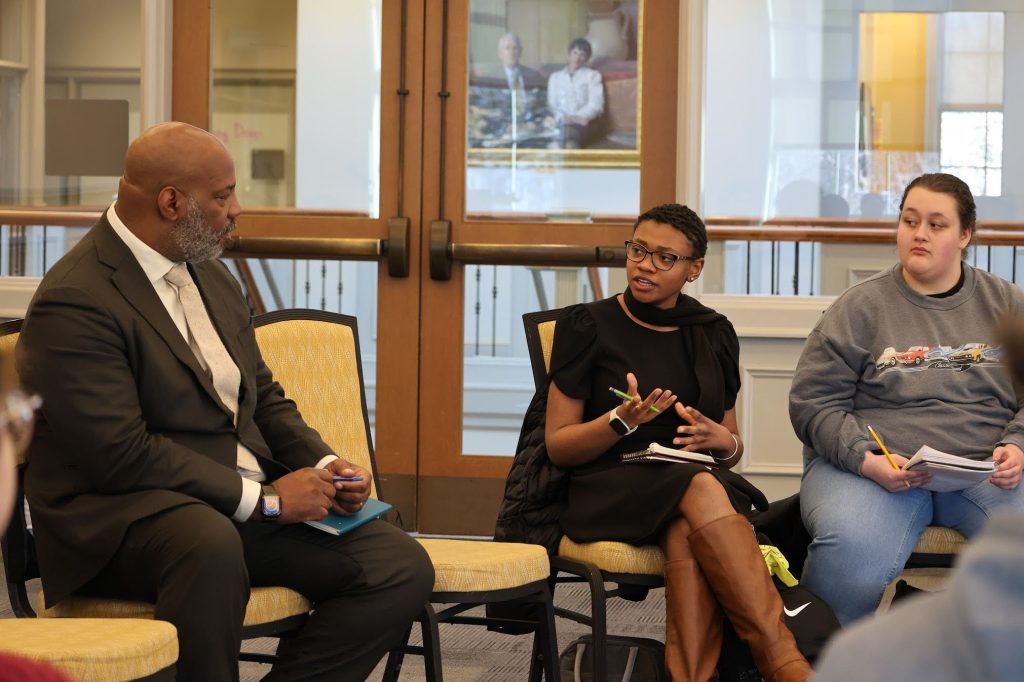
“This idea of King being the all-knowing sage who is the fountain of wisdom and all these other things, I think that we’re better off without it,” Cobb said. “We’re better engaging with him as the brilliant, talented, fallible, insecure human being that all of us are.”
On legacy and the present political moment, Cobb shared a metaphor, telling the story of his young sons viewing a storm off in the distance from their New York apartment before the rain reached their windows.
“We’re trying to map these storms,” Cobb explained. “The question is how is the storm moving? What direction is it moving? How do we act in response to it? And how do we get ourselves to a place where we’re safe?”
Ultimately, Cobb asserted that he remains hopeful in the face of storms that the justice Dr. King fought for can be a reality.
“Having that longitudinal view of history makes the world look different,” he said. “In the long run, the movements that I admire and that I try to study and understand faced much longer odds than we do right now.”