

Former Political Prisoner Vladimir Kara-Murza Offers Vision of Hope for Russian Democracy

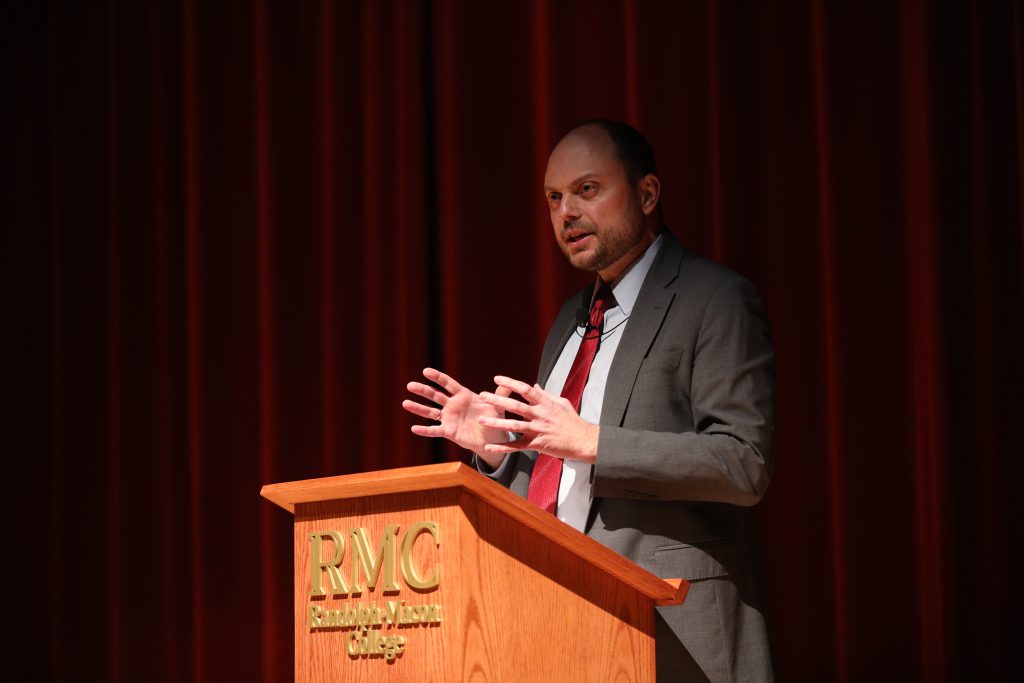
Vladimir Kara-Murza, a Russian author, historian, opposition politician, and former political prisoner, delivered Gone Today, Here Tomorrow: The Fight for Democracy as part of the Paul and Lois Watkins Lecture Series inside Blackwell Auditorium at the Center for the Performing Arts on Nov. 6.
Kara-Murza’s lecture detailed his time as a political prisoner in a Siberian penal colony, strongly condemned the authoritarian rule of Russian president Vladimir Putin, and laid out a vision for a democratic and free future for Russia. Kara-Murza’s remarks were followed by a Q&A session moderated by Dr. Mine Eren, Professor of Modern Languages and Director of the Film Studies program.
Kara-Murza was arrested in April of 2022 for publicly denouncing Russia’s invasion of Ukraine and later sentenced to 25 years for “high treason.” He described the harsh conditions in solitary confinement, where he would pace his 3×4-meter cell with only an hour and a half per day with pen and paper to read and write.
“You stop understanding the difference between what is real and what is imagined,” Kara-Murza recalled. “It takes a special effort in these conditions to actually keep one’s sanity.”
Despite the tortuous conditions, Kara-Murza maintained his writing and earned a Pulitzer Prize for his columns written from prison. He described the surreal day in August of 2024 where guards led him out of his room off the normal schedule, a moment he was convinced would lead to his execution but instead put him on a plane that led to Ankara, Türkiye, where he was part of the largest East-West prisoner exchange since the Cold War. There, he spoke on the phone with then-U.S. President Joe Biden and, for the first time in years, his wife and children.
While he is now a free man, Kara-Murza recognized those who are still political prisoners under Putin’s regime, including Arseny Turbin, a teenager sentenced to prison for distributing leaflets criticizing Putin and the war in Ukraine. Kara-Murza used the staggering number of Russia’s political prisoners—thousands, more than those imprisoned under the authoritarian Communist regime of the Soviet Union in the 1980s—to make the case that Putin is operating as a dictator.
His other evidence included the elimination of independent media outlets in 2003, and elections that were technically free, but far from fair. Kara-Murza recalled his own opposition candidacy for parliament that suffered significant government interference.
“The story of Russia since then has been a story of non-stop tightening of the screws,” Kara-Murza said. “Full steam ahead from authoritarian to totalitarian rule.”
The final line was crossed, in his view, with the 2015 assassination of former deputy prime minister and opposition leader Boris Nemtsov, gunned down in front of the Kremlin. Kara-Murza argued this act was tantamount to murder by Putin’s hand, and a warning for other countries around the world.
“We see that internal repression and external aggression always come as part of the same parcel,” Kara-Murza asserted. “Because a government that does not respect the rights of its own people will not respect the borders of other countries.”
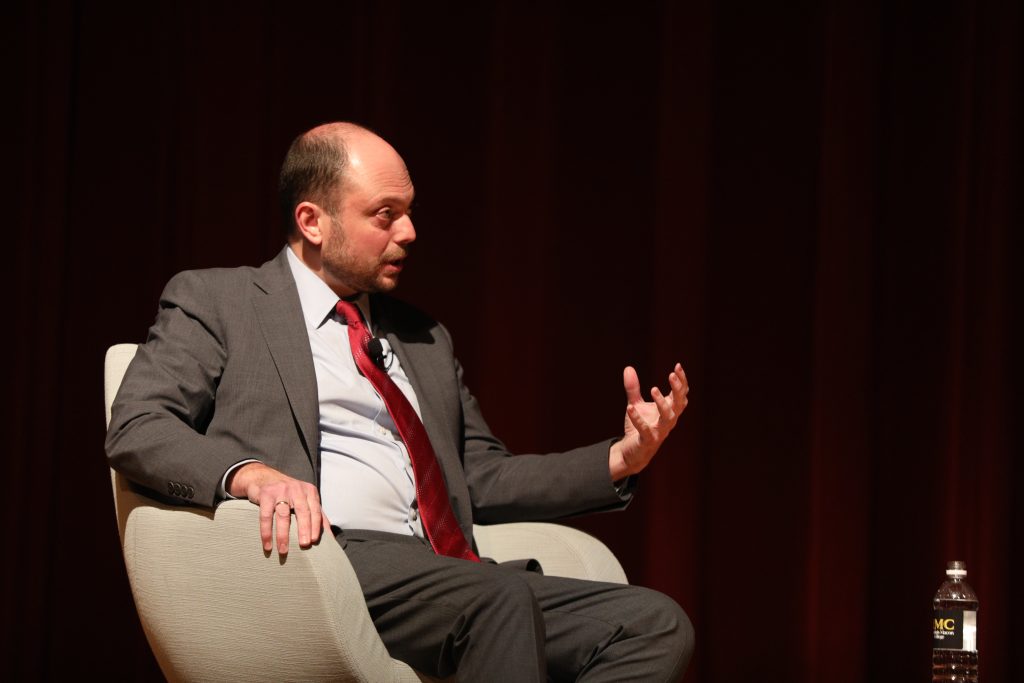
But he also painted a picture of hope, pointing to the inevitability of the end of Putin’s reign. He drew on the history of Russia, a cycle of reform and regression, and called on his countrymen to not make the same mistakes that were made in the early 1990s after the fall of the Soviet Union, because the window to make lasting change will be short. For Kara-Murza, a key element will be “transitional justice.”
“It’s really all about transparency and accountability,” he argued. “It is when the archives are opened up, detailing the past crimes of the fallen regime, the people who are committing these crimes are brought to account, the state security structures that are perpetrating these crimes are disbanded, and when the ideologies and practices of the former regime are publicly and unequivocally condemned.”
Before his talk, Kara-Murza held a Q&A session with RMC Honors students, one of whom—political science major Kayla Klontzaris ‘26—gave a formal introduction of Kara-Murza to the Watkins Lecture crowd. In both his conversation with students and the discussion led by Professor Eren, Kara-Murza emphasized the role of young people in driving change and inspiring hope for a brighter future in Russia and beyond. In particular, he commended the Feminist Anti-War Resistance.
“Frankly, when I look at these people, I’m filled with hope and optimism about the future of my country,” Kara-Murza said. “Because these young girls who are in the Feminist Anti-War Resistance, they are the future of Russia and not a septuagenarian dictator in the Kremlin.”
RMC’s Watkins Lecture Series
The Watkins Lecture Series was established in 1999 by Marion Watkins Herget and Dr. George D. Watkins ’44 and is named in honor of their parents, who owned and operated the Herald-Progress newspaper. The series brings together the Town of Ashland and RMC communities—two entities important to the Watkins family.
The Watkins’ gift has provided lecture attendees the opportunity to hear from a host of notable speakers, including Bill Bryson, Soledad O’Brien, Ari Shapiro, Nina Totenberg, James Carville, Julian Bond, Bob Woodward, David Gergen, Rubin “Hurricane” Carter, and Anthony Ray Hinton.