

Faculty Q&A: Using Environmental DNA to Track Hard-to-Find Animal Populations with Dr. Stephanie Coster
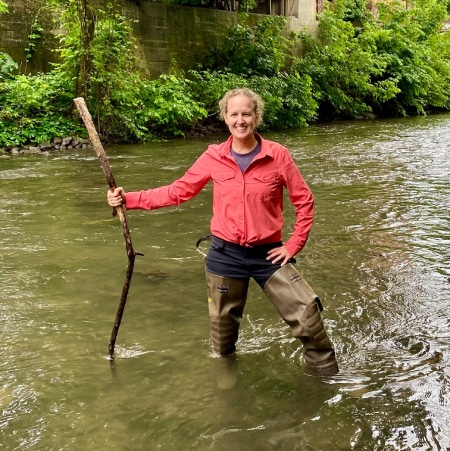 Dr. Stephanie Coster, Associate Professor of Biology, uses genetic techniques to answer ecological questions and facilitate the management of wildlife populations.
You’re working with the Virginia Department of Wildlife Resources to track nutria. What are they and why do they need to be tracked?
The nutria is a mammal, very similar in size to a beaver, with a narrow round tail and really big orange teeth, and they’re an invasive species. They’re native to South America and were brought to the U.S. and Europe because they were thought to be good for fur farming. Since then, populations in the wild have exploded. One of the problems with them is they live in wetland systems and instead of eating vegetation that’s above ground, they tear up all the vegetation and eat everything underground, so they are a huge menace to wetland resources and marshes.
How are you tracking them?
One of the tricky things about working with this particular animal, and often animals in general, is that they can be hard to find because they’re hiding. The technique that we’re employing to track them is called environmental DNA. I have a grant from the Mid-Atlantic Panel on Aquatic Invasive Species to test out this technique in Virginia. This is where we take water samples and filter them, and essentially we are looking for remnant DNA in the water system from that target organism to determine if that organism is present or absent from that area.
Environmental DNA is a theme in your work. What other projects involving eDNA are you working on?
I’ve been working with the Canaan Valley Institute to explore how stream restoration projects are impacting the very elusive hellbender, which is a giant salamander that lives in stream networks. We’ve been using eDNA to figure out where they are and where they are not and trying to see if some of their restoration work is impacting the presence of those hellbenders.
I’ve also been working with Dr. Nicholas Ruppel, who is a plant biologist at RMC, to figure out what kind of pollinators are interacting with flowers.
I’ve also been using this technique on crayfish. One concern is the rusty crayfish impacting brook trout fishing because the crayfish and young brook trout are going to be competing for the same food resources. If the crayfish get into Raystown Lake in Pennsylvania, which is known for fishing, that’s bad for the trout fishing industry. With invasive species, it’s all about tracking them and helping stop the spread.
How do organisms leave this DNA behind for you to collect?
This could be feces, urine, shedding skin, or reproductive output. For the hellbender, specifically, it’s quite interesting; the best time to sample them is during their breeding season because they have this breeding scenario where the males release sperm into the water system, so there’s lots of cells there. Whereas otherwise, they’re hiding underneath rocks, and they’re not doing a lot of shedding skin.
How does the process of testing for eDNA work?
There are two different types of environmental DNA techniques. One of them is specific for a target organism, like with the nutria. You filter a sample of water and run a DNA extraction process to extract all the DNA from all the organisms that were caught in that filter. Then you have a specific target probe of interest that you run on that mix of DNA, and when you run it through a qPCR machine, it has a fluorescent label attached to it. If the animal is present, it will light up and you’ll get a signal. If that animal is absent, you’ll get no signal.
For the pollinator work, it’s a little different as it’s based on metabarcoding. If I’m interested in all the pollinators that could possibly land on a flower, the target there is much more generic. We extract the DNA very similarly, but instead of having that fluorescent probe that tells us about a single species, we have to sequence all the DNA that we have in the sample. Once we get that sequence, we can match it up to known sequences and determine which organisms were there.