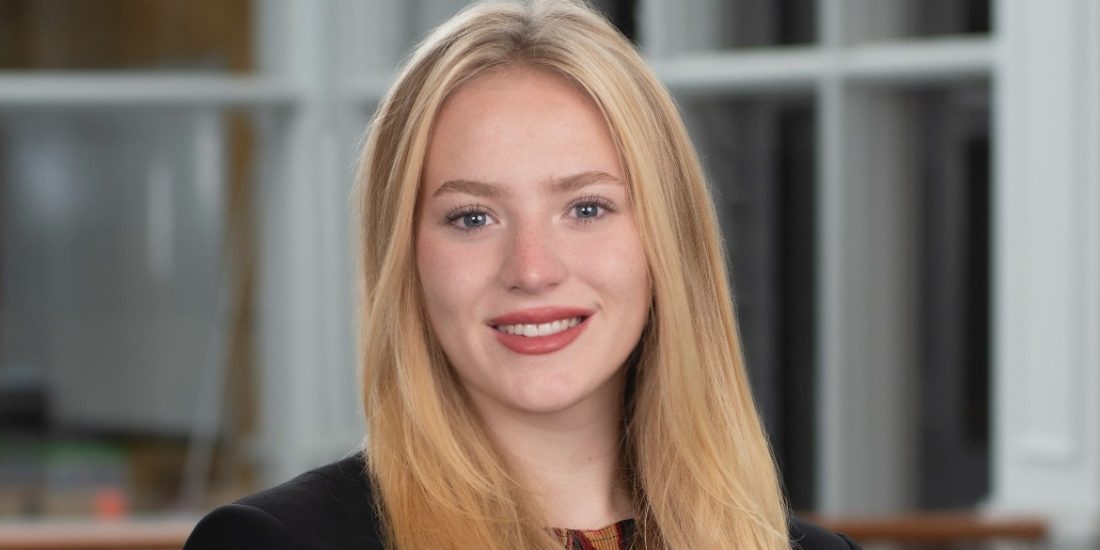


Exploring Independent Archival Research: Waverly Gouldman ’20
Randolph-Macon College student Waverly Gouldman ’20 is spending the summer researching a topic that has long interested her: the evolution of slave resistance in Virginia. As a participant in RMC’s Schapiro Undergraduate Research Fellowship (SURF) program, Gouldman is doing 10 weeks of research under the guidance of History Professor Mathias Bergmann.
A history major and education minor, Gouldman spends much of her time combing through resource materials at Richmond’s Library of Virginia. Founded in 1823, the Library is the most comprehensive resource in the world for the study of Virginia history, culture and government.
Reading Between the Lines
Gouldman’s topic, An Analysis of the Evolution of Slave Resistance in Virginia, 1730-1830, requires that she read a lot of secondary source and archival materials about the 1730 Chesapeake rebellion, Gabriel’s conspiracy, and Nat Turner’s rebellion, and analyze the possible similarities in their means, methods and goals of the resistance efforts.
“I am also looking at primary source documents, such as newspapers from 1730 onward, and Virginia Governor papers,” she explains. “In doing this I am ‘reading between the lines’ of what white authors wrote in order to determine the motivations of the slaves and their reasons for rebellion.”
Significant Historical Research
Bergmann notes, “Waverly developed a challenging project that will test the critical reading and analysis skills that she has developed as a history major. SURF has already been a rewarding experience for her by allowing her to conduct in-depth research into 18th- and 19th-century documentary evidence and to do the fun part of history—finding and synthesizing fragmentary evidence from past generations to create a fuller understanding of the past. Few of her peers at other institutions benefit from the opportunity to conduct original and significant historical research and writing.”
Exploring Capabilities
Gouldman was inspired to apply to the SURF program after she heard a lecture about Nat Turner at Stratford Hall Plantation, where she works part-time.
“I was drawn to the idea of looking further into Virginia slave conspiracies and rebellions,” she says. “It was close to home, quite literally, as I grew up 10 minutes from the plantation and now work there, and it was something I hadn’t heard about before. I applied to the SURF program because I want to explore my capabilities as a researcher and the possibility of contributing something new to my field.”
Independent Archival Research
“Having taught Waverly in several courses, I knew about her academic strengths and preparedness for the project, but I have been amazed by how quickly she took to independent archival research at several sites, an often daunting task for a novice researcher,” says Bergmann. “She is making connections—both with professionals in the field and among events in the past—and really putting into use her historical skills. I am eager to see her results.”
Through her research, Gouldman “hopes to uncover an evolution from the rebellions/conspiracy that they are either unique to their own time period or that they built off of each other—for example, the 1800 conspiracy and the 1830 rebellion. SURF gives me a sense of independence and confidence and empowers me to think about future research projects.”
Guidance and Expertise
Gouldman, a member of the Student Virginia Education Association and Delta Zeta sorority, is grateful to Bergmann for his guidance and expertise.
“Professor Bergmann is a great mentor because he listens to any assumptions I have and helps me either develop them further—or drops a hint that I am way off track!” she says. “He is an invaluable resource, and I am thankful to him for encouraging me to major in history—and to do a SURF project. Mentorship is another example of the ‘personal touch’ that makes RMC unique.”
Future Plans
Gouldman, the recipient of the Coke S. and Adele C. Sheffey Scholarship and the Scanlon-Kilduff Scholarship, plans to work as a kindergarten teacher and pursue a master’s degree in education.
The SURF Program
The SURF program was established in 1995 through a generous endowment made by Ben Schapiro ’64 and his wife, Peggy Schapiro. The Schapiros continue to support this program, which promotes scholarly undergraduate research by students in all disciplines. Ben Schapiro has served on a number of RMC committees, including the Board of Trustees and the Society of Alumni.
In order to participate in the program, students write proposals and apply for grant money to fund their research. SURF students receive a stipend and room and board, and results of their research are presented at the annual SURF Symposium and on Research Day. Many SURF participants have presented their research throughout the United States and internationally, and some have published their work. The SURF program is co-directed by Art History Professor Evie Terrono and Chemistry Professor Serge Schreiner.