

Environmental Studies Program to Monitor Benefits of Removing Ashland Mill Dam
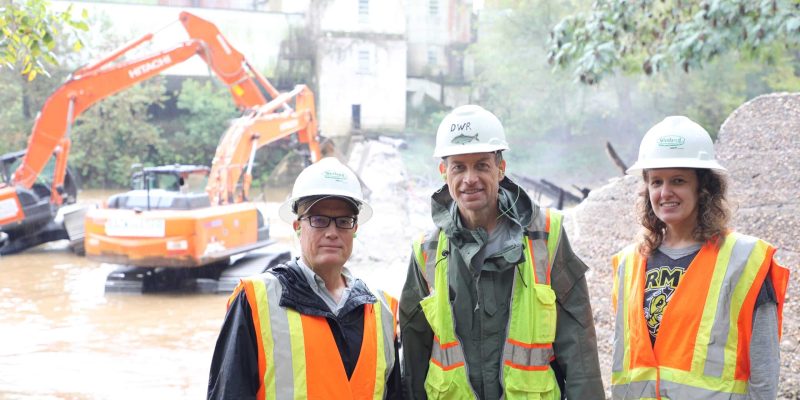
The dam’s removal is linked to a public/private/academic partnership.
Randolph-Macon College’s Environmental Studies Program is partnering with the Virginia Department of Wildlife Resources (DWR) to conduct biological monitoring of the South Anna River after removal of an obsolete dam north of Ashland, Virginia. The dam’s removal will give access to at least seven species of fish, including American shad, that are currently blocked from accessing over 400 miles of historical spawning and rearing habitat above the dam.
Removing the dam has been a high priority for the Virginia DWR for many years because of declining fish populations, particularly those which grow up in the ocean and then return upstream to spawn in rivers.
“The dam has obstructed the migration of seven species of diadromous fish, including American shad, river herring, American eel, and sea lamprey, on the South Anna River for over a century,” Randolph-Macon professor and Director of Environmental Studies Dr. Chas. Gowan explained. Professor Gowan has been personally involved in research that has pointed to the need to remove the dam for nearly 20 years—and has often incorporated students in the work.
Davey Mitigation, a private ecological restoration firm and a division of Davey Resource Group, Inc., is completing the long-desired ecological restoration project in pursuit of mitigation credits, issued by the U.S. Army Corps of Engineers and the Virginia Department of Environmental Quality, which are sold to developers to offset environmental impacts of future projects in the York River watershed. This is the first time a dam removal project of this type has been implemented in Virginia using this business model, which offers a way to protect the environment at no cost to taxpayers.

Alan Weaver, Fish Passage Coordinator with the Virginia DWR said, “Dam removal is the best approach to provide fish passage. This is a major achievement, a great accomplishment for the ecological improvement of the river and a long-awaited win for migratory fish restoration. It’s a great example of private, public, and academic teamwork.”
Randolph-Macon and DWR are conducting the pre- and post-removal monitoring necessary to document the environmental benefits of the project, including monitoring physical conditions in the reservoir and river, water quality, and fish use of the river.
This summer, Jacob Langley ’26 completed a Schapiro Undergraduate Research Fellowship focused on the project.
This fall, 27 RMC students are doing the work as part of interdisciplinary ‘problem-solving’ courses that are core to the environmental studies curriculum at RMC. Each class works for an entire semester for an off-campus client. Majors take three such courses, each time with a different client and a new project. Gowan explains, “These courses form the cornerstone of the Environmental Studies major and provide excellent training for a variety of careers in environmental science, public policy, economics, engineering and other environmental sub-disciplines. Our majors enter the workforce or go to graduate school ready to hit the ground running as environmental professionals.”
Monitoring will continue for at least 10 years, with a variety of techniques and phases of student participation. Randolph-Macon biology professor Dr. Stephanie Coster is also working on the project, conducting environmental DNA analysis to document the presence of various fish species below and above the dam. “With eDNA, we’re adding an extra level of sensitivity to see if fish are making it past the dam, which is a great new tool to have alongside traditional fish sampling,” said Coster.
Ultimately, the work is likely to involve hundreds of students who will be trained in monitoring techniques and educated on the regulatory and economic aspects of the project. “This dam removal is a particularly rich example that helps students see how they might approach environmental programs from a scientific, governmental, or business career. What makes this project a huge public win is also what makes it a wonderful interdisciplinary learning experience. That’s extremely rewarding for us at Randolph-Macon,” Gowan reflected.