

Dillard Family’s Generosity Creates A Winning Legacy
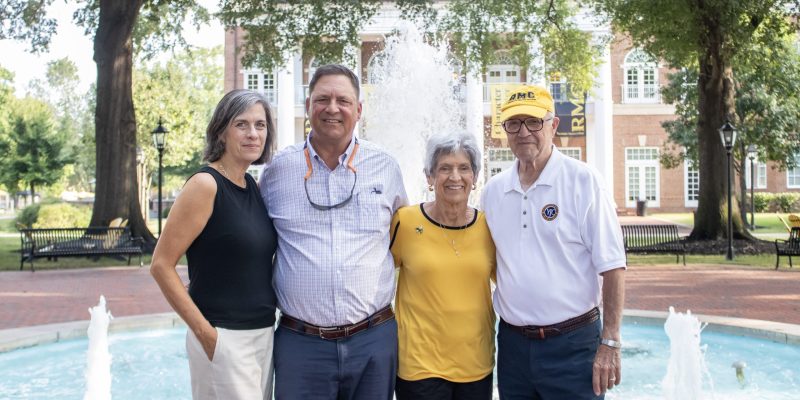
It’s a humid Tuesday morning, and Parker ’62, Beverly, and Paul ’89 Dillard are sitting on a shade-covered bench in the Frank E. Brown Fountain Plaza just before 9 a.m. “Cheryl’s not here yet,” Paul says, glancing down at his watch. “But knowing her, she’ll say she’s still got eight minutes,” he says of his wife with a smile.
As if summoned, Cheryl ’91 appears on the other side of Henry Street. When she spots her husband and in-laws, she quickly goes in for a hug.
The closeness between them is immediately apparent. They feel at home with each other, but it’s more than that; they also feel at home in this place.
Perhaps because for all four of them, Randolph-Macon plays a significant part in their stories.
In his senior year of high school, Parker was visited by legendary RMC Baseball coach Hugh Stephens. Parker admits he wasn’t the strongest student, but Stephens saw potential in him and recruited Parker to play left field for the Yellow Jackets.
“I was grateful,” Parker says joyfully. “And as I got older, I was really grateful for the opportunity to come here.”
While at RMC, Parker played two years of football and four years of baseball. Athletics, he says, was a major part of his college experience, and when he wasn’t on the field, he could be found cheering on his classmates and fellow student-athletes.
In fact, that’s how he met his wife, Beverly. “I saw her from across the room in the alumni gym,” Parker recalls.
“I was on a date with someone else,” Beverly chimes in with a laugh.
The two started dating in Parker’s sophomore year. By then, Parker had found his stride in the classroom as an English major. “I made the connection,” Parker says of his academic journey.
Parker graduated in 1962, and soon after, he and Beverly married and started a family. Parker spent two years teaching English in public schools before joining his family’s welding supply business, which he later took over and grew into the welding supply giant Arc3 Gases. Beverly took up the helm at home, raising their four rambunctious boys.
In that busy season of life, the Dillards endeavored to stay plugged in at Randolph-Macon, with Parker as an inaugural member of the College’s Board of Associates and later the Board of Trustees. “I’ve always been a benefactor—not always a lot, especially in the beginning. But even if it’s $50, that makes a difference.”
They often brought their boys back to campus, creating a new generation of Yellow Jacket memories along the way.
“I remember the basketball games the most,” Paul Dillard ’89 says. “It was just such a great environment.”
Following in his father’s footsteps, Paul was also a multi-sport athlete in high school, but his talents shined brightest on the gridiron and caught the attention of another legendary RMC coach, Jim Blackburn.
“I’d grown up with Randolph-Macon, and I wanted to play ball—I wanted a shot. Coach Blackburn gave me a shot,” Paul says. Decades after Hugh Stephens had done the same for Parker, that opportunity fundamentally changed the course of Paul’s life.
At Randolph-Macon, Paul says he “learned to work.” He found his stride academically while developing the self-discipline that came with being a college athlete. The practices were grueling: 5 a.m. wake-up calls, multiple practices a day, and plenty of moments when he and his teammates wondered whether they wanted to keep going.
“They wouldn’t let me quit,” Paul says, pointing to his parents.
“We wanted to come see you play,” Beverly quips back with a laugh.
And then there’s Cheryl. Just as Randolph-Macon brought Parker and Beverly together decades earlier, it would bring Paul and Cheryl together, too.
Paul and Cheryl’s RMC experiences looked decidedly different. While Paul’s was underscored by athletics, Cheryl’s was centered around arts and academics.
“Meeting and going out with the quarterback…my friends were blown away,” Cheryl says with a laugh.
Paul and Cheryl eventually married and raised three children of their own. And as their relationship evolved, so did their relationship with Randolph-Macon.
Both even returned to the College professionally: Cheryl as the Clubs and Reunions Coordinator in the Office of Alumni Relations and Paul as an assistant football coach alongside the same man who had once recruited him, Jim Blackburn.
For Cheryl, her RMC education instilled an awareness of the responsibility people have to care for themselves and for one another.
“That,” she says, “is what the connections here are built on.”
It also taught her that challenges can be overcome and that failure can become an opportunity to learn. Those lessons have followed her throughout her life and career. Today, Cheryl works at SCRAP RVA, a Richmond arts nonprofit focused on reducing art-supply waste, while continuing the passion for painting and art she cultivated as an Arts Management student at RMC.
For Parker and Paul, athletics provided many of those same lessons.
“I’ve always felt athletics played a huge part in teaching me self-discipline,” Parker says.
The Dillards had different Randolph-Macon experiences across different generations, but the result was remarkably similar: each left the College understanding the value of opportunity, community, and investing in something larger than oneself.
Over the years, that understanding has translated into a deep commitment to giving back.
“Dad’s passion is contagious,” Paul says. “You just want to see your team win. That doesn’t necessarily mean athletics. It means academics, it means community, it means the culture.”
That desire to see their team win is exactly what has inspired the Dillards to give so generously to the College over the years. And while their own contributions have been significant, they are quick to emphasize that supporting Randolph-Macon isn’t only reserved for those who can make the largest gifts.
“Even if you’re young, in your early 20s, and all you can give is $50 to the Annual Fund, that’s important,” Cheryl says.
Those gifts and the generations of alumni behind them support the continued growth and development of the College.
Paul sees the evidence every time he returns to campus.
“The facilities from when I was here to now—it’s meteoric,” he says. “And I’m glad we could be part of it. The facilities are now worthy of the students.”
Someone gave Parker a shot. Years later, someone gave Paul one, too. Both took those opportunities and built families, community, and careers.
Now, the Dillards are helping make sure someone else gets a shot.