



Device-Free Classroom Enhances Student Experience
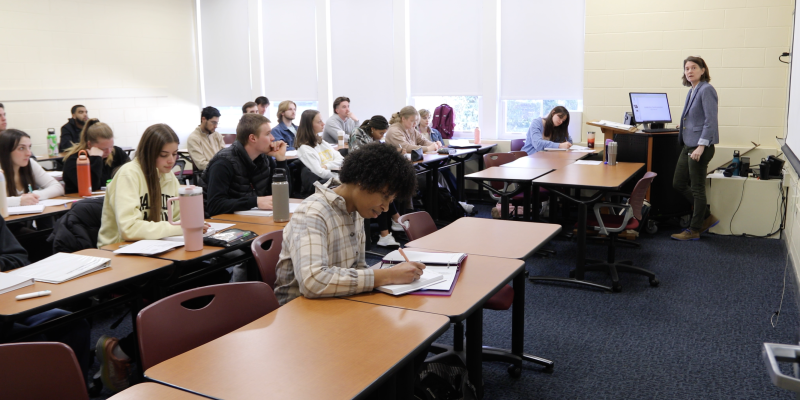
Like so many aspects of life, Professor Kelly Merrill felt she’d seen a shift in her communication studies classes since the 2020 pandemic: a notable decline in student engagement in class.
“It was much easier to scroll and be otherwise focused with online education, and I suspect that students brought that habit into the classroom,” explained Merrill, who has taught several classes as an adjunct faculty member at Randolph-Macon College for more than a decade. “Honestly, I know that I have brought that habit into meetings; I grab my phone mindlessly and know that I’m not fully engaged either.”
Fearing its impact on the quality of classroom discussion and students’ understanding of the concepts, Merrill decided to make a dramatic change in our modern world, banning devices entirely in her Interpersonal Communication classroom in the fall of 2024.
Her policy was highly unusual in higher education. It meant no scrolling on phones, of course, but also no laptops or tablets either.
“I heard some moans, but I think mostly they were up for the challenge. I present it with my rationale, and I also apologize,” Merrill said. “I say ‘I am so sorry. My inclination is to trust you as learners. But I think that we are drawn to these online places in a way that we’re not giving much thought to. And I do it too, and I’m going to try to help you through that temptation by just not allowing it as a classroom culture.’”
Practically speaking, the shift required a substantial shift in how students engaged with the readings and with note-taking. That too, Merrill saw as a tangible educational benefit to going device-free. “There’s research that shows that memory retention improves when we can learn something, and it goes from our brain to our hand, and not to type, but to actually write,” Merrill said.
And while the students may have been skeptical at first, the practice paid dividends in its first semester.
“The results of their exams were amazing. Their level of creativity in their assignments really spiked,” Merrill said. “Student engagement was probably the best I’ve ever seen before.”
“I was way more engaged than I have been with my other classes,” said Adelina Doyle ’26, a communication studies major. “I actually feel like I got more use out of it, more life skills out of it, just because I was more involved.”
Merrill was excited about how the fall class went and shared her enthusiasm about the experience on her personal social media. Her post got the attention of Cloth & Paper, a luxury retailer who donated some of their high-quality notebooks, pens, and highlighters for her classes in the spring.
“This is an amazing gift,” Merrill reflected on the donation. “This is an amazing opportunity to show students how this can be an art, this can be a lifestyle, that it can be part of the intellectual pursuit, a part of self-improvement, and part of being better people.”
With the success of the device-free class in the fall, Merrill expanded the practice to her J-Term class and now two courses in the spring. She was pleased when Doyle chose to enroll in her other courses as well.
She also hopes the experience impacts her students beyond just the walls of her classroom.
“At the end of the semester, I had a number of students tell me how much they appreciated the class,” Merrill said. “I rephrased it back to them and said, ‘If you think not being on your devices during class time was such a game changer, I challenge you to do that in your other classes and hold yourself to that standard to improve your own education, improve your own learning.’”