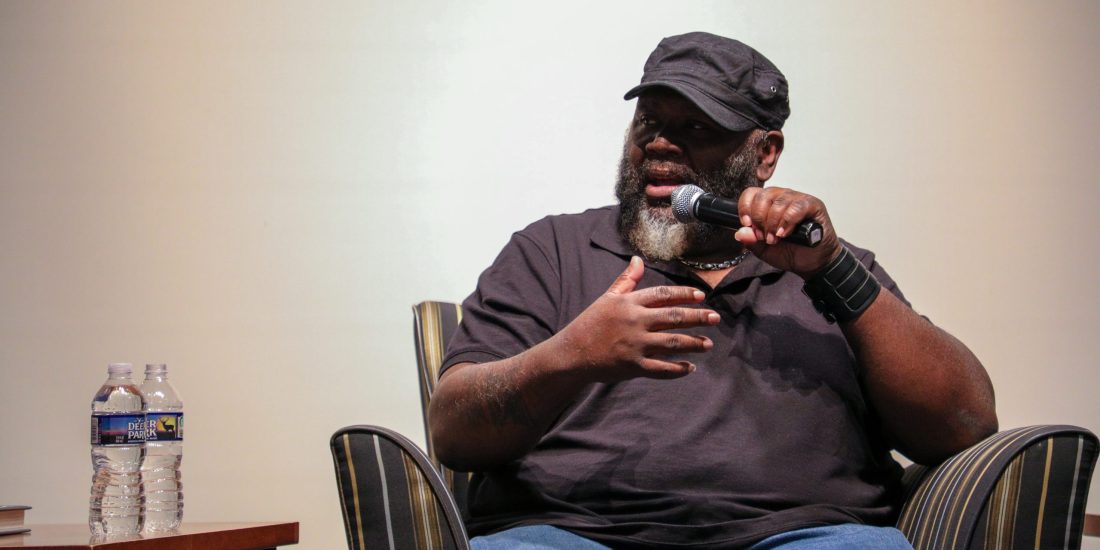


Close Student-Faculty Relationships, Interdisciplinary Study Celebrated as Part of Inauguration Week Ceremonies
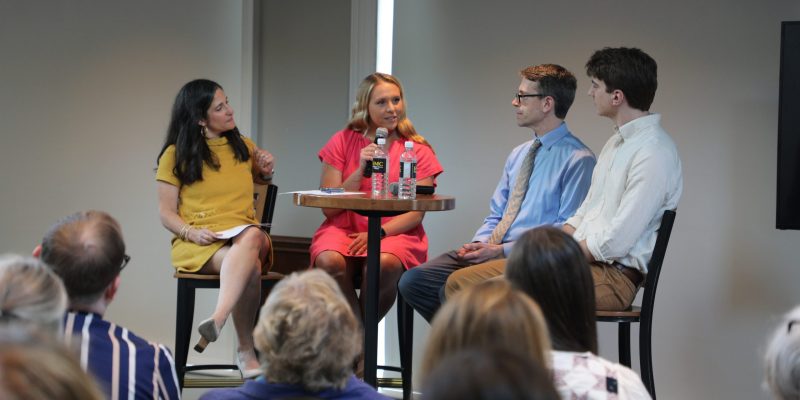
An Academic Symposium and Community Showcase hosted in Birdsong Hall Thursday afternoon, part of a week of programming celebrating the inauguration of Dr. Michael E. Hill as RMC’s 16th President, featured conversations from across campus highlighting the close relationships among students, faculty, staff, and alumni that provide meaningful experiences.
The symposium provided a glimpse into daily life culture at Randolph-Macon, one that Provost Alisa Rosenthal remarked fosters the “development of mind and character through close relationships between people who take each other seriously.”
Tackling Engineering: The Recruiting Partnership Between Football and a Fast-Growing STEM Field
Head Football Coach Pedro Arruza and Dr. Jim McLeskey, the Maria Wornom Rippe Professor in Engineering, shared the stage to discuss the relationship between athletics and academics, and how that dynamic can impact recruiting.
While many schools may limit opportunities for student-athletes to declare labor-intensive majors like Engineering or Nursing, faculty at Randolph-Macon work together with coaches to ensure the best possible experience for their athletes. That relationship can serve as a major recruitment tool to attract students with high academic ambitions who also want to compete at a high level.
“He’s our top recruiter,” Arruza quipped of McLeskey, who regularly has conversations with recruits to spotlight the value of the opportunities at RMC. Engineering is the fourth-most popular major on the football team (which has won four consecutive ODAC Championships), while roughly 50% of Engineering majors are student-athletes on one of RMC’s 18 NCAA Division III teams.
The ability to balance academics and athletics pays dividends for graduates. McLeskey pointed to the numerous RMC Football alumni who work for the Timmons Group, a regional civil engineering firm, as an example of this success.
FURtilizing Potting Soil: How Your Dog Could be Your Garden’s Best Friend
What started as a simple assignment in the class of Associate Professor of Biology Dr. Ben Ramage has evolved into a sustained line of research for RMC students—and potentially a revolutionary way to approach potting soil.
Zoe Long ’24 was first inspired by her newly adopted dog to design an experiment that tested the effect of using dog fur to help potted plants grow. While unorthodox, the nitrogen-rich makeup of the fur, combined with the soil mix, produced a dramatic difference in the growth of plants compared to those without.
Crucially, the dog fur could serve as a substitute for peat moss, a non-renewable resource that raises environmental concerns during harvesting. While Long has graduated and now works as a veterinary assistant, the research has continued. Shane Hale ’27, undertook a Schapiro Undergraduate Research Fellowship (SURF) to expand the replicates of the experiment: different ratios of fur to soil mix, new kinds of plants, and sterilized fur.
A chemical analysis revealed high levels of Imodium in the fur might explain the improved performance, and lay the groundwork for future students to keep pushing the work forward.
Reclaiming an Epic Voice: A Faculty-Student Collaboration in Classics
The research background of Rev. Dr. Bartolo Natoli, Professor of Classics, focuses on uncovering unheralded voices from antiquity. Left on the cutting room floor of Ancient Women Writers of Greece and Rome, a book co-authored by Natoli, was the story of fourth-century Christian poet Faltonia Betitia Proba.
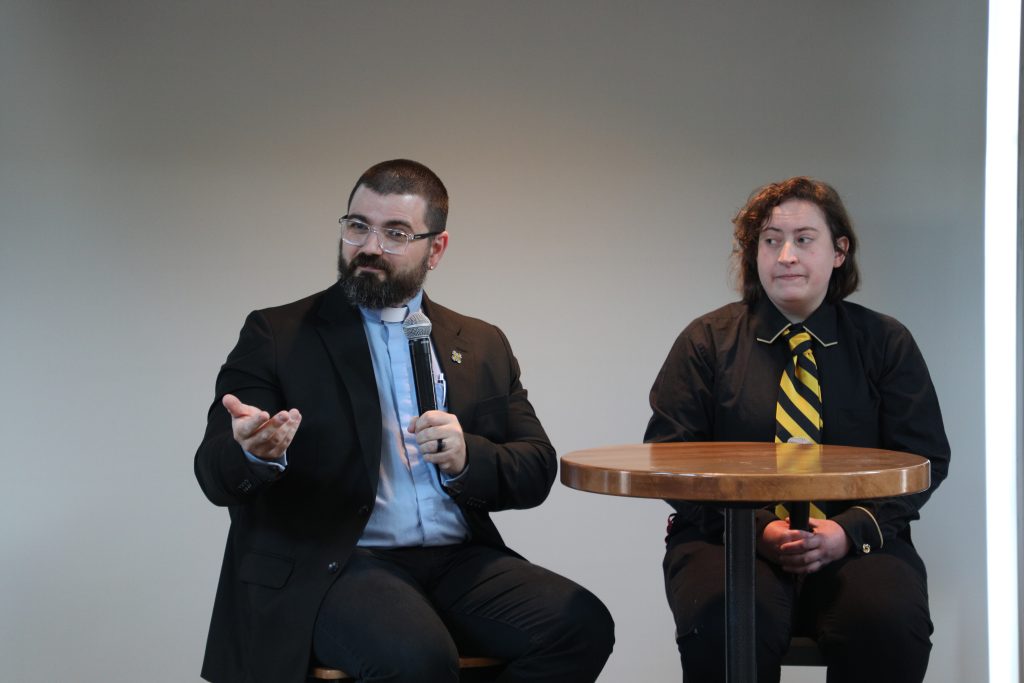
While Natoli wanted to elevate Proba’s Cento Vergilianus de laudibus Christi, no English-language commentary existed from which to teach. So, he and his students set out to create their own, work that will culminate in a co-authored textbook to be published next year.
Proba’s Cento is a poetical work composed entirely of verses from Virgil’s Aeneid, rearranging the pagan poem to tell the story of Christianity. This line of scholarship has spawned multiple SURF projects, including that of Maille Carrington ’27, who presented her work at the Classical Association of the Middle West and South (CAMWS), one of the largest gatherings of classicists in the United States.
Carrington cross-referenced texts in Latin, Greek, Italian, and Hebrew in an attempt to determine when exactly Proba penned her work, and in turn learn more about who she was. While laborious, Carrington described the work as the “first step to being a scholar myself.”
Solving Environmental Problems: The Case Study of the Ashland Mill Dam
For the better part of three decades, Dr. Chas. Gowan, Professor of Biology and Environmental Studies, fought for the removal of the Ashland Mill Dam. Among the approximately 8,000 dams in the Chesapeake Bay watershed, it was one of the five most environmentally destructive, prohibiting passage to hundreds of miles of the South Anna River to seven species of fish.
When Davey Mitigation, a private ecological restoration firm, finally removed the dam in 2024, RMC’s Environmental Studies program partnered with the Virginia Department of Wildlife Services to conduct biological monitoring of migration and spawning of the affected species.
This also served as an opportunity for the Environmental Studies program’s Environmental Problem Solving course, which pairs students with real-world clients to solve a real-world problem. This unique coursework simulates the kind of work that graduates will do as environmental professionals.
“Interdisciplinary means things are integrated together to meet the needs of all the organizations,” commented Assistant Professor of Biology and Environmental Studies Dr. Liz Burmester. “It’s beautiful to watch how all these things are connected to each other.”
A Legacy of Powerful Internships: A Conversation with Richline
Dave Meleski ’81 is the CEO of Richline Group, a manufacturer and marketer of jewelry and precious metals, and a Berkshire Hathaway company. Every summer since 2014, he has partnered with the Edge Career Center to host RMC students for internships in New York City.
In contrast to the “meat grinder” of a typical investment bank internship, Meleski strives to give students a full and valuable experience. Beyond living and commuting in New York, often much different than life in Ashland or Richmond, interns work in the areas of data analytics, sales, and merchandise. Even over the span of a few months, Meleski remarked that he often sees students mature significantly through the internship.
Amr Areikat ’26 interned with Richline this past summer, using data to make decisions and forecasts for materials amid an evolving global economy. Not only did he learn a lot, but the experience also bolstered his resume to land future internships and jobs. In his words, getting out of his comfort zone was “the best decision.”
Travel Course Experiences: Studying Human Rights in the Netherlands
RMC’s unique January Term structure allows students to take impactful study-travel courses in between the fall and spring semesters, offering opportunities for cross-cultural education.
This January, Sociology and Anthropology professors Dr. Brittany Freelin and Dr. Scott London led a travel course to the Netherlands focused on human rights, with visits to the International Criminal Court in The Hague and the Anne Frank House in Amsterdam.
Not only did the course explore who decides justice around human rights, it brought students to the institutions who make those decisions in person. The course also allotted time for students to explore the country, a hands-on anthropological study of their own.
Ella McClenny ’26 described meaningful interactions with Dutch locals, noting that “at the end of the day, we’re all people that want to learn from each other.”