

Chemistry Department Receives Donated Instruments from Ashland Offices of Multinational Firm
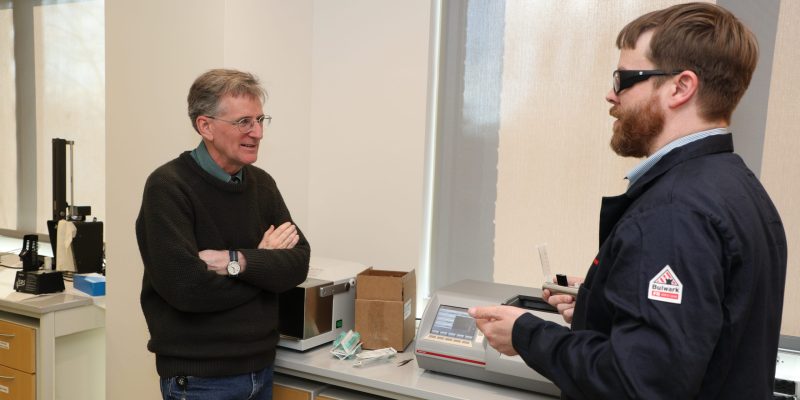
Anton Paar, a multinational company that develops, produces, and distributes highly accurate laboratory instruments, has donated two instruments—a polarimeter and a Monowave 50—to Randolph-Macon’s Department of Chemistry for use in its labs.
A polarimeter is an instrument used to measure optical rotation, a valuable piece of data within the chemical makeup of substances. Often used in industries like pharmaceuticals, food and beverages, and fragrances for quality control, these instruments retail for tens of thousands of dollars.
The Monowave 50 is an instrument that heats up samples at both high temperature and high pressure, allowing for reactions that could take an hour under normal conditions to be completed in minutes.
“We can now make the connection from what we talk about in the classroom and what you can do in the laboratory,” said Dr. John Thoburn, the Garnett-Lambert Professor of Chemistry, who teaches the Instrumental Methods of Analysis course.
Among its global locations, Anton Paar has a regional office down the road from RMC in Ashland, Va. The company is a world leader in the measurement of density, concentration, and CO2 and in the field of rheometry.
“Being able to donate some instruments that we have, that we’re capable of donating, to give the next generation of students the ability to understand science is really important to us as a company,” said Greg Sesny, Anton Paar’s Apprenticeship Program Manager. “It’s part of our DNA to be philanthropic to our institutions, and as a company in Hanover County, we want to be great neighbors.”
Thoburn already has plans on how to incorporate this technology into the classroom.
“A good fraction of drugs are chiral, and that’s really important for how they behave and how they function in the body,” Thoburn explained. “What I’d like to do is bring that into the laboratory, have the students make a compound that is chiral—a compound that is asymmetric—and then do some measurements on it. Have they made the compound they were supposed to? Is it pure? All that you can find out with this piece of equipment.”