






Cheers to Wash-Frank
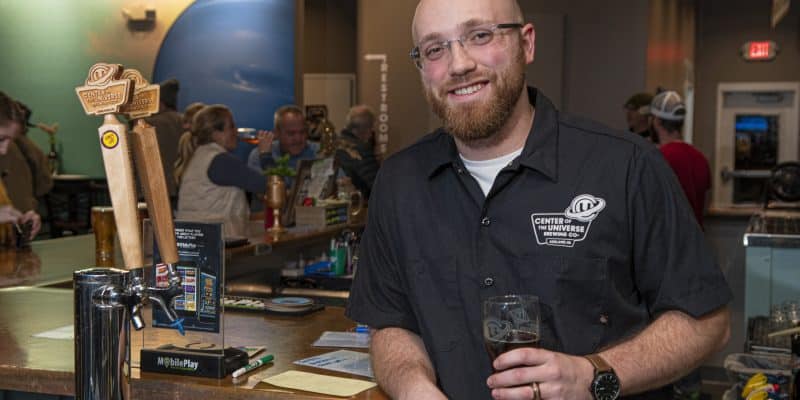
Brewer Nathan Landers ’16 on the Red Wheat Lager that Commemorates Wash-Frank’s 150th
When history professor Michael Fischbach first began brainstorming ways to celebrate the 150th anniversary of the building of Washington-Franklin Hall, he turned to a former student and current collaborator in Nathan Landers ‘16. Landers, brewer at Center of the Universe (COTU) Brewing Company in Ashland, was a history major at RMC and has partnered with Fishbach on several occasions to bring ancient ales to life with historical context.
Together, they hatched a plan to create The 150, a red wheat lager that commemorates the College’s first building on its Ashland campus and the present-day home of RMC’s history department.
Read on to learn more about beer-making choices made to honor the legendary Wash-Frank.
Why did you select a red wheat lager?
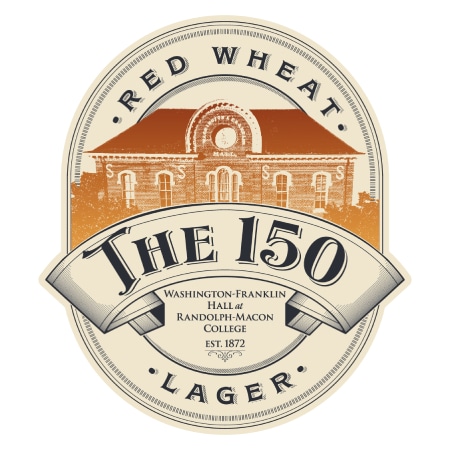
We wanted to use wheat because, at the time that Wash-Frank was built, wheat was actually the primary cash crop in Hanover County. It was worth more than tobacco. So, we got local soft red wheat, which actually grows better in Virginia soil than barley ever does. [In particular,] we wanted to make it red because of the bricks of the building.
What else did you learn while researching this project?
I learned that the architecture of Wash-Frank is supposed to be based on Italian villas and farm estates from the medieval era. When I read about the tall windows of the style, one thing that stuck out to me was that the beer should be rustic because of the brick, but also elegant because of those windows. But we also knew it should be something of the common people, and that’s why we went with a lager.
What is the process of making this and other beers?
We will take grain that has been malted, which is a process of soaking and drying grain, and in some cases roasting them. The grain themselves grow an endosperm, which then allows us to extract all the sugars, proteins, etc. that are in the piece of grain itself. We’ll crush those up and we’ll mix them together with hot water; depending on what body or flavor profile we want, we’ll adjust the temperature of that water. If we want something that has a really thick body, we’ll boost up that temperature. If you want something a little more crisp, we’ll go low.
From that process, we’ll rinse all the grain and drain it out into our kettle. Then we’ll boil it for a certain amount of time; depending on the grain you use, you can go from 60 minutes to 90 minutes. From there, we’ll cast that out into our fermenters and ferment that for a certain time depending on the style. For lagers, it’s typically two to three weeks. Lager yeast is a little slower because it ferments at a lower temperature.
How does a red wheat lager compare to other types of beers?
You don’t normally see a wheat lager, so this is an experiment on our end too, which is always fun. For a red lager, think of an Irish Red. You’re going to have sweet, malty, and crisp flavors. We wanted to bring all of that into this, but still have wheat be the main focus. A big portion of this beer is both malted wheat and unmalted wheat, the latter to help give more body and head retention, which is the foam you have at the top of a glass. We also added dark wheat malt to help out with the color, and that dark wheat malt actually allows us to have a more complex flavor profile than just having wheat malt in there.
What will the beer taste like?
It should be tasting malty and caramelly. There should be some earthy depth from the wheat, and it’s pretty crisp as well.
COTU is a local brewer. Where did these ingredients come from?
We contacted a malting company in North Carolina called Riverbend, and they focus solely on local malting and local farms. They don’t source their grain farther than 500 miles or so from their facility. They had a wheat grain grown, they call it Appalachian Wheat, from a farm in Virginia.
Is this beer similar to what would have been enjoyed around the time Wash-Frank was built?
Probably not. At the time, it would have been more of a pilsner or your basic light lager; it still could have included wheat if they wanted to. At the time, Richmond was becoming a big scene for German lagers, so pilsners would have been more of a common thing to see than a red lager.
Yellow Jackets of drinking age can try the 150 at FountainFest on Friday Oct. 14 and in the tailgate lot at Homecoming on Saturday, Oct. 15.