

Berkleytown Park to Feature Stories Gathered by History Students
This past fall semester, the students in the Introduction to Public History course, taught by Assistant Professor of History Dr. Donelle Boose, visited museums and archives, and explored the myriad ways in which the public actively makes historical interpretations.
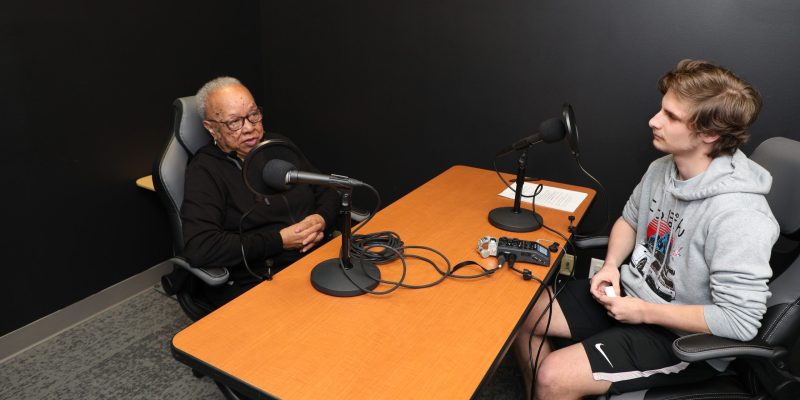
They also produced their own works of public history, conducting oral history interviews with residents of Berkleytown which will be prominently featured as the cornerstone of a heritage park project being developed by the Town of Ashland.
Berkleytown, situated along the northern edge of Randolph-Macon’s campus, is a historically Black community which developed in response to Jim Crow-era segregation in the early 1900s. Although Berkleytown has evolved over the years as community members aged and families relocated, its historic roots were recognized in 2022 when the neighborhood was added to the Virginia Landmarks Register and the National Register of Historic Places as the Berkleytown Historic District.
The land for the planned park project was donated by Habitat for Humanity at the suggestion of the Hanover County Black Heritage Society and its founder Carolyn Hemphill to be developed into a park that honors the history of the neighborhood.
Ashland held several community meetings to solicit feedback on the project. The vision that emerged was a park with walking trails that could serve as a quiet place of respite for the community, and tell Berkleytown’s compelling story.
“We always knew that it would be great to have this be not just a walking path, but a storytelling initiative or a heritage park, where as you walk, you could learn more about the context of the history of the people in the neighborhood around the park,” said Martha Miller, Ashland’s Assistant Town Manager of External Operations. The park will include signs with historical content throughout the park and QR codes linked to audio recordings of full interviews.
That’s where RMC students came in, utilizing the skills they’ve learned throughout Dr. Boose’s course. They read previous interviews with Berkleytown residents and visited the Hanover County Black Heritage Society to look at records and talk with Hemphill for her perspective on the community. From there, the students crafted questions to best elicit memories from four residents of the neighborhood.
Sylvie Leshen ’27 described interviewing Nell Morris, who still lives in Berkleytown and talked about the close-knit community she experienced as a child. “She was really big on saying that everyone around her felt like a parent.”
Julian Huber ’27 and his group interviewed Ms. Ella Grimes, who, among many stories, shared memories of being the scorekeeper for basketball games at John M. Gandy High School. “She was telling me all about the experiences of how important the high school and those games were for the community,” Huber said.
“I think it’s wonderful. It will leave something here to show that we were here, and we were a viable community,” Grimes said of the park project. She hopes future park visitors take away the message “that we were able to survive and thrive in this environment that was, I think, unfair for us to have to be in, but we learned how to deal with it. It gave us strength, courage, and hope.”
The park, which is on track to open in 2025, is nearly three and a half acres. It’s bordered by Archie Cannon Drive to the north, Henry Street to the east, Berkley Street to the south, and the train tracks to the west. The park will feature artwork from duo Tim Harper and Matt Lively in addition to the oral histories.
“We’re really excited about this being a true partnership with the College and the Black community here in Ashland, and we’re excited to see it come to fruition here,” Miller added.
The exchange of stories through the oral histories, and the powerful experiences across generations, have also inspired future career paths for some of the Randolph-Macon student participants.
“I would like to go into public history. I’m looking to work in museums, battlefields, and parks. So this is right up my alley,” Huber said. “[This project] gives me some experience, and this is something I can talk about in future job interviews. I think the biggest thing I’ve learned is that there’s so much public history.”