

Archaeology Students Unearth Remnants of Hellenistic Period at Pella Dig
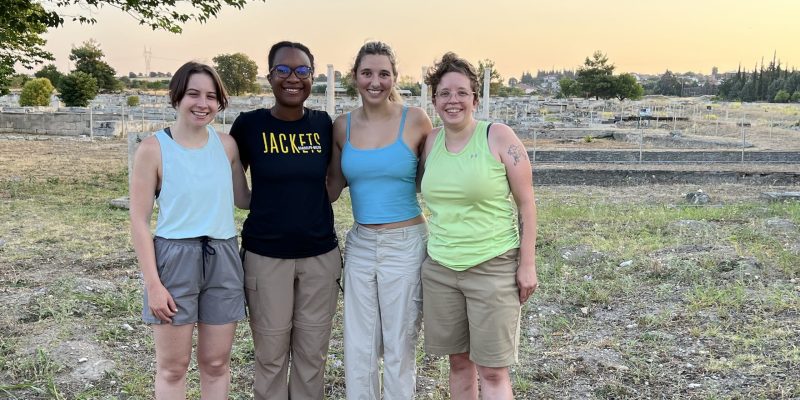
Digging through the dirt for eight hours a day under the hot Greek sun may not be everybody’s idea of a great summer vacation, but for Shannon Galaxy ’25 it was the perfect experience.
This summer, she and three other Randolph-Macon students joined Dr. Nadhira Hill ’16, a Stavros Niarchos Foundation (SNF) Fellow and Assistant Professor of Archaeology, for six weeks of archaeological excavation in Pella, the birthplace of Alexander the Great.
“This is what people look for when they look for the meaning of life. It was like my meaning of life was digging,” Galaxy, an archaeology and classics double-major, joked.
The opportunity to do this meaningful work was arranged by Hill—herself an alumna of RMC’s archaeology program—as a continuation of her graduate work in Pella while she completed her Ph.D. at the University of Michigan. This summer’s dig site, adjacent to previous Pella digs, brought together more than 30 participants from American, Greek, and other European universities to look for evidence of a household and household activities.
“We’re digging up the stuff that people would have used in their house, and trying to get an idea of what people lived like in the Hellenistic period, so right after the time of Alexander the Great,” Hill explained.
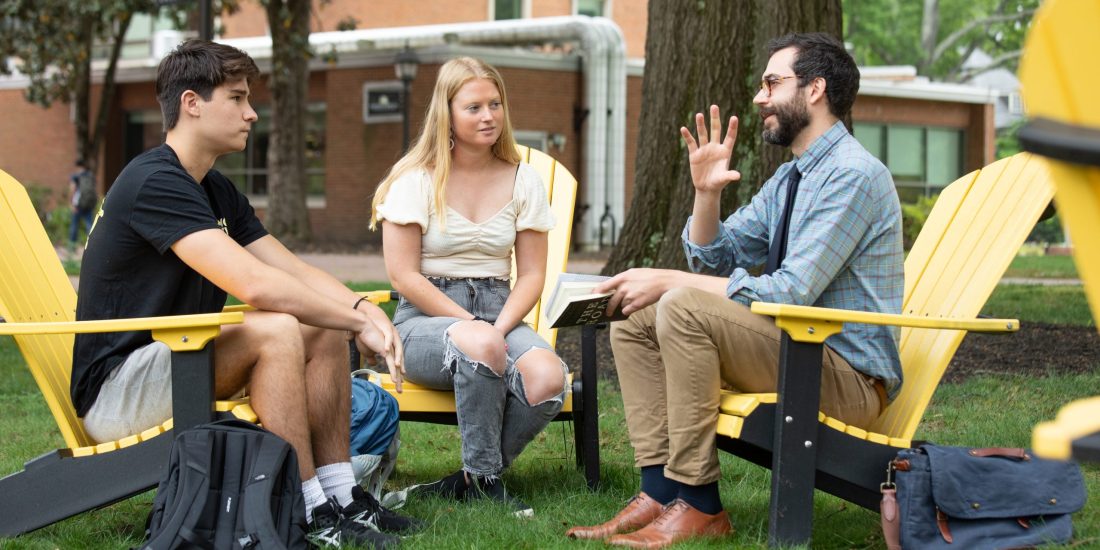
During the school year, archaeology students at RMC take an Archaeological Methods course where they master techniques and learn how archaeologists think through findings. Last spring, they completed fieldwork on location at Signal Hill, the 19th century era home of Professor Emerita Beth Fisher and SNF Professor Emeritus John Camp. For the students who traveled to Greece this summer, digging at Pella was the ultimate real-world application of what they learned in this outdoor classroom in Virginia.
“Seeing that in action on a much larger scale was just a great experience for me to have,” said Ellen Stark ’25, an archaeology and classics double-major with a minor in French.
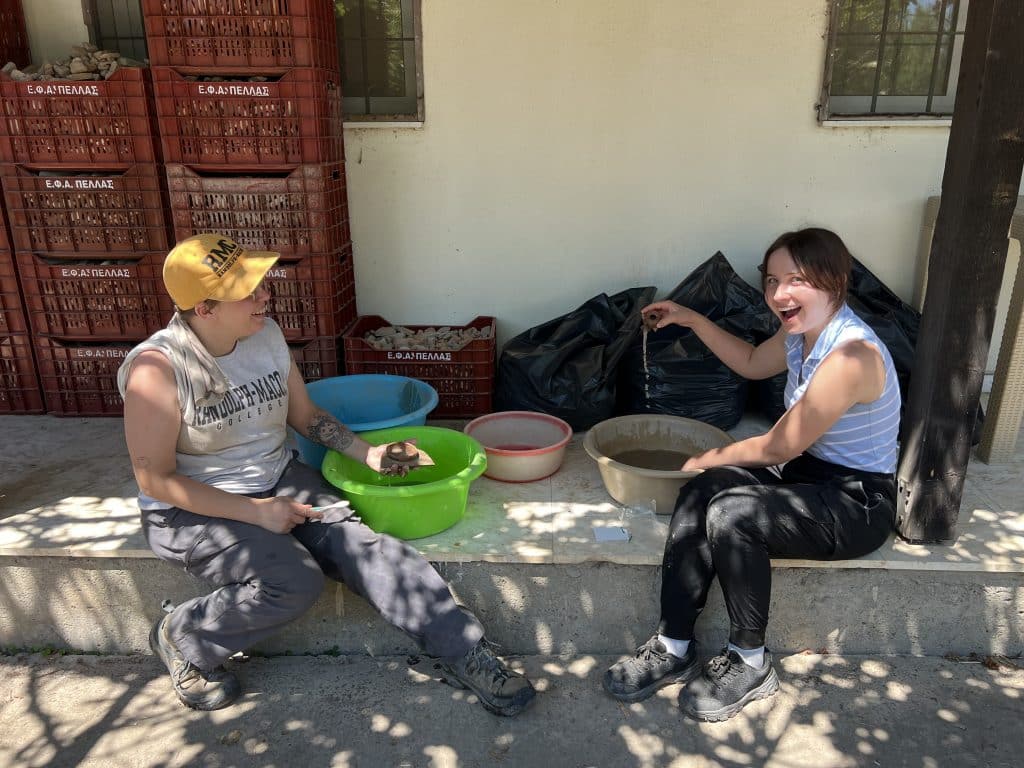
From Monday through Friday in Pella, from 6:30 a.m. until about 12:30 p.m., students were in the trenches excavating and processing artifacts. After a break for lunch, they’d help wash found pottery and catalog other special finds. The digging is incredibly methodical, with shallow passes across a trench to preserve the condition of the artifacts.
“When you’re looking at the wall, you can see color changes in the soil or different levels of tiles in the wall that have fallen different ways,” Stark explained. “You can see a little bit of how the house might have fallen over time or been destroyed.”
Two of Hill’s students participated in the dig for three weeks; two completed the full six. Each student had the opportunity to rotate through the different roles at the site (including Hill’s specialty, ceramics), gaining a perspective for every piece of an archaeological operation.
Of course, the most rewarding part of an archaeological dig is uncovering artifacts. In addition to what Hill recalled as “crates and crates” of pottery, including some whole vessels, the team discovered coins, beads, and a variety of bone objects. Most importantly, evidence is emerging for the architecture of the home.
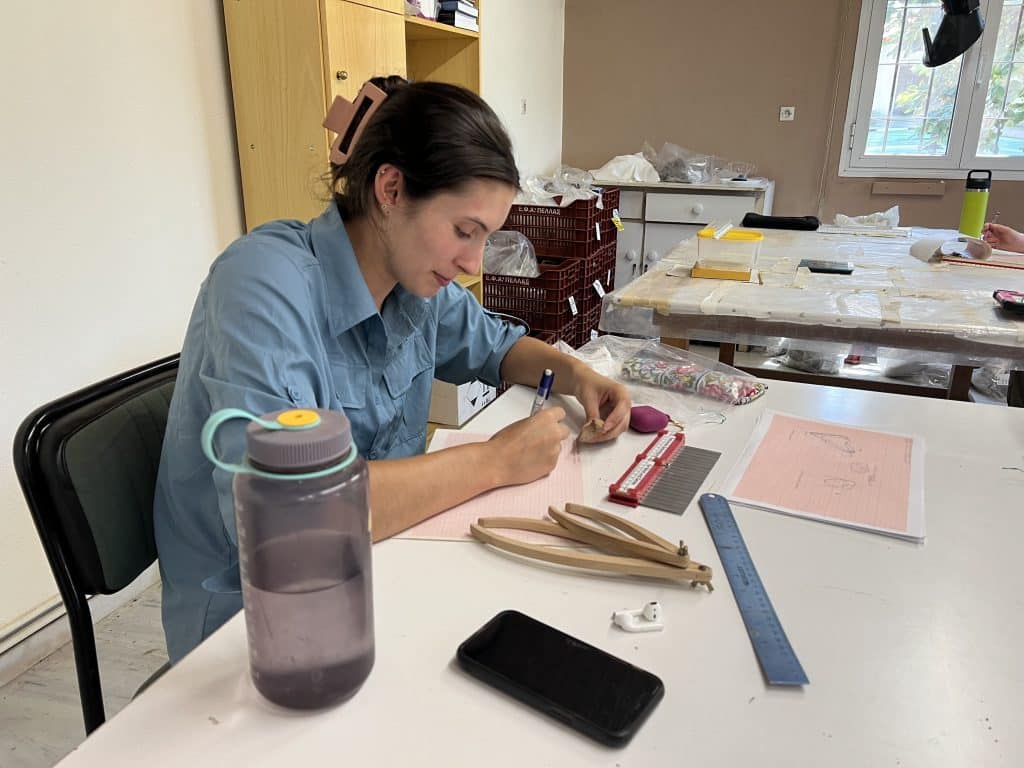
At each stage of a dig, researchers work to understand the time period in which they’re operating, using each artifact to piece together a picture of what life was like nearly two and a half millennia ago.
“If there’s any writing on a pot, the style of the pot, the date of a coin, that helps with making sure we’re in the right layer and we’re in the period that we care about,” Hill explained.
“If there’s a space that has a lot of storage vessels or transport vessels, maybe this space was used as a storeroom,” Hill continued. “Versus another space that may have a lot of charcoal and burned material, maybe that’s a space that they were cooking in.”
The group from RMC also found time for excursions outside of the dig site, visiting the cities of Edessa and Thessaloniki, exploring waterfalls and museums. The students expressed appreciation for being in an environment with others who shared their passion.
“This is a group of people who came across the ocean to do this—it was just really awesome,” said Galaxy. “It was just this little niche circle of super-nerds, and I say that lovingly because I am one of them.”
The trip was a full-circle moment for Hill, who participated in archaeological digs while she was a student at RMC, under the tutelage of Professor Beth Fisher. Now she has the funding to make this experience a reality for her own students.
“I feel very strongly because when I was a student, I got funding to go, and that was the reason I went, and now here I am,” Hill said. “I wanted to make sure that if we have this opportunity for students, I want to make sure that they can get there.”
The dedication is paying dividends with pupils like Galaxy and Stark, who both plan on pursuing graduate degrees in archaeology and want to return to Pella next year. Above all else, the experience in Greece, finding artifacts that help paint a picture of history, has kindled their passion for archaeology.
“It’s part of why I find it so fascinating,” Stark said. “It’s like putting together a puzzle without the box.”